

2 Influence of Controlled Breathing (Pranayama) on Dermal Perfusion
45
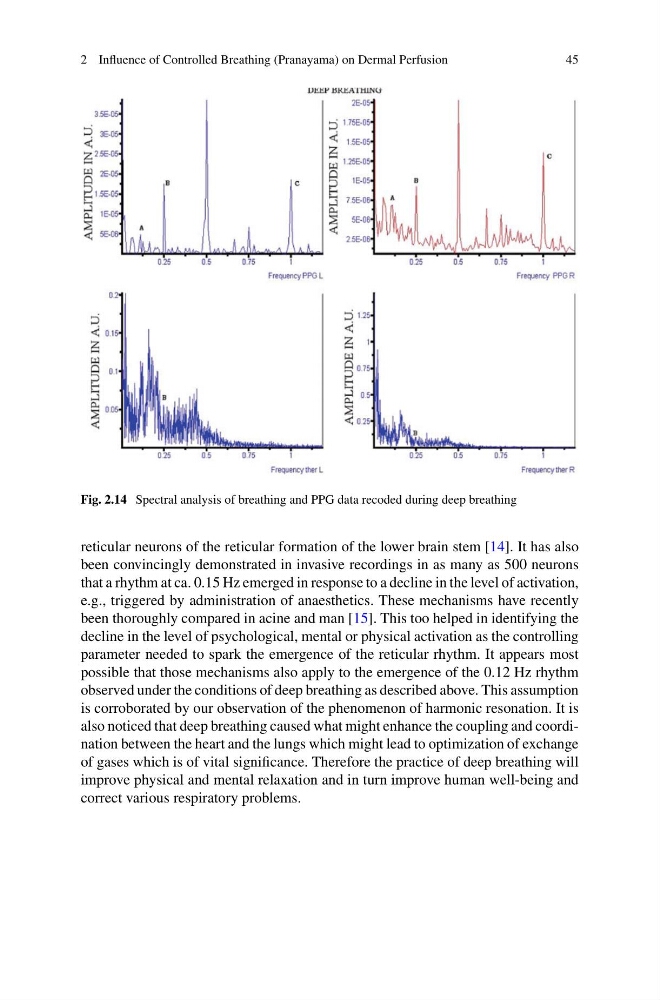
Fig. 2.14 Spectral analysis of breathing and PPG data recoded during deep breathing
reticular neurons of the reticular formation of the lower brain stem [14]. It has also
been convincingly demonstrated in invasive recordings in as many as 500 neurons
that a rhythm at ca. 0.15 Hz emerged in response to a decline in the level of activation,
e.g., triggered by administration of anaesthetics. These mechanisms have recently
been thoroughly compared in acine and man [15]. This too helped in identifying the
decline in the level of psychological, mental or physical activation as the controlling
parameter needed to spark the emergence of the reticular rhythm. It appears most
possible that those mechanisms also apply to the emergence of the 0.12 Hz rhythm
observed under the conditions of deep breathing as described above. This assumption
is corroborated by our observation of the phenomenon of harmonic resonation. It is
also noticed that deep breathing caused what might enhance the coupling and coordination between the heart and the lungs which might lead to optimization of exchange
of gases which is of vital significance. Therefore the practice of deep breathing will
improve physical and mental relaxation and in turn improve human well-being and
correct various respiratory problems.
45
Fig. 2.14 Spectral analysis of breathing and PPG data recoded during deep breathing
reticular neurons of the reticular formation of the lower brain stem [14]. It has also
been convincingly demonstrated in invasive recordings in as many as 500 neurons
that a rhythm at ca. 0.15 Hz emerged in response to a decline in the level of activation,
e.g., triggered by administration of anaesthetics. These mechanisms have recently
been thoroughly compared in acine and man [15]. This too helped in identifying the
decline in the level of psychological, mental or physical activation as the controlling
parameter needed to spark the emergence of the reticular rhythm. It appears most
possible that those mechanisms also apply to the emergence of the 0.12 Hz rhythm
observed under the conditions of deep breathing as described above. This assumption
is corroborated by our observation of the phenomenon of harmonic resonation. It is
also noticed that deep breathing caused what might enhance the coupling and coordination between the heart and the lungs which might lead to optimization of exchange
of gases which is of vital significance. Therefore the practice of deep breathing will
improve physical and mental relaxation and in turn improve human well-being and
correct various respiratory problems.