

2 Influence of Controlled Breathing (Pranayama) on Dermal Perfusion
41
The signals were recorded at a sampling rate of 250 Hz and the measurement system
has a built-in notch filter for removing the 50 Hz noise. This system also has an
inbuilt variable filter confined to each channel. This was used as a 25 Hz low pass
filter for removing other noises while making the measurements. The Diadem 7.0
software (National Instruments) was used for the filtering of raw data, the application
of the Fast Fourier Transform (FFT)/Power Spectral Density (PSD) and for plotting
of graphs. This equipment was generously donated by Alexander von Humboldt
(AvH) of Germany to the author who was an AvH Fellow and is presently located in
Sri Ramachandra University where these investigations were carried out.
Deep breathing (Protocol followed in making the measurements): The subject is
first informed about the protocol to be followed during deep breathing. Breathing is
done consciously and continuously such that the stomach and the chest of the subject
remain fully stretched after one full inspiration. During expiration, the subject is
requested to expire as much as possible continuously without break and then start
inspiration again. Essential care is taken to ensure that inspiration and expiration are
done with the same force. While under normal breathing conditions, tidal volume of
an average adult person is about 500 ml, it amounts in the case of deep breathing to
roughly 2000–3000 ml. The measurements were carried out using the above set-up
under two different breathing conditions viz. Normal breathing and Deep breathing.
Measurements were also made in subjects asked to relax with the help of autogenic
training (AT), a relaxation technique to compare results. AT is usually performed by
internally visualizing limbs and projection of physiological sensations onto them,
and on an enhanced level extending such sensations to internal organs, e.g. heart
pace and respiration, feeling that they are relaxed. This kind of relaxation was done
for 15 min before the measurement was started. AT suggestion was given by Sanysi
Krishna Yogam, Chennai and the measurements were made on subjects trained by
him. Seven male subjects and three female subjects with a mean age of 22 years with
no breathing disorders were taken for the present study.
As the FFT of these signals contain numerous peaks, PSD which is nothing but
the square of FFT is used to avoid any confusion in interpreting. However, only FFT
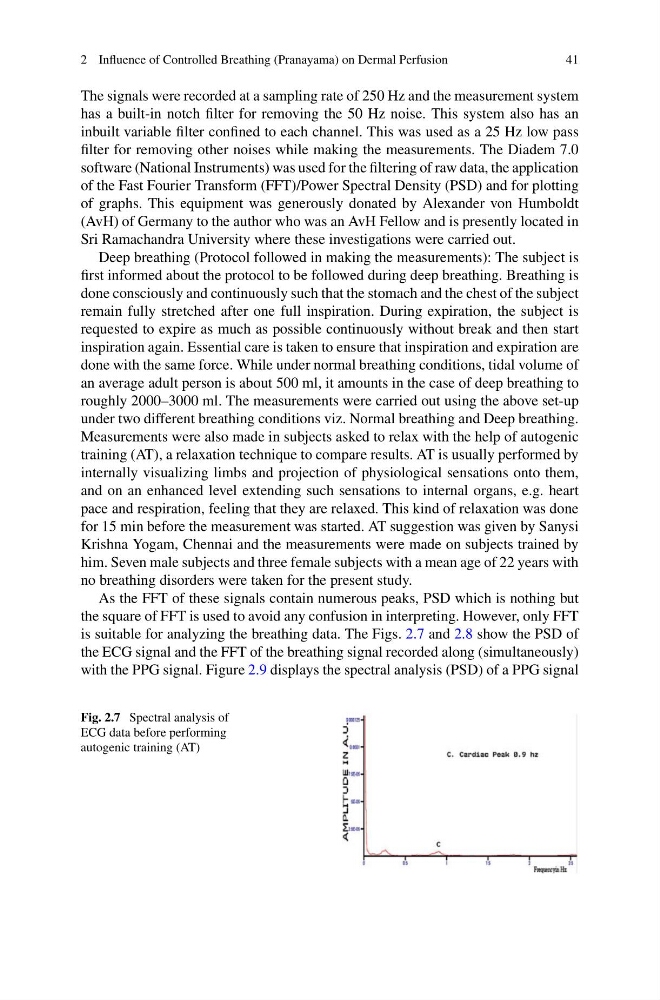
is suitable for analyzing the breathing data. The Figs. 2.7 and 2.8 show the PSD of
the ECG signal and the FFT of the breathing signal recorded along (simultaneously)
with the PPG signal. Figure 2.9 displays the spectral analysis (PSD) of a PPG signal
Fig. 2.7 Spectral analysis of
ECG data before performing
autogenic training (AT)
41
The signals were recorded at a sampling rate of 250 Hz and the measurement system
has a built-in notch filter for removing the 50 Hz noise. This system also has an
inbuilt variable filter confined to each channel. This was used as a 25 Hz low pass
filter for removing other noises while making the measurements. The Diadem 7.0
software (National Instruments) was used for the filtering of raw data, the application
of the Fast Fourier Transform (FFT)/Power Spectral Density (PSD) and for plotting
of graphs. This equipment was generously donated by Alexander von Humboldt
(AvH) of Germany to the author who was an AvH Fellow and is presently located in
Sri Ramachandra University where these investigations were carried out.
Deep breathing (Protocol followed in making the measurements): The subject is
first informed about the protocol to be followed during deep breathing. Breathing is
done consciously and continuously such that the stomach and the chest of the subject
remain fully stretched after one full inspiration. During expiration, the subject is
requested to expire as much as possible continuously without break and then start
inspiration again. Essential care is taken to ensure that inspiration and expiration are
done with the same force. While under normal breathing conditions, tidal volume of
an average adult person is about 500 ml, it amounts in the case of deep breathing to
roughly 2000–3000 ml. The measurements were carried out using the above set-up
under two different breathing conditions viz. Normal breathing and Deep breathing.
Measurements were also made in subjects asked to relax with the help of autogenic
training (AT), a relaxation technique to compare results. AT is usually performed by
internally visualizing limbs and projection of physiological sensations onto them,
and on an enhanced level extending such sensations to internal organs, e.g. heart
pace and respiration, feeling that they are relaxed. This kind of relaxation was done
for 15 min before the measurement was started. AT suggestion was given by Sanysi
Krishna Yogam, Chennai and the measurements were made on subjects trained by
him. Seven male subjects and three female subjects with a mean age of 22 years with
no breathing disorders were taken for the present study.
As the FFT of these signals contain numerous peaks, PSD which is nothing but
the square of FFT is used to avoid any confusion in interpreting. However, only FFT
is suitable for analyzing the breathing data. The Figs. 2.7 and 2.8 show the PSD of
the ECG signal and the FFT of the breathing signal recorded along (simultaneously)
with the PPG signal. Figure 2.9 displays the spectral analysis (PSD) of a PPG signal
Fig. 2.7 Spectral analysis of
ECG data before performing
autogenic training (AT)