

38
M. Mukunda Rao
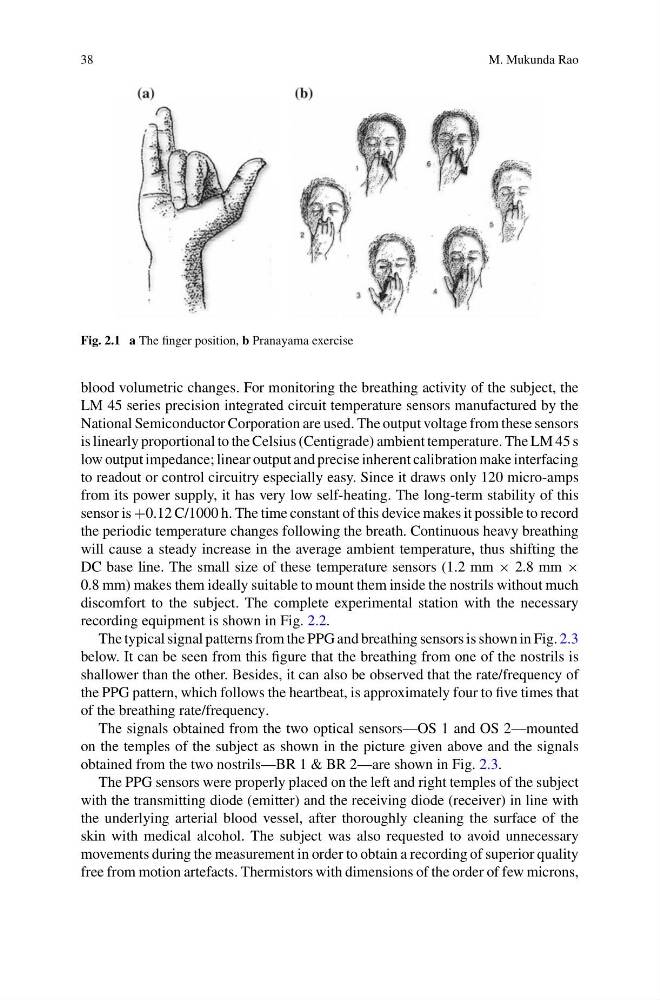
Fig. 2.1 a The finger position, b Pranayama exercise
blood volumetric changes. For monitoring the breathing activity of the subject, the
LM 45 series precision integrated circuit temperature sensors manufactured by the
National Semiconductor Corporation are used. The output voltage from these sensors
is linearly proportional to the Celsius (Centigrade) ambient temperature. The LM 45 s
low output impedance; linear output and precise inherent calibration make interfacing
to readout or control circuitry especially easy. Since it draws only 120 micro-amps
from its power supply, it has very low self-heating. The long-term stability of this
sensor is +0.12 C/1000 h. The time constant of this device makes it possible to record
the periodic temperature changes following the breath. Continuous heavy breathing
will cause a steady increase in the average ambient temperature, thus shifting the
DC base line. The small size of these temperature sensors (1.2 mm × 2.8 mm ×
0.8 mm) makes them ideally suitable to mount them inside the nostrils without much
discomfort to the subject. The complete experimental station with the necessary
recording equipment is shown in Fig. 2.2.
The typical signal patterns from the PPG and breathing sensors is shown in Fig. 2.3
below. It can be seen from this figure that the breathing from one of the nostrils is
shallower than the other. Besides, it can also be observed that the rate/frequency of
the PPG pattern, which follows the heartbeat, is approximately four to five times that
of the breathing rate/frequency.
The signals obtained from the two optical sensors—OS 1 and OS 2—mounted
on the temples of the subject as shown in the picture given above and the signals
obtained from the two nostrils—BR 1 & BR 2—are shown in Fig. 2.3.
The PPG sensors were properly placed on the left and right temples of the subject
with the transmitting diode (emitter) and the receiving diode (receiver) in line with
the underlying arterial blood vessel, after thoroughly cleaning the surface of the
skin with medical alcohol. The subject was also requested to avoid unnecessary
movements during the measurement in order to obtain a recording of superior quality
free from motion artefacts. Thermistors with dimensions of the order of few microns,
M. Mukunda Rao
Fig. 2.1 a The finger position, b Pranayama exercise
blood volumetric changes. For monitoring the breathing activity of the subject, the
LM 45 series precision integrated circuit temperature sensors manufactured by the
National Semiconductor Corporation are used. The output voltage from these sensors
is linearly proportional to the Celsius (Centigrade) ambient temperature. The LM 45 s
low output impedance; linear output and precise inherent calibration make interfacing
to readout or control circuitry especially easy. Since it draws only 120 micro-amps
from its power supply, it has very low self-heating. The long-term stability of this
sensor is +0.12 C/1000 h. The time constant of this device makes it possible to record
the periodic temperature changes following the breath. Continuous heavy breathing
will cause a steady increase in the average ambient temperature, thus shifting the
DC base line. The small size of these temperature sensors (1.2 mm × 2.8 mm ×
0.8 mm) makes them ideally suitable to mount them inside the nostrils without much
discomfort to the subject. The complete experimental station with the necessary
recording equipment is shown in Fig. 2.2.
The typical signal patterns from the PPG and breathing sensors is shown in Fig. 2.3
below. It can be seen from this figure that the breathing from one of the nostrils is
shallower than the other. Besides, it can also be observed that the rate/frequency of
the PPG pattern, which follows the heartbeat, is approximately four to five times that
of the breathing rate/frequency.
The signals obtained from the two optical sensors—OS 1 and OS 2—mounted
on the temples of the subject as shown in the picture given above and the signals
obtained from the two nostrils—BR 1 & BR 2—are shown in Fig. 2.3.
The PPG sensors were properly placed on the left and right temples of the subject
with the transmitting diode (emitter) and the receiving diode (receiver) in line with
the underlying arterial blood vessel, after thoroughly cleaning the surface of the
skin with medical alcohol. The subject was also requested to avoid unnecessary
movements during the measurement in order to obtain a recording of superior quality
free from motion artefacts. Thermistors with dimensions of the order of few microns,