

12 Selected Clinical Applications of Functional PPGI Perfusion Mapping …
219
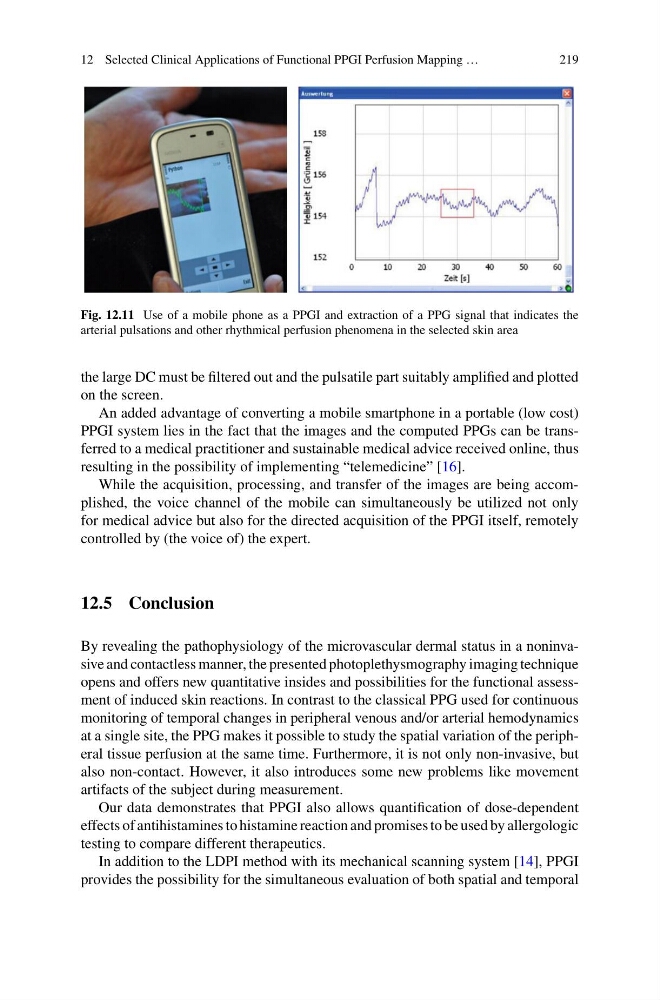
Fig. 12.11 Use of a mobile phone as a PPGI and extraction of a PPG signal that indicates the
arterial pulsations and other rhythmical perfusion phenomena in the selected skin area
the large DC must be filtered out and the pulsatile part suitably amplified and plotted
on the screen.
An added advantage of converting a mobile smartphone in a portable (low cost)
PPGI system lies in the fact that the images and the computed PPGs can be transferred to a medical practitioner and sustainable medical advice received online, thus
resulting in the possibility of implementing “telemedicine” [16].
While the acquisition, processing, and transfer of the images are being accomplished, the voice channel of the mobile can simultaneously be utilized not only
for medical advice but also for the directed acquisition of the PPGI itself, remotely
controlled by (the voice of) the expert.
12.5 Conclusion
By revealing the pathophysiology of the microvascular dermal status in a noninvasive and contactless manner, the presented photoplethysmography imaging technique
opens and offers new quantitative insides and possibilities for the functional assessment of induced skin reactions. In contrast to the classical PPG used for continuous
monitoring of temporal changes in peripheral venous and/or arterial hemodynamics
at a single site, the PPG makes it possible to study the spatial variation of the peripheral tissue perfusion at the same time. Furthermore, it is not only non-invasive, but
also non-contact. However, it also introduces some new problems like movement
artifacts of the subject during measurement.
Our data demonstrates that PPGI also allows quantification of dose-dependent
effects of antihistamines to histamine reaction and promises to be used by allergologic
testing to compare different therapeutics.
In addition to the LDPI method with its mechanical scanning system [14], PPGI
provides the possibility for the simultaneous evaluation of both spatial and temporal
219
Fig. 12.11 Use of a mobile phone as a PPGI and extraction of a PPG signal that indicates the
arterial pulsations and other rhythmical perfusion phenomena in the selected skin area
the large DC must be filtered out and the pulsatile part suitably amplified and plotted
on the screen.
An added advantage of converting a mobile smartphone in a portable (low cost)
PPGI system lies in the fact that the images and the computed PPGs can be transferred to a medical practitioner and sustainable medical advice received online, thus
resulting in the possibility of implementing “telemedicine” [16].
While the acquisition, processing, and transfer of the images are being accomplished, the voice channel of the mobile can simultaneously be utilized not only
for medical advice but also for the directed acquisition of the PPGI itself, remotely
controlled by (the voice of) the expert.
12.5 Conclusion
By revealing the pathophysiology of the microvascular dermal status in a noninvasive and contactless manner, the presented photoplethysmography imaging technique
opens and offers new quantitative insides and possibilities for the functional assessment of induced skin reactions. In contrast to the classical PPG used for continuous
monitoring of temporal changes in peripheral venous and/or arterial hemodynamics
at a single site, the PPG makes it possible to study the spatial variation of the peripheral tissue perfusion at the same time. Furthermore, it is not only non-invasive, but
also non-contact. However, it also introduces some new problems like movement
artifacts of the subject during measurement.
Our data demonstrates that PPGI also allows quantification of dose-dependent
effects of antihistamines to histamine reaction and promises to be used by allergologic
testing to compare different therapeutics.
In addition to the LDPI method with its mechanical scanning system [14], PPGI
provides the possibility for the simultaneous evaluation of both spatial and temporal