

11 Remote Space- and Time-Resolved Skin Perfusion Detection …
179
11.2.1 Comparison of PPG Signal Composition for Different
PPG Modes
The monitoring and analysis of vital parameters like heart or breathing rhythms
through PPGI necessitates an assessment of the composition of the recorded light
intensityI x,y I x,y of the single pixels obtained during the process. Figure 11.2 shows
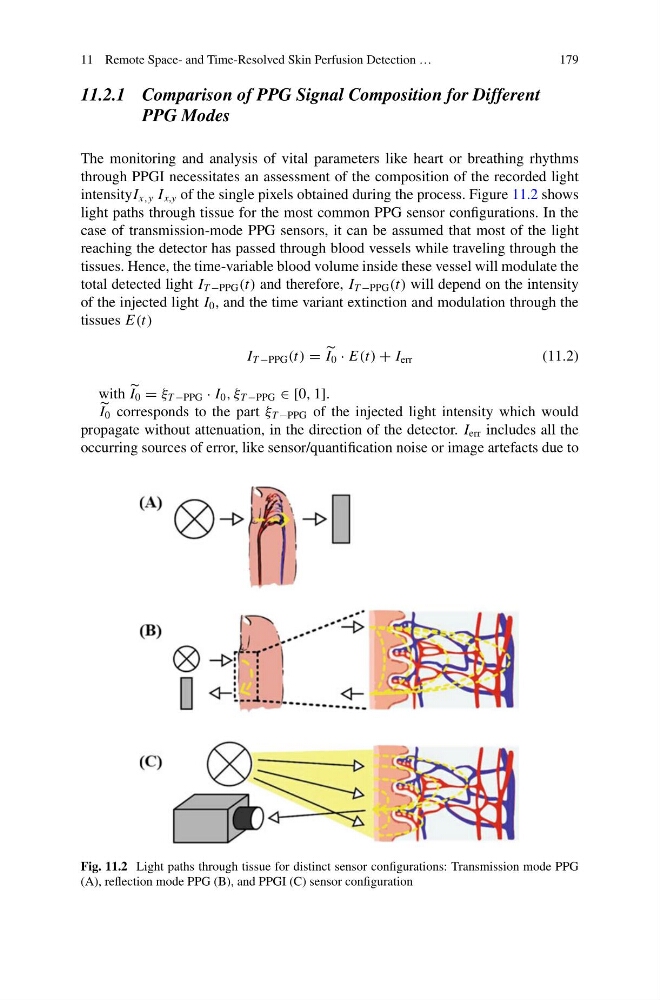
light paths through tissue for the most common PPG sensor configurations. In the
case of transmission-mode PPG sensors, it can be assumed that most of the light
reaching the detector has passed through blood vessels while traveling through the
tissues. Hence, the time-variable blood volume inside these vessel will modulate the
total detected light I T −PPG (t) and therefore, I T −PPG (t) will depend on the intensity
of the injected light I 0 , and the time variant extinction and modulation through the
tissues E(t)
I T −PPG (t) = I 0 · E(t) + I err
(11.2)
with I 0 = ξ T −PPG · I 0 , ξ T −PPG ∈ [0, 1].
I 0 corresponds to the part ξ T −PPG of the injected light intensity which would
propagate without attenuation, in the direction of the detector. I err includes all the
occurring sources of error, like sensor/quantification noise or image artefacts due to
Fig. 11.2 Light paths through tissue for distinct sensor configurations: Transmission mode PPG
(A), reflection mode PPG (B), and PPGI (C) sensor configuration
179
11.2.1 Comparison of PPG Signal Composition for Different
PPG Modes
The monitoring and analysis of vital parameters like heart or breathing rhythms
through PPGI necessitates an assessment of the composition of the recorded light
intensityI x,y I x,y of the single pixels obtained during the process. Figure 11.2 shows
light paths through tissue for the most common PPG sensor configurations. In the
case of transmission-mode PPG sensors, it can be assumed that most of the light
reaching the detector has passed through blood vessels while traveling through the
tissues. Hence, the time-variable blood volume inside these vessel will modulate the
total detected light I T −PPG (t) and therefore, I T −PPG (t) will depend on the intensity
of the injected light I 0 , and the time variant extinction and modulation through the
tissues E(t)
I T −PPG (t) = I 0 · E(t) + I err
(11.2)
with I 0 = ξ T −PPG · I 0 , ξ T −PPG ∈ [0, 1].
I 0 corresponds to the part ξ T −PPG of the injected light intensity which would
propagate without attenuation, in the direction of the detector. I err includes all the
occurring sources of error, like sensor/quantification noise or image artefacts due to
Fig. 11.2 Light paths through tissue for distinct sensor configurations: Transmission mode PPG
(A), reflection mode PPG (B), and PPGI (C) sensor configuration