

178
N. Blanik
The advanced technology of photoplethysmography imaging (PPGI), though
based on the same principle as PGG, goes a step further and employs a camera
with a high dynamic range to measure the optical damping of skin, thereby eliminating the need for a contact photo sensor. This markedly improved feature equips the
system to register even minor variations of light intensities arising from the perfusion
rhythms in the skin surface being monitored, with an additional spatial resolution in
a contactless manor [2].
11.2 PPGI Measurement Setup
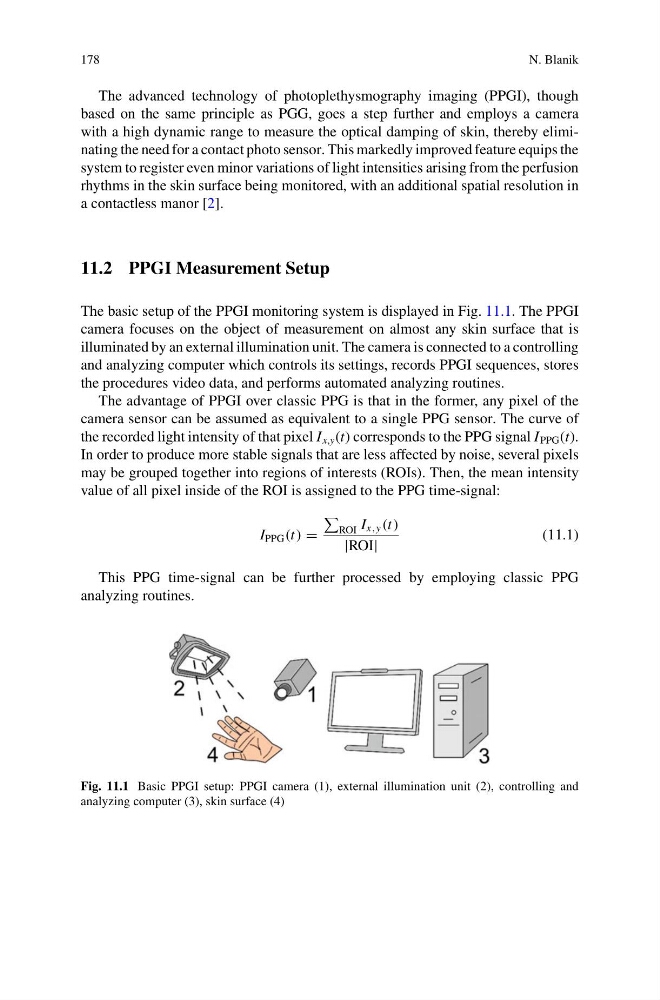
The basic setup of the PPGI monitoring system is displayed in Fig. 11.1. The PPGI
camera focuses on the object of measurement on almost any skin surface that is
illuminated by an external illumination unit. The camera is connected to a controlling
and analyzing computer which controls its settings, records PPGI sequences, stores
the procedures video data, and performs automated analyzing routines.
The advantage of PPGI over classic PPG is that in the former, any pixel of the
camera sensor can be assumed as equivalent to a single PPG sensor. The curve of
the recorded light intensity of that pixel I x,y (t) corresponds to the PPG signal I PPG (t).
In order to produce more stable signals that are less affected by noise, several pixels
may be grouped together into regions of interests (ROIs). Then, the mean intensity
value of all pixel inside of the ROI is assigned to the PPG time-signal:
I PPG (t) =
ROI I x,y (t)
|ROI|
(11.1)
This PPG time-signal can be further processed by employing classic PPG
analyzing routines.
Fig. 11.1 Basic PPGI setup: PPGI camera (1), external illumination unit (2), controlling and
analyzing computer (3), skin surface (4)
N. Blanik
The advanced technology of photoplethysmography imaging (PPGI), though
based on the same principle as PGG, goes a step further and employs a camera
with a high dynamic range to measure the optical damping of skin, thereby eliminating the need for a contact photo sensor. This markedly improved feature equips the
system to register even minor variations of light intensities arising from the perfusion
rhythms in the skin surface being monitored, with an additional spatial resolution in
a contactless manor [2].
11.2 PPGI Measurement Setup
The basic setup of the PPGI monitoring system is displayed in Fig. 11.1. The PPGI
camera focuses on the object of measurement on almost any skin surface that is
illuminated by an external illumination unit. The camera is connected to a controlling
and analyzing computer which controls its settings, records PPGI sequences, stores
the procedures video data, and performs automated analyzing routines.
The advantage of PPGI over classic PPG is that in the former, any pixel of the
camera sensor can be assumed as equivalent to a single PPG sensor. The curve of
the recorded light intensity of that pixel I x,y (t) corresponds to the PPG signal I PPG (t).
In order to produce more stable signals that are less affected by noise, several pixels
may be grouped together into regions of interests (ROIs). Then, the mean intensity
value of all pixel inside of the ROI is assigned to the PPG time-signal:
I PPG (t) =
ROI I x,y (t)
|ROI|
(11.1)
This PPG time-signal can be further processed by employing classic PPG
analyzing routines.
Fig. 11.1 Basic PPGI setup: PPGI camera (1), external illumination unit (2), controlling and
analyzing computer (3), skin surface (4)