

174
M. Hülsbusch and V. Blazek
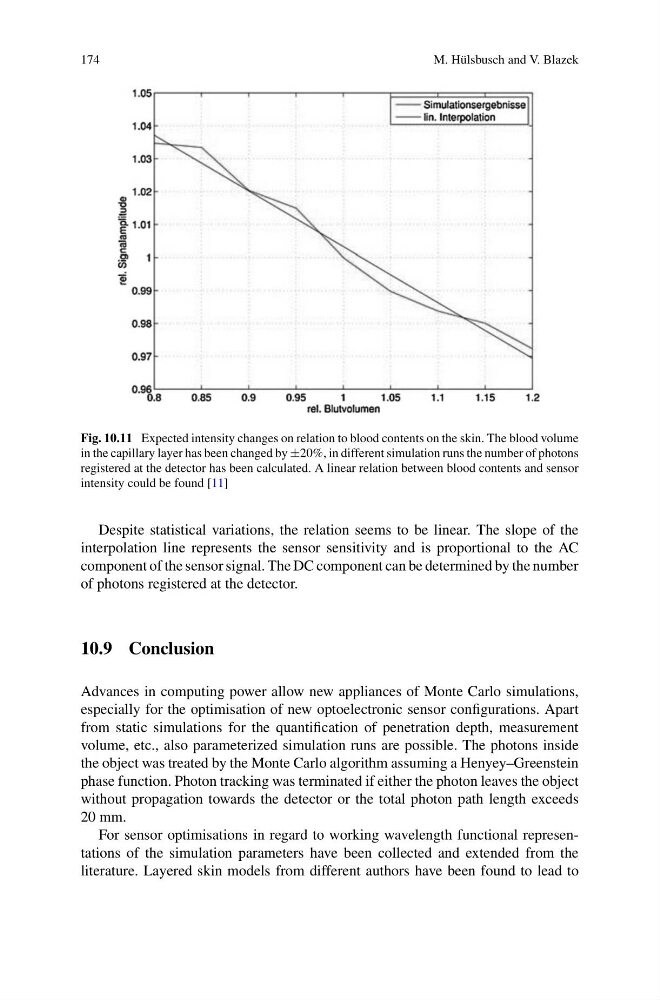
Fig. 10.11 Expected intensity changes on relation to blood contents on the skin. The blood volume
in the capillary layer has been changed by ±20%, in different simulation runs the number of photons
registered at the detector has been calculated. A linear relation between blood contents and sensor
intensity could be found [11]
Despite statistical variations, the relation seems to be linear. The slope of the
interpolation line represents the sensor sensitivity and is proportional to the AC
component of the sensor signal. The DC component can be determined by the number
of photons registered at the detector.
10.9 Conclusion
Advances in computing power allow new appliances of Monte Carlo simulations,
especially for the optimisation of new optoelectronic sensor configurations. Apart
from static simulations for the quantification of penetration depth, measurement
volume, etc., also parameterized simulation runs are possible. The photons inside
the object was treated by the Monte Carlo algorithm assuming a Henyey–Greenstein
phase function. Photon tracking was terminated if either the photon leaves the object
without propagation towards the detector or the total photon path length exceeds
20 mm.
For sensor optimisations in regard to working wavelength functional representations of the simulation parameters have been collected and extended from the
literature. Layered skin models from different authors have been found to lead to
M. Hülsbusch and V. Blazek
Fig. 10.11 Expected intensity changes on relation to blood contents on the skin. The blood volume
in the capillary layer has been changed by ±20%, in different simulation runs the number of photons
registered at the detector has been calculated. A linear relation between blood contents and sensor
intensity could be found [11]
Despite statistical variations, the relation seems to be linear. The slope of the
interpolation line represents the sensor sensitivity and is proportional to the AC
component of the sensor signal. The DC component can be determined by the number
of photons registered at the detector.
10.9 Conclusion
Advances in computing power allow new appliances of Monte Carlo simulations,
especially for the optimisation of new optoelectronic sensor configurations. Apart
from static simulations for the quantification of penetration depth, measurement
volume, etc., also parameterized simulation runs are possible. The photons inside
the object was treated by the Monte Carlo algorithm assuming a Henyey–Greenstein
phase function. Photon tracking was terminated if either the photon leaves the object
without propagation towards the detector or the total photon path length exceeds
20 mm.
For sensor optimisations in regard to working wavelength functional representations of the simulation parameters have been collected and extended from the
literature. Layered skin models from different authors have been found to lead to