

4
V. Blazek
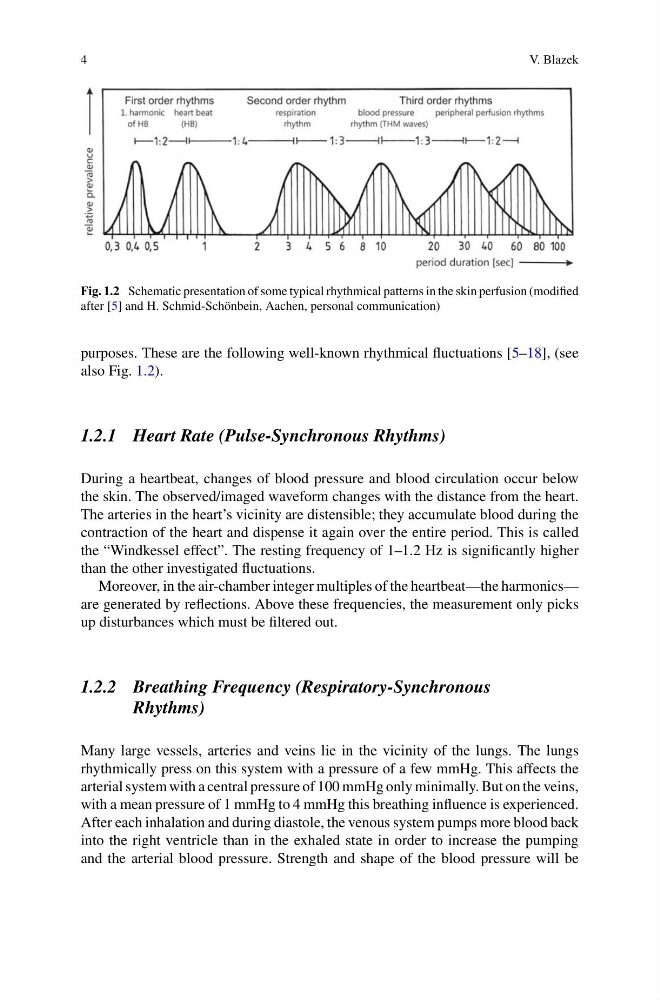
Fig. 1.2 Schematic presentation of some typical rhythmical patterns in the skin perfusion (modified
after [5] and H. Schmid-Schönbein, Aachen, personal communication)
purposes. These are the following well-known rhythmical fluctuations [5–18], (see
also Fig. 1.2).
1.2.1 Heart Rate (Pulse-Synchronous Rhythms)
During a heartbeat, changes of blood pressure and blood circulation occur below
the skin. The observed/imaged waveform changes with the distance from the heart.
The arteries in the heart’s vicinity are distensible; they accumulate blood during the
contraction of the heart and dispense it again over the entire period. This is called
the “Windkessel effect”. The resting frequency of 1–1.2 Hz is significantly higher
than the other investigated fluctuations.
Moreover, in the air-chamber integer multiples of the heartbeat—the harmonics—
are generated by reflections. Above these frequencies, the measurement only picks
up disturbances which must be filtered out.
1.2.2 Breathing Frequency (Respiratory-Synchronous
Rhythms)
Many large vessels, arteries and veins lie in the vicinity of the lungs. The lungs
rhythmically press on this system with a pressure of a few mmHg. This affects the
arterial system with a central pressure of 100 mmHg only minimally. But on the veins,
with a mean pressure of 1 mmHg to 4 mmHg this breathing influence is experienced.
After each inhalation and during diastole, the venous system pumps more blood back
into the right ventricle than in the exhaled state in order to increase the pumping
and the arterial blood pressure. Strength and shape of the blood pressure will be
V. Blazek
Fig. 1.2 Schematic presentation of some typical rhythmical patterns in the skin perfusion (modified
after [5] and H. Schmid-Schönbein, Aachen, personal communication)
purposes. These are the following well-known rhythmical fluctuations [5–18], (see
also Fig. 1.2).
1.2.1 Heart Rate (Pulse-Synchronous Rhythms)
During a heartbeat, changes of blood pressure and blood circulation occur below
the skin. The observed/imaged waveform changes with the distance from the heart.
The arteries in the heart’s vicinity are distensible; they accumulate blood during the
contraction of the heart and dispense it again over the entire period. This is called
the “Windkessel effect”. The resting frequency of 1–1.2 Hz is significantly higher
than the other investigated fluctuations.
Moreover, in the air-chamber integer multiples of the heartbeat—the harmonics—
are generated by reflections. Above these frequencies, the measurement only picks
up disturbances which must be filtered out.
1.2.2 Breathing Frequency (Respiratory-Synchronous
Rhythms)
Many large vessels, arteries and veins lie in the vicinity of the lungs. The lungs
rhythmically press on this system with a pressure of a few mmHg. This affects the
arterial system with a central pressure of 100 mmHg only minimally. But on the veins,
with a mean pressure of 1 mmHg to 4 mmHg this breathing influence is experienced.
After each inhalation and during diastole, the venous system pumps more blood back
into the right ventricle than in the exhaled state in order to increase the pumping
and the arterial blood pressure. Strength and shape of the blood pressure will be