

1 Skin Perfusion Studies: Historical Notes and Modern Measuring …
3
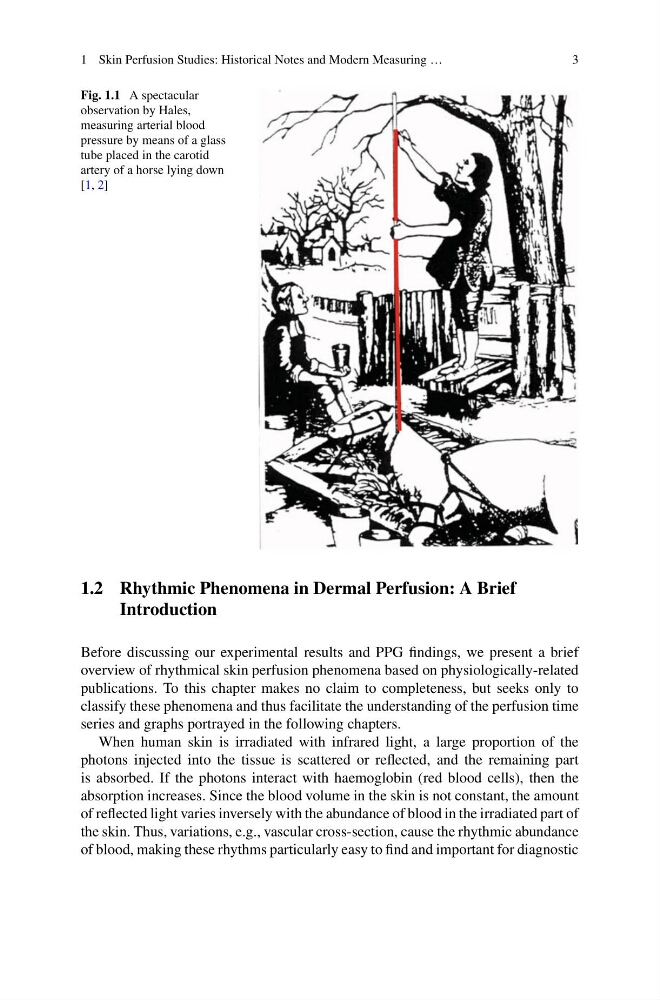
Fig. 1.1 A spectacular
observation by Hales,
measuring arterial blood
pressure by means of a glass
tube placed in the carotid
artery of a horse lying down
[1, 2]
1.2 Rhythmic Phenomena in Dermal Perfusion: A Brief
Introduction
Before discussing our experimental results and PPG findings, we present a brief
overview of rhythmical skin perfusion phenomena based on physiologically-related
publications. To this chapter makes no claim to completeness, but seeks only to
classify these phenomena and thus facilitate the understanding of the perfusion time
series and graphs portrayed in the following chapters.
When human skin is irradiated with infrared light, a large proportion of the
photons injected into the tissue is scattered or reflected, and the remaining part
is absorbed. If the photons interact with haemoglobin (red blood cells), then the
absorption increases. Since the blood volume in the skin is not constant, the amount
of reflected light varies inversely with the abundance of blood in the irradiated part of
the skin. Thus, variations, e.g., vascular cross-section, cause the rhythmic abundance
of blood, making these rhythms particularly easy to find and important for diagnostic
3
Fig. 1.1 A spectacular
observation by Hales,
measuring arterial blood
pressure by means of a glass
tube placed in the carotid
artery of a horse lying down
[1, 2]
1.2 Rhythmic Phenomena in Dermal Perfusion: A Brief
Introduction
Before discussing our experimental results and PPG findings, we present a brief
overview of rhythmical skin perfusion phenomena based on physiologically-related
publications. To this chapter makes no claim to completeness, but seeks only to
classify these phenomena and thus facilitate the understanding of the perfusion time
series and graphs portrayed in the following chapters.
When human skin is irradiated with infrared light, a large proportion of the
photons injected into the tissue is scattered or reflected, and the remaining part
is absorbed. If the photons interact with haemoglobin (red blood cells), then the
absorption increases. Since the blood volume in the skin is not constant, the amount
of reflected light varies inversely with the abundance of blood in the irradiated part of
the skin. Thus, variations, e.g., vascular cross-section, cause the rhythmic abundance
of blood, making these rhythms particularly easy to find and important for diagnostic