

10 Photon-Tissue Interaction Modelled by Monte Carlo Method …
165
P trans = P inc · e
−μ a d
(10.3)
If the light passes through a scattering medium with thickness of d, the unscattered
transmission is weakened by
P trans = P inc · e
−μ t d
(10.4)
The extinction coefficient μ γ describes the attenuation of optical radiation by
absorption and scattering:
μ γ = μ s + μ a
(10.5)
Most of the time, the scattering and absorption coefficients are given in mm
−1 or
cm
−1 .
Phase function of the scattering process, anisotropy factor g
Depending on the form, magnitude and particle property, mainly a scattering process
have a direction of forward (0 < g < 1), backward (−1 < g < 0), or isotropic (g = 0,
for all scattering angles the probability is same).
The character of scattering is described by aniosotropy factor. It is defined as
the average cosine of the scattering angle. Biological tissues have a strong forward
scattering (g = 0.8 … 0.95). The scattering character in the biological tissues can be
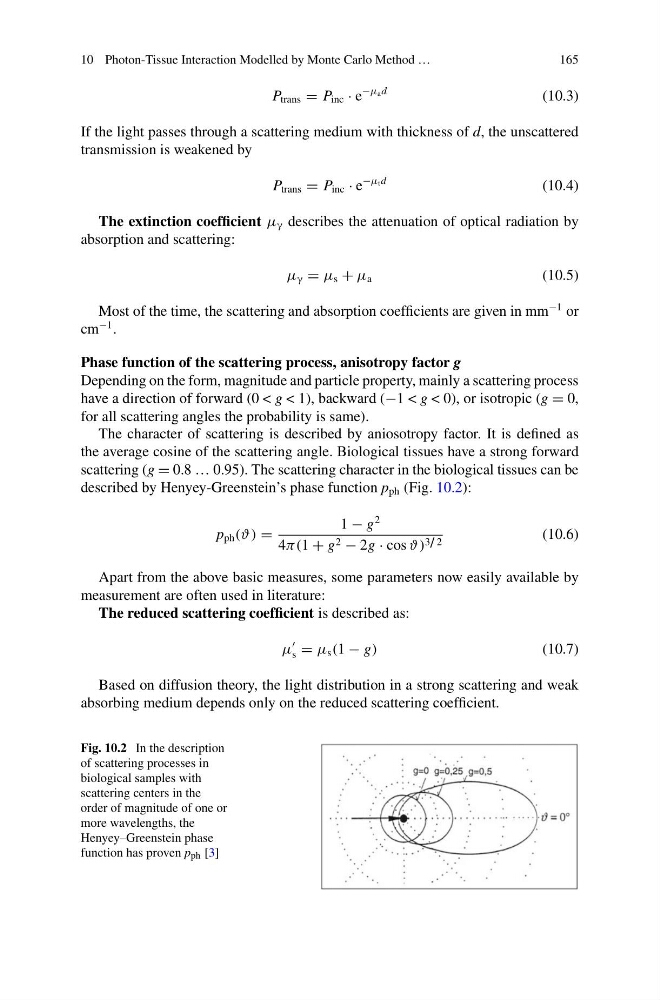
described by Henyey-Greenstein’s phase function p ph (Fig. 10.2):
p ph (ϑ) =
1 − g
2
4π(1 + g 2 − 2g · cos ϑ) 3 / 2
(10.6)
Apart from the above basic measures, some parameters now easily available by
measurement are often used in literature:
The reduced scattering coefficient is described as:
μ
s = μ s (1 − g)
(10.7)
Based on diffusion theory, the light distribution in a strong scattering and weak
absorbing medium depends only on the reduced scattering coefficient.
Fig. 10.2 In the description
of scattering processes in
biological samples with
scattering centers in the
order of magnitude of one or
more wavelengths, the
Henyey–Greenstein phase
function has proven p ph [3]
165
P trans = P inc · e
−μ a d
(10.3)
If the light passes through a scattering medium with thickness of d, the unscattered
transmission is weakened by
P trans = P inc · e
−μ t d
(10.4)
The extinction coefficient μ γ describes the attenuation of optical radiation by
absorption and scattering:
μ γ = μ s + μ a
(10.5)
Most of the time, the scattering and absorption coefficients are given in mm
−1 or
cm
−1 .
Phase function of the scattering process, anisotropy factor g
Depending on the form, magnitude and particle property, mainly a scattering process
have a direction of forward (0 < g < 1), backward (−1 < g < 0), or isotropic (g = 0,
for all scattering angles the probability is same).
The character of scattering is described by aniosotropy factor. It is defined as
the average cosine of the scattering angle. Biological tissues have a strong forward
scattering (g = 0.8 … 0.95). The scattering character in the biological tissues can be
described by Henyey-Greenstein’s phase function p ph (Fig. 10.2):
p ph (ϑ) =
1 − g
2
4π(1 + g 2 − 2g · cos ϑ) 3 / 2
(10.6)
Apart from the above basic measures, some parameters now easily available by
measurement are often used in literature:
The reduced scattering coefficient is described as:
μ
s = μ s (1 − g)
(10.7)
Based on diffusion theory, the light distribution in a strong scattering and weak
absorbing medium depends only on the reduced scattering coefficient.
Fig. 10.2 In the description
of scattering processes in
biological samples with
scattering centers in the
order of magnitude of one or
more wavelengths, the
Henyey–Greenstein phase
function has proven p ph [3]