

164
M. Hülsbusch and V. Blazek
particles, which can be absorbed or scattered in turbid media like tissue or blood.
The photon path is then calculated using ray tracing algorithms.
10.2 Terms and Parameters of Tissue Optics
For the optical characterization of skin and other biological samples serve primarily
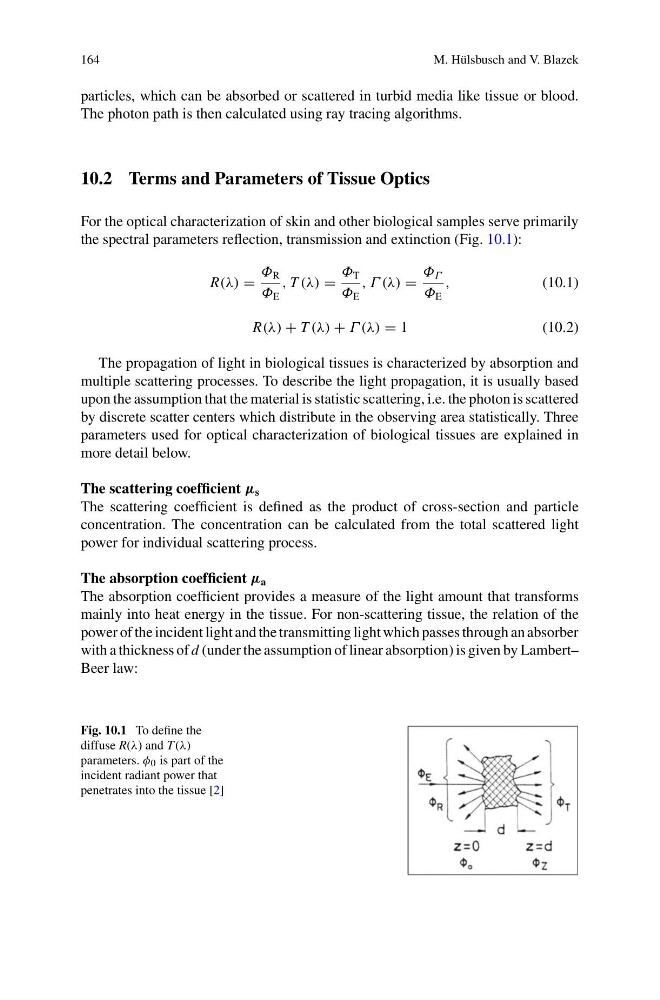
the spectral parameters reflection, transmission and extinction (Fig. 10.1):
R(λ) =
Φ R
Φ E
, T (λ) =
Φ T
Φ E
, Γ (λ) =
Φ Γ
Φ E
,
(10.1)
R(λ) + T (λ) + Γ (λ) = 1
(10.2)
The propagation of light in biological tissues is characterized by absorption and
multiple scattering processes. To describe the light propagation, it is usually based
upon the assumption that the material is statistic scattering, i.e. the photon is scattered
by discrete scatter centers which distribute in the observing area statistically. Three
parameters used for optical characterization of biological tissues are explained in
more detail below.
The scattering coefficient µ s
The scattering coefficient is defined as the product of cross-section and particle
concentration. The concentration can be calculated from the total scattered light
power for individual scattering process.
The absorption coefficient µ a
The absorption coefficient provides a measure of the light amount that transforms
mainly into heat energy in the tissue. For non-scattering tissue, the relation of the
power of the incident light and the transmitting light which passes through an absorber
with a thickness of d (under the assumption of linear absorption) is given by Lambert–
Beer law:
Fig. 10.1 To define the
diffuse R(λ) and T (λ)
parameters. φ 0 is part of the
incident radiant power that
penetrates into the tissue [2]
M. Hülsbusch and V. Blazek
particles, which can be absorbed or scattered in turbid media like tissue or blood.
The photon path is then calculated using ray tracing algorithms.
10.2 Terms and Parameters of Tissue Optics
For the optical characterization of skin and other biological samples serve primarily
the spectral parameters reflection, transmission and extinction (Fig. 10.1):
R(λ) =
Φ R
Φ E
, T (λ) =
Φ T
Φ E
, Γ (λ) =
Φ Γ
Φ E
,
(10.1)
R(λ) + T (λ) + Γ (λ) = 1
(10.2)
The propagation of light in biological tissues is characterized by absorption and
multiple scattering processes. To describe the light propagation, it is usually based
upon the assumption that the material is statistic scattering, i.e. the photon is scattered
by discrete scatter centers which distribute in the observing area statistically. Three
parameters used for optical characterization of biological tissues are explained in
more detail below.
The scattering coefficient µ s
The scattering coefficient is defined as the product of cross-section and particle
concentration. The concentration can be calculated from the total scattered light
power for individual scattering process.
The absorption coefficient µ a
The absorption coefficient provides a measure of the light amount that transforms
mainly into heat energy in the tissue. For non-scattering tissue, the relation of the
power of the incident light and the transmitting light which passes through an absorber
with a thickness of d (under the assumption of linear absorption) is given by Lambert–
Beer law:
Fig. 10.1 To define the
diffuse R(λ) and T (λ)
parameters. φ 0 is part of the
incident radiant power that
penetrates into the tissue [2]