

144
V. Perlitz
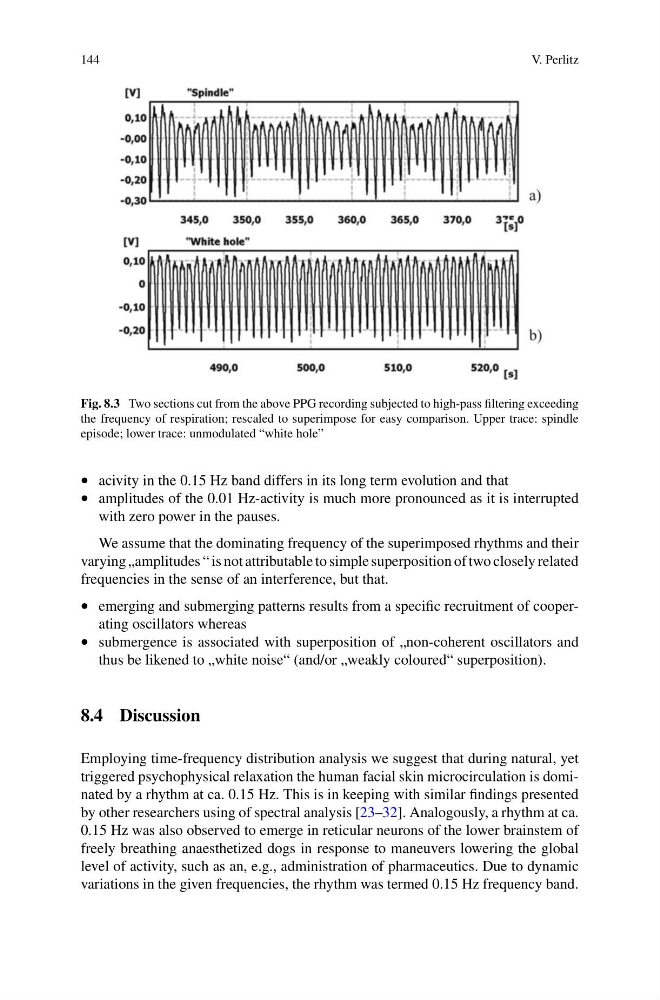
Fig. 8.3 Two sections cut from the above PPG recording subjected to high-pass filtering exceeding
the frequency of respiration; rescaled to superimpose for easy comparison. Upper trace: spindle
episode; lower trace: unmodulated “white hole”
• acivity in the 0.15 Hz band differs in its long term evolution and that
• amplitudes of the 0.01 Hz-activity is much more pronounced as it is interrupted
with zero power in the pauses.
We assume that the dominating frequency of the superimposed rhythms and their
varying „amplitudes “ is not attributable to simple superposition of two closely related
frequencies in the sense of an interference, but that.
• emerging and submerging patterns results from a specific recruitment of cooperating oscillators whereas
• submergence is associated with superposition of „non-coherent oscillators and
thus be likened to „white noise“ (and/or „weakly coloured“ superposition).
8.4 Discussion
Employing time-frequency distribution analysis we suggest that during natural, yet
triggered psychophysical relaxation the human facial skin microcirculation is dominated by a rhythm at ca. 0.15 Hz. This is in keeping with similar findings presented
by other researchers using of spectral analysis [23–32]. Analogously, a rhythm at ca.
0.15 Hz was also observed to emerge in reticular neurons of the lower brainstem of
freely breathing anaesthetized dogs in response to maneuvers lowering the global
level of activity, such as an, e.g., administration of pharmaceutics. Due to dynamic
variations in the given frequencies, the rhythm was termed 0.15 Hz frequency band.
V. Perlitz
Fig. 8.3 Two sections cut from the above PPG recording subjected to high-pass filtering exceeding
the frequency of respiration; rescaled to superimpose for easy comparison. Upper trace: spindle
episode; lower trace: unmodulated “white hole”
• acivity in the 0.15 Hz band differs in its long term evolution and that
• amplitudes of the 0.01 Hz-activity is much more pronounced as it is interrupted
with zero power in the pauses.
We assume that the dominating frequency of the superimposed rhythms and their
varying „amplitudes “ is not attributable to simple superposition of two closely related
frequencies in the sense of an interference, but that.
• emerging and submerging patterns results from a specific recruitment of cooperating oscillators whereas
• submergence is associated with superposition of „non-coherent oscillators and
thus be likened to „white noise“ (and/or „weakly coloured“ superposition).
8.4 Discussion
Employing time-frequency distribution analysis we suggest that during natural, yet
triggered psychophysical relaxation the human facial skin microcirculation is dominated by a rhythm at ca. 0.15 Hz. This is in keeping with similar findings presented
by other researchers using of spectral analysis [23–32]. Analogously, a rhythm at ca.
0.15 Hz was also observed to emerge in reticular neurons of the lower brainstem of
freely breathing anaesthetized dogs in response to maneuvers lowering the global
level of activity, such as an, e.g., administration of pharmaceutics. Due to dynamic
variations in the given frequencies, the rhythm was termed 0.15 Hz frequency band.