

6 Low-Frequency Blood Volume Rhythms in the Skin Perfusion …
107
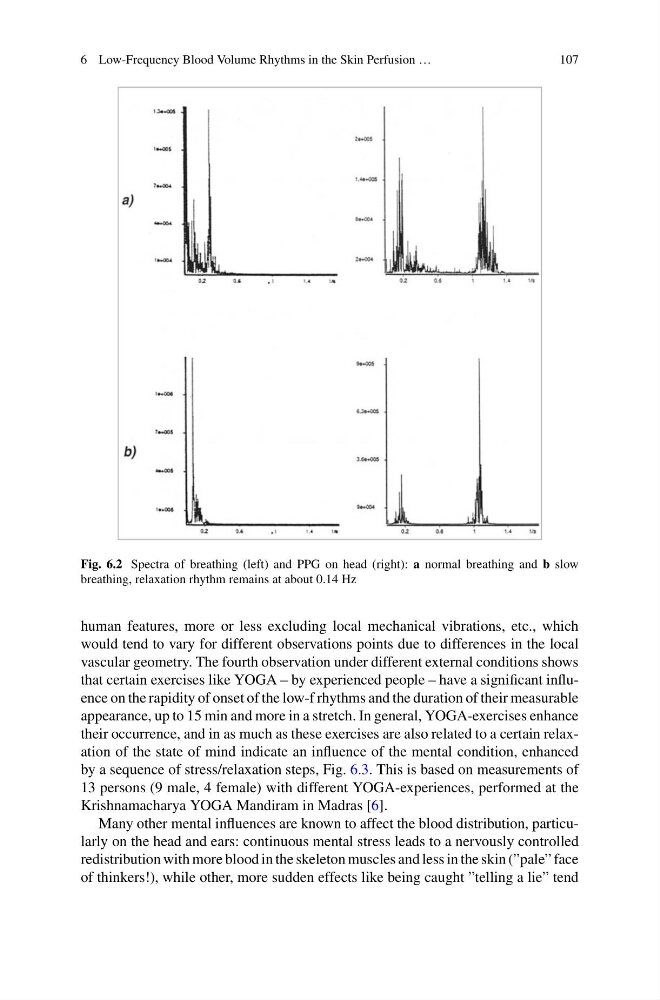
Fig. 6.2 Spectra of breathing (left) and PPG on head (right): a normal breathing and b slow
breathing, relaxation rhythm remains at about 0.14 Hz
human features, more or less excluding local mechanical vibrations, etc., which
would tend to vary for different observations points due to differences in the local
vascular geometry. The fourth observation under different external conditions shows
that certain exercises like YOGA – by experienced people – have a significant influence on the rapidity of onset of the low-f rhythms and the duration of their measurable
appearance, up to 15 min and more in a stretch. In general, YOGA-exercises enhance
their occurrence, and in as much as these exercises are also related to a certain relaxation of the state of mind indicate an influence of the mental condition, enhanced
by a sequence of stress/relaxation steps, Fig. 6.3. This is based on measurements of
13 persons (9 male, 4 female) with different YOGA-experiences, performed at the
Krishnamacharya YOGA Mandiram in Madras [6].
Many other mental influences are known to affect the blood distribution, particularly on the head and ears: continuous mental stress leads to a nervously controlled
redistribution with more blood in the skeleton muscles and less in the skin (”pale” face
of thinkers!), while other, more sudden effects like being caught ”telling a lie” tend
107
Fig. 6.2 Spectra of breathing (left) and PPG on head (right): a normal breathing and b slow
breathing, relaxation rhythm remains at about 0.14 Hz
human features, more or less excluding local mechanical vibrations, etc., which
would tend to vary for different observations points due to differences in the local
vascular geometry. The fourth observation under different external conditions shows
that certain exercises like YOGA – by experienced people – have a significant influence on the rapidity of onset of the low-f rhythms and the duration of their measurable
appearance, up to 15 min and more in a stretch. In general, YOGA-exercises enhance
their occurrence, and in as much as these exercises are also related to a certain relaxation of the state of mind indicate an influence of the mental condition, enhanced
by a sequence of stress/relaxation steps, Fig. 6.3. This is based on measurements of
13 persons (9 male, 4 female) with different YOGA-experiences, performed at the
Krishnamacharya YOGA Mandiram in Madras [6].
Many other mental influences are known to affect the blood distribution, particularly on the head and ears: continuous mental stress leads to a nervously controlled
redistribution with more blood in the skeleton muscles and less in the skin (”pale” face
of thinkers!), while other, more sudden effects like being caught ”telling a lie” tend