

98
V. Blazek and C. Blazek
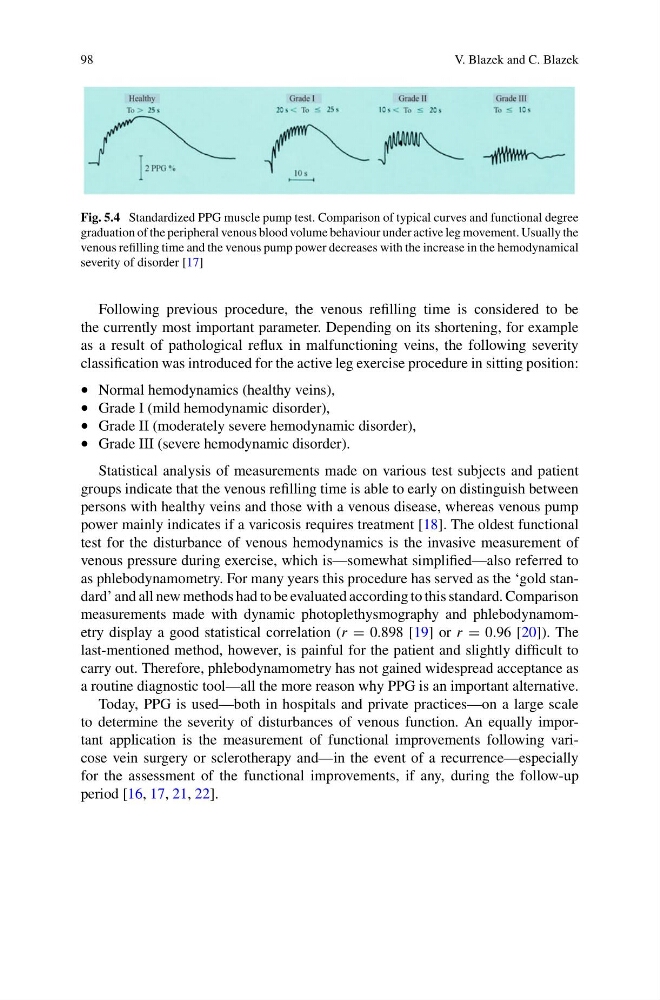
Fig. 5.4 Standardized PPG muscle pump test. Comparison of typical curves and functional degree
graduation of the peripheral venous blood volume behaviour under active leg movement. Usually the
venous refilling time and the venous pump power decreases with the increase in the hemodynamical
severity of disorder [17]
Following previous procedure, the venous refilling time is considered to be
the currently most important parameter. Depending on its shortening, for example
as a result of pathological reflux in malfunctioning veins, the following severity
classification was introduced for the active leg exercise procedure in sitting position:
• Normal hemodynamics (healthy veins),
• Grade I (mild hemodynamic disorder),
• Grade II (moderately severe hemodynamic disorder),
• Grade III (severe hemodynamic disorder).
Statistical analysis of measurements made on various test subjects and patient
groups indicate that the venous refilling time is able to early on distinguish between
persons with healthy veins and those with a venous disease, whereas venous pump
power mainly indicates if a varicosis requires treatment [18]. The oldest functional
test for the disturbance of venous hemodynamics is the invasive measurement of
venous pressure during exercise, which is—somewhat simplified—also referred to
as phlebodynamometry. For many years this procedure has served as the ‘gold standard’ and all new methods had to be evaluated according to this standard. Comparison
measurements made with dynamic photoplethysmography and phlebodynamometry display a good statistical correlation (r = 0.898 [19] or r = 0.96 [20]). The
last-mentioned method, however, is painful for the patient and slightly difficult to
carry out. Therefore, phlebodynamometry has not gained widespread acceptance as
a routine diagnostic tool—all the more reason why PPG is an important alternative.
Today, PPG is used—both in hospitals and private practices—on a large scale
to determine the severity of disturbances of venous function. An equally important application is the measurement of functional improvements following varicose vein surgery or sclerotherapy and—in the event of a recurrence—especially
for the assessment of the functional improvements, if any, during the follow-up
period [16, 17, 21, 22].
V. Blazek and C. Blazek
Fig. 5.4 Standardized PPG muscle pump test. Comparison of typical curves and functional degree
graduation of the peripheral venous blood volume behaviour under active leg movement. Usually the
venous refilling time and the venous pump power decreases with the increase in the hemodynamical
severity of disorder [17]
Following previous procedure, the venous refilling time is considered to be
the currently most important parameter. Depending on its shortening, for example
as a result of pathological reflux in malfunctioning veins, the following severity
classification was introduced for the active leg exercise procedure in sitting position:
• Normal hemodynamics (healthy veins),
• Grade I (mild hemodynamic disorder),
• Grade II (moderately severe hemodynamic disorder),
• Grade III (severe hemodynamic disorder).
Statistical analysis of measurements made on various test subjects and patient
groups indicate that the venous refilling time is able to early on distinguish between
persons with healthy veins and those with a venous disease, whereas venous pump
power mainly indicates if a varicosis requires treatment [18]. The oldest functional
test for the disturbance of venous hemodynamics is the invasive measurement of
venous pressure during exercise, which is—somewhat simplified—also referred to
as phlebodynamometry. For many years this procedure has served as the ‘gold standard’ and all new methods had to be evaluated according to this standard. Comparison
measurements made with dynamic photoplethysmography and phlebodynamometry display a good statistical correlation (r = 0.898 [19] or r = 0.96 [20]). The
last-mentioned method, however, is painful for the patient and slightly difficult to
carry out. Therefore, phlebodynamometry has not gained widespread acceptance as
a routine diagnostic tool—all the more reason why PPG is an important alternative.
Today, PPG is used—both in hospitals and private practices—on a large scale
to determine the severity of disturbances of venous function. An equally important application is the measurement of functional improvements following varicose vein surgery or sclerotherapy and—in the event of a recurrence—especially
for the assessment of the functional improvements, if any, during the follow-up
period [16, 17, 21, 22].