

96
V. Blazek and C. Blazek
(VMPT). A VMPT is performed to measure the “venous refilling time“ (VRT) and
“muscle pump capacity” (MPC). It is shown here that using the standardized leg
exercise (muscle pump) performed during a VMPT, apart from determining the VRT
and MPC, arterial oxygen saturation (SvO 2 ) and venous saturation levels (SpO 2 and
SvO 2 ) at the local test site also can easily be determined.
An advantage of the method is that it is possible to calculate the oxygen intake
from the SpO 2 and SvO 2 values and hence a measure on the metabolism activity
of the tissues surrounding the test site. It should be noted here that such a measure
on combined arterial and venous saturation and thus the determination of oxygen
consumption (that provides insight into metabolism) is very difficult and thus, the
present method is a pioneering one.
On the other hand, in a venous muscle pump test, large variations in venous
blood flow, especially in the peripheries, can be achieved. Thus, if such large blood
volume changes that occur in veins during a VMPT are used for the measurement of
SvO 2 , clinically acceptable levels of accuracy can be reached [12]. Such a technique
utilizing the absorption spectra of hemoglobin is described next.
5.4 Optical Absorption Spectra of Hemoglobin
Hemoglobin acts as a transporter for oxygen within the blood. If the hemoglobin
molecule is bound to oxygen then one has oxy-hemoglobin or HbO 2 . If the
hemoglobin molecule is bound to carbon monoxide then one has carboxyhemoglobin or HbCO [13]. If the hemoglobin molecule is bound to nothing then
one has deoxy-hemoglobin or simply Hb. If the hemoglobin molecule has broken
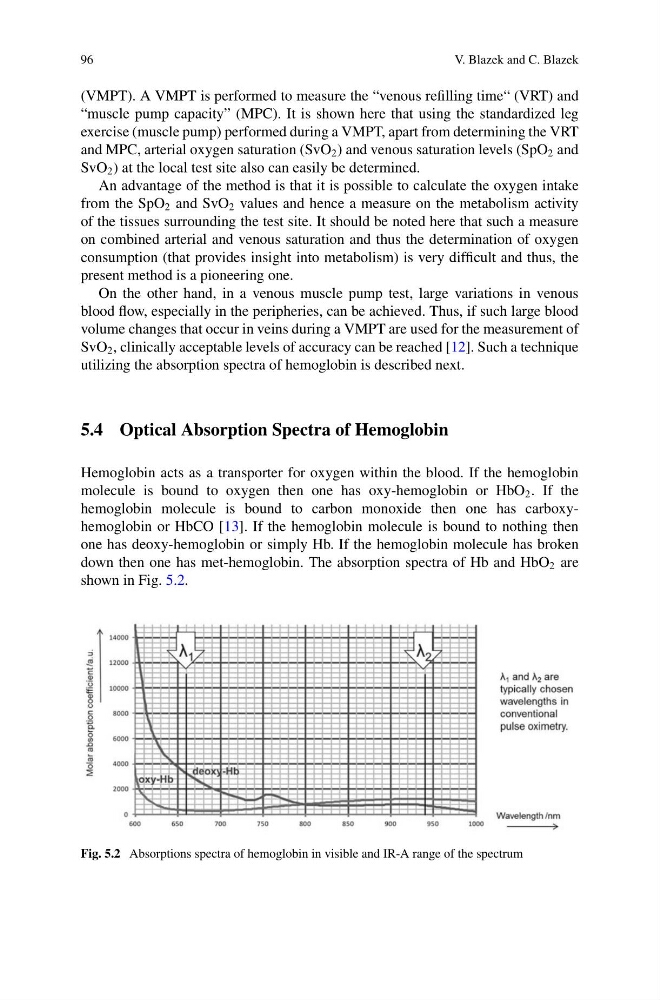
down then one has met-hemoglobin. The absorption spectra of Hb and HbO 2 are
shown in Fig. 5.2.
Fig. 5.2 Absorptions spectra of hemoglobin in visible and IR-A range of the spectrum
V. Blazek and C. Blazek
(VMPT). A VMPT is performed to measure the “venous refilling time“ (VRT) and
“muscle pump capacity” (MPC). It is shown here that using the standardized leg
exercise (muscle pump) performed during a VMPT, apart from determining the VRT
and MPC, arterial oxygen saturation (SvO 2 ) and venous saturation levels (SpO 2 and
SvO 2 ) at the local test site also can easily be determined.
An advantage of the method is that it is possible to calculate the oxygen intake
from the SpO 2 and SvO 2 values and hence a measure on the metabolism activity
of the tissues surrounding the test site. It should be noted here that such a measure
on combined arterial and venous saturation and thus the determination of oxygen
consumption (that provides insight into metabolism) is very difficult and thus, the
present method is a pioneering one.
On the other hand, in a venous muscle pump test, large variations in venous
blood flow, especially in the peripheries, can be achieved. Thus, if such large blood
volume changes that occur in veins during a VMPT are used for the measurement of
SvO 2 , clinically acceptable levels of accuracy can be reached [12]. Such a technique
utilizing the absorption spectra of hemoglobin is described next.
5.4 Optical Absorption Spectra of Hemoglobin
Hemoglobin acts as a transporter for oxygen within the blood. If the hemoglobin
molecule is bound to oxygen then one has oxy-hemoglobin or HbO 2 . If the
hemoglobin molecule is bound to carbon monoxide then one has carboxyhemoglobin or HbCO [13]. If the hemoglobin molecule is bound to nothing then
one has deoxy-hemoglobin or simply Hb. If the hemoglobin molecule has broken
down then one has met-hemoglobin. The absorption spectra of Hb and HbO 2 are
shown in Fig. 5.2.
Fig. 5.2 Absorptions spectra of hemoglobin in visible and IR-A range of the spectrum