

4 Reflective Arterial Pulse Oximetry for New Measuring Sites …
89
This measurement error is within the required measurement band.
4.3.4 Breathing Activity
The combination of heart rate, its variability, and the breathing rate gives a comprehensive insight into the circulatory system. Usually, all physiological phenomena
that lead to fluctuations in the blood pressure influence the PPG signal. Therefore,
it is possible that respiration rate can also be obtained by PPG. A simple approach
for the extraction of breathing cycle information is to analyze the signal amplitude
fluctuations (SAV) in the respiratory frequency band between 0.1 Hz and 0.33 Hz
(3s –10 s for the duration of the breathing cycles).
However, the signal components that are associated with respiration are comparatively small. Hence, it might be difficult to distinguish between the respiratory-related
frequencies and other slow oscillation phenomena, such as Traube–Hering–Mayer
waves or thermal regulation [13].
In addition, the cardio-respiratory coupling (CC), also known as respiratory sinus
arrhythmia, can be used to obtain breathing-related information from PPG signals by
analyzing rhythmical fluctuations in heart rate. We applied a Naive Bayes’ classifier
to combine both approaches for the estimation of the moment of inspiration and
expiration. A time delay between SAV and CC was automatically compensated. The
signals were divided into sections of 0.25 s each. Maximum, standard deviation,
mean value, and slope were calculated for every section as classifier features. A
total of 1,827 breathing cycles derived from diverse volunteers were used as training
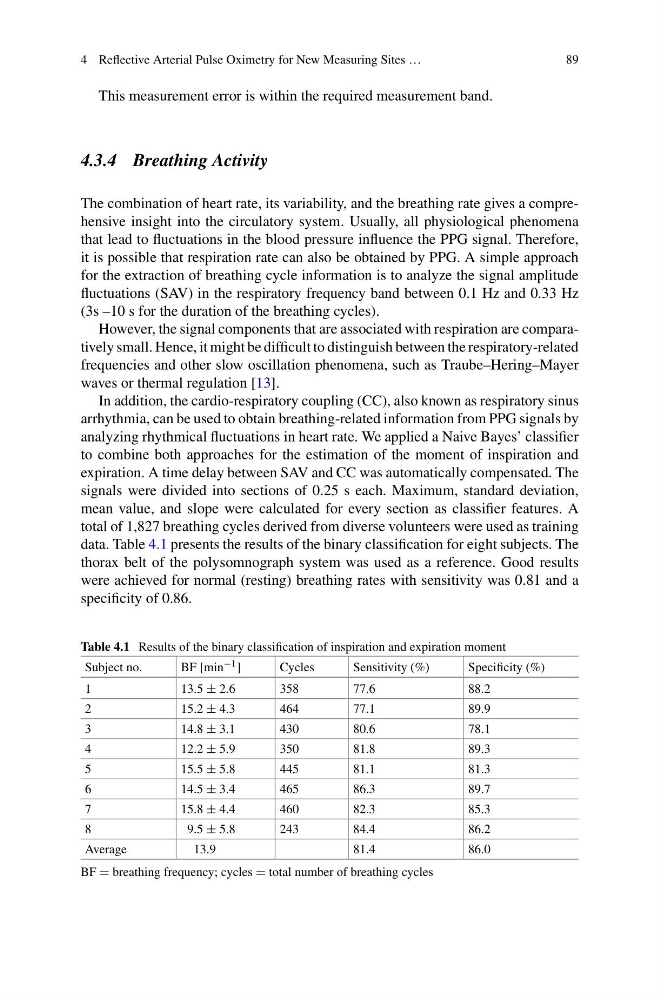
data. Table 4.1 presents the results of the binary classification for eight subjects. The
thorax belt of the polysomnograph system was used as a reference. Good results
were achieved for normal (resting) breathing rates with sensitivity was 0.81 and a
specificity of 0.86.
Table 4.1 Results of the binary classification of inspiration and expiration moment
Subject no.
BF [min −1 ]
Cycles
Sensitivity (%)
Specificity (%)
1
13.5 ± 2.6
358
77.6
88.2
2
15.2 ± 4.3
464
77.1
89.9
3
14.8 ± 3.1
430
80.6
78.1
4
12.2 ± 5.9
350
81.8
89.3
5
15.5 ± 5.8
445
81.1
81.3
6
14.5 ± 3.4
465
86.3
89.7
7
15.8 ± 4.4
460
82.3
85.3
8
9.5 ± 5.8
243
84.4
86.2
Average
13.9
81.4
86.0
BF = breathing frequency; cycles = total number of breathing cycles
89
This measurement error is within the required measurement band.
4.3.4 Breathing Activity
The combination of heart rate, its variability, and the breathing rate gives a comprehensive insight into the circulatory system. Usually, all physiological phenomena
that lead to fluctuations in the blood pressure influence the PPG signal. Therefore,
it is possible that respiration rate can also be obtained by PPG. A simple approach
for the extraction of breathing cycle information is to analyze the signal amplitude
fluctuations (SAV) in the respiratory frequency band between 0.1 Hz and 0.33 Hz
(3s –10 s for the duration of the breathing cycles).
However, the signal components that are associated with respiration are comparatively small. Hence, it might be difficult to distinguish between the respiratory-related
frequencies and other slow oscillation phenomena, such as Traube–Hering–Mayer
waves or thermal regulation [13].
In addition, the cardio-respiratory coupling (CC), also known as respiratory sinus
arrhythmia, can be used to obtain breathing-related information from PPG signals by
analyzing rhythmical fluctuations in heart rate. We applied a Naive Bayes’ classifier
to combine both approaches for the estimation of the moment of inspiration and
expiration. A time delay between SAV and CC was automatically compensated. The
signals were divided into sections of 0.25 s each. Maximum, standard deviation,
mean value, and slope were calculated for every section as classifier features. A
total of 1,827 breathing cycles derived from diverse volunteers were used as training
data. Table 4.1 presents the results of the binary classification for eight subjects. The
thorax belt of the polysomnograph system was used as a reference. Good results
were achieved for normal (resting) breathing rates with sensitivity was 0.81 and a
specificity of 0.86.
Table 4.1 Results of the binary classification of inspiration and expiration moment
Subject no.
BF [min −1 ]
Cycles
Sensitivity (%)
Specificity (%)
1
13.5 ± 2.6
358
77.6
88.2
2
15.2 ± 4.3
464
77.1
89.9
3
14.8 ± 3.1
430
80.6
78.1
4
12.2 ± 5.9
350
81.8
89.3
5
15.5 ± 5.8
445
81.1
81.3
6
14.5 ± 3.4
465
86.3
89.7
7
15.8 ± 4.4
460
82.3
85.3
8
9.5 ± 5.8
243
84.4
86.2
Average
13.9
81.4
86.0
BF = breathing frequency; cycles = total number of breathing cycles