

methods which have been adopted by major
international standardization agencies, e.g., US
Environmental Protection Agency (Brain and
Solomon 2007).
Duckweed species show variable sensitivity to
the heavy metals. It was reported that the dormant organ of Spirodela before the germination
was more tolerant to heavy metals than normal
fronds (Olah et al. 2016). Spirodela intermedia
and Lemna minor were proved to effectively
remove several heavy metals by their phytoremediation capacity (Miretzky et al. 2004).
A significant decrease of Cr and Cd level in
polluted water was investigated by Spirodela
polyrhiza with the 15-day treatment, showing
their strong removal ability of heavy metals (Rai
et al. 1995).
The use of dyes and pigments in industries has
posed severe problems in wastewater that reduce
light penetration and affect plant photosynthesis.
It causes fatal impact on aquatic plants and animals, breaking the balance of ecosystem. The
dried Spirodela polyrhiza was examined to be an
efficient adsorbent to take away the basic dye of
methylene blue from aqueous solution. As the
amount of the dried Spirodela increased, more
percentage of dye was eliminated accordingly
(Waranusantigul et al. 2003).
7.5 Why Sequence Spirodela
Genome
The previous studies were intensively concentrated on the classical botany, plant physiology,
or biochemistry on duckweeds due to the lack of
Spirodela genome. The Spirodela genome
sequence could elucidate the remarkable potential of a rapidly growing speed, biomass accumulation, and biofuel production. The further
functional genomics of Spirodela would gain
insight into the mechanisms of the high production of starch and protein. Undoubtedly, the
accessibility of Spirodela genome would set a
milestone and represent significant advance in
the fields of molecular biology and plant
evolution.
7.6 History and Consortium
With the driving to develop sustainable and clean
feedstocks for biofuel production, researchers
from Rutgers University initiated the Spirodela
genome sequencing project led by Dr. Joachim
Messing together with Dr. Todd P. Michael and
funded by the US Department of Energy Joint
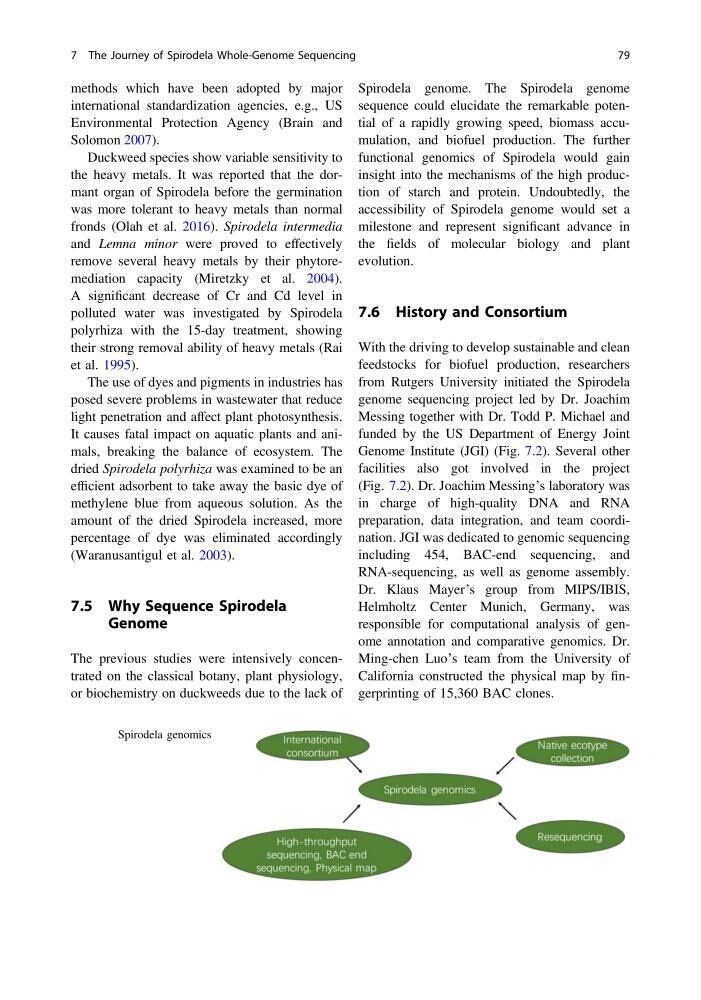
Genome Institute (JGI) (Fig. 7.2). Several other
facilities also got involved in the project
(Fig. 7.2). Dr. Joachim Messing’s laboratory was
in charge of high-quality DNA and RNA
preparation, data integration, and team coordination. JGI was dedicated to genomic sequencing
including 454, BAC-end sequencing, and
RNA-sequencing, as well as genome assembly.
Dr. Klaus Mayer’s group from MIPS/IBIS,
Helmholtz Center Munich, Germany, was
responsible for computational analysis of genome annotation and comparative genomics. Dr.
Ming-chen Luo’s team from the University of
California constructed the physical map by fingerprinting of 15,360 BAC clones.
Fig. 7.2 Spirodela genomics
7 The Journey of Spirodela Whole-Genome Sequencing
79
international standardization agencies, e.g., US
Environmental Protection Agency (Brain and
Solomon 2007).
Duckweed species show variable sensitivity to
the heavy metals. It was reported that the dormant organ of Spirodela before the germination
was more tolerant to heavy metals than normal
fronds (Olah et al. 2016). Spirodela intermedia
and Lemna minor were proved to effectively
remove several heavy metals by their phytoremediation capacity (Miretzky et al. 2004).
A significant decrease of Cr and Cd level in
polluted water was investigated by Spirodela
polyrhiza with the 15-day treatment, showing
their strong removal ability of heavy metals (Rai
et al. 1995).
The use of dyes and pigments in industries has
posed severe problems in wastewater that reduce
light penetration and affect plant photosynthesis.
It causes fatal impact on aquatic plants and animals, breaking the balance of ecosystem. The
dried Spirodela polyrhiza was examined to be an
efficient adsorbent to take away the basic dye of
methylene blue from aqueous solution. As the
amount of the dried Spirodela increased, more
percentage of dye was eliminated accordingly
(Waranusantigul et al. 2003).
7.5 Why Sequence Spirodela
Genome
The previous studies were intensively concentrated on the classical botany, plant physiology,
or biochemistry on duckweeds due to the lack of
Spirodela genome. The Spirodela genome
sequence could elucidate the remarkable potential of a rapidly growing speed, biomass accumulation, and biofuel production. The further
functional genomics of Spirodela would gain
insight into the mechanisms of the high production of starch and protein. Undoubtedly, the
accessibility of Spirodela genome would set a
milestone and represent significant advance in
the fields of molecular biology and plant
evolution.
7.6 History and Consortium
With the driving to develop sustainable and clean
feedstocks for biofuel production, researchers
from Rutgers University initiated the Spirodela
genome sequencing project led by Dr. Joachim
Messing together with Dr. Todd P. Michael and
funded by the US Department of Energy Joint
Genome Institute (JGI) (Fig. 7.2). Several other
facilities also got involved in the project
(Fig. 7.2). Dr. Joachim Messing’s laboratory was
in charge of high-quality DNA and RNA
preparation, data integration, and team coordination. JGI was dedicated to genomic sequencing
including 454, BAC-end sequencing, and
RNA-sequencing, as well as genome assembly.
Dr. Klaus Mayer’s group from MIPS/IBIS,
Helmholtz Center Munich, Germany, was
responsible for computational analysis of genome annotation and comparative genomics. Dr.
Ming-chen Luo’s team from the University of
California constructed the physical map by fingerprinting of 15,360 BAC clones.
Fig. 7.2 Spirodela genomics
7 The Journey of Spirodela Whole-Genome Sequencing
79