

without the organ differentiation and continuously produces cotyledon leaves. This prolonging of juvenile traits is called “neoteny” (Wang
et al. 2014).
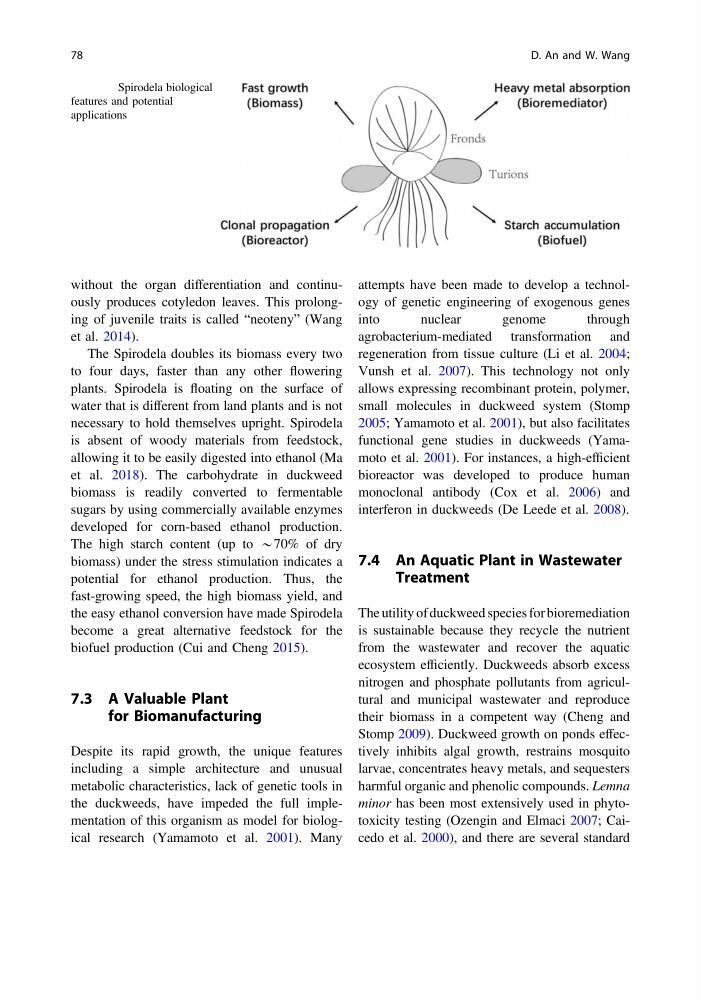
The Spirodela doubles its biomass every two
to four days, faster than any other flowering
plants. Spirodela is floating on the surface of
water that is different from land plants and is not
necessary to hold themselves upright. Spirodela
is absent of woody materials from feedstock,
allowing it to be easily digested into ethanol (Ma
et al. 2018). The carbohydrate in duckweed
biomass is readily converted to fermentable
sugars by using commercially available enzymes
developed for corn-based ethanol production.
The high starch content (up to *70% of dry
biomass) under the stress stimulation indicates a
potential for ethanol production. Thus, the
fast-growing speed, the high biomass yield, and
the easy ethanol conversion have made Spirodela
become a great alternative feedstock for the
biofuel production (Cui and Cheng 2015).
7.3 A Valuable Plant
for Biomanufacturing
Despite its rapid growth, the unique features
including a simple architecture and unusual
metabolic characteristics, lack of genetic tools in
the duckweeds, have impeded the full implementation of this organism as model for biological research (Yamamoto et al. 2001). Many
attempts have been made to develop a technology of genetic engineering of exogenous genes
into
nuclear
genome
through
agrobacterium-mediated transformation and
regeneration from tissue culture (Li et al. 2004;
Vunsh et al. 2007). This technology not only
allows expressing recombinant protein, polymer,
small molecules in duckweed system (Stomp
2005; Yamamoto et al. 2001), but also facilitates
functional gene studies in duckweeds (Yamamoto et al. 2001). For instances, a high-efficient
bioreactor was developed to produce human
monoclonal antibody (Cox et al. 2006) and
interferon in duckweeds (De Leede et al. 2008).
7.4 An Aquatic Plant in Wastewater
Treatment
The utility of duckweed species for bioremediation
is sustainable because they recycle the nutrient
from the wastewater and recover the aquatic
ecosystem efficiently. Duckweeds absorb excess
nitrogen and phosphate pollutants from agricultural and municipal wastewater and reproduce
their biomass in a competent way (Cheng and
Stomp 2009). Duckweed growth on ponds effectively inhibits algal growth, restrains mosquito
larvae, concentrates heavy metals, and sequesters
harmful organic and phenolic compounds. Lemna
minor has been most extensively used in phytotoxicity testing (Ozengin and Elmaci 2007; Caicedo et al. 2000), and there are several standard
Fig. 7.1 Spirodela biological
features and potential
applications
78
D. An and W. Wang
et al. 2014).
The Spirodela doubles its biomass every two
to four days, faster than any other flowering
plants. Spirodela is floating on the surface of
water that is different from land plants and is not
necessary to hold themselves upright. Spirodela
is absent of woody materials from feedstock,
allowing it to be easily digested into ethanol (Ma
et al. 2018). The carbohydrate in duckweed
biomass is readily converted to fermentable
sugars by using commercially available enzymes
developed for corn-based ethanol production.
The high starch content (up to *70% of dry
biomass) under the stress stimulation indicates a
potential for ethanol production. Thus, the
fast-growing speed, the high biomass yield, and
the easy ethanol conversion have made Spirodela
become a great alternative feedstock for the
biofuel production (Cui and Cheng 2015).
7.3 A Valuable Plant
for Biomanufacturing
Despite its rapid growth, the unique features
including a simple architecture and unusual
metabolic characteristics, lack of genetic tools in
the duckweeds, have impeded the full implementation of this organism as model for biological research (Yamamoto et al. 2001). Many
attempts have been made to develop a technology of genetic engineering of exogenous genes
into
nuclear
genome
through
agrobacterium-mediated transformation and
regeneration from tissue culture (Li et al. 2004;
Vunsh et al. 2007). This technology not only
allows expressing recombinant protein, polymer,
small molecules in duckweed system (Stomp
2005; Yamamoto et al. 2001), but also facilitates
functional gene studies in duckweeds (Yamamoto et al. 2001). For instances, a high-efficient
bioreactor was developed to produce human
monoclonal antibody (Cox et al. 2006) and
interferon in duckweeds (De Leede et al. 2008).
7.4 An Aquatic Plant in Wastewater
Treatment
The utility of duckweed species for bioremediation
is sustainable because they recycle the nutrient
from the wastewater and recover the aquatic
ecosystem efficiently. Duckweeds absorb excess
nitrogen and phosphate pollutants from agricultural and municipal wastewater and reproduce
their biomass in a competent way (Cheng and
Stomp 2009). Duckweed growth on ponds effectively inhibits algal growth, restrains mosquito
larvae, concentrates heavy metals, and sequesters
harmful organic and phenolic compounds. Lemna
minor has been most extensively used in phytotoxicity testing (Ozengin and Elmaci 2007; Caicedo et al. 2000), and there are several standard
Fig. 7.1 Spirodela biological
features and potential
applications
78
D. An and W. Wang