

chromosome preparation of duckweed species
has been recently optimized and advanced (Cao
et al. 2016). With the availability of a Spirodela
polyrhiza BAC library and a genome-integrated
minimum tiling path (Wang et al. 2014), fundamental resources for molecular cytogenetic
studies with multicolour fluorescence in situ
hybridization (mcFISH) of duckweed have been
established. That includes a Spirodela cytogenetic map containing 96 BAC markers with an
average distance of 0.89 Mbp and a cocktail of
41 BACs in three colours for simultaneous
identification of all chromosome pairs. The
mcFISH system has been demonstrated as an
independent and unique way to validate, correct
and integrate the NGS assemblies and genomic
optical maps by offering long-range linkage
information over the whole chromosome.
Importantly, the seven ancestral chromosome
blocks which were emerged from two rounds of
whole-genome duplications approximately 90
My ago were reconstructed, enabling future
studies on the chromosome homoeology and
karyotype evolution of duckweed species by
comparative chromosome painting for instance.
4.3 Genome Features, Organization
and Adaptation
The famous couplet of Dr. Kihara (1947) “The
history of the earth is recorded in the layers of its
crust. The history of all organisms is inscribed in
the chromosomes”. It has increasingly been
become evident. Evolutionary path to flowering
plants began more than 400 million years ago with
the marine green algae ancestor, which evolved to
cope with terrestrial habitats and to produce
flowers and seeds (de Vries and Archibald 2018).
Then duckweeds performed a remarkable
accomplishment when they adapted to a freshwater lifestyle (about 100 Mya in the Cretaceous,
Nauheimer et al. 2012) and became able to compete with other aquatic plants, which managed
also similar extreme habitat shifts. The recent and
imminent release of duckweed genomes has and
will lead to a progressively greater understanding
of genome features and organization in this plant
family. At the time of writing, there are three
duckweed genome sequences publicly available
from two geographical accessions of the Greater
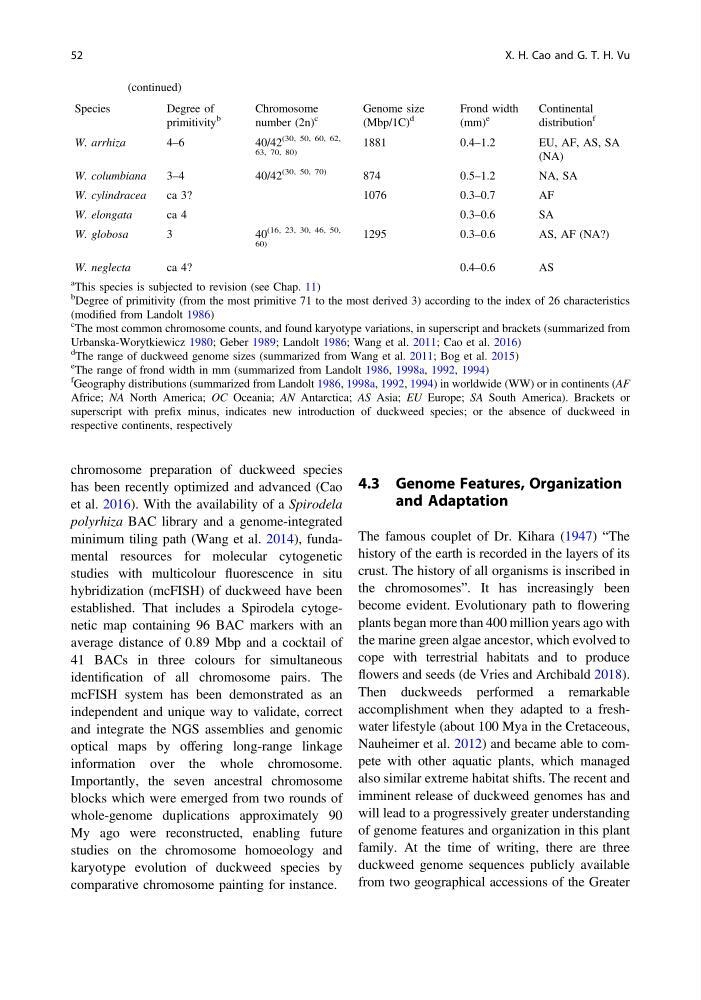
Table 4.1 (continued)
Species
Degree of
primitivity
b
Chromosome
number (2n)
c
Genome size
(Mbp/1C)
d
Frond width
(mm)
e
Continental
distribution
f
W. arrhiza
4–6
40/42
(30, 50, 60, 62,
63, 70, 80)
1881
0.4–1.2
EU, AF, AS, SA
(NA)
W. columbiana
3–4
40/42
(30, 50, 70)
874
0.5–1.2
NA, SA
W. cylindracea
ca 3?
1076
0.3–0.7
AF
W. elongata
ca 4
0.3–0.6
SA
W. globosa
3
4 0
(16, 23, 30, 46, 50,
60)
1295
0.3–0.6
AS, AF (NA?)
W. neglecta
ca 4?
0.4–0.6
AS
a This species is subjected to revision (see Chap. 11)
b
Degree of primitivity (from the most primitive 71 to the most derived 3) according to the index of 26 characteristics
(modified from Landolt 1986)
c The most common chromosome counts, and found karyotype variations, in superscript and brackets (summarized from
Urbanska-Worytkiewicz 1980; Geber 1989; Landolt 1986; Wang et al. 2011; Cao et al. 2016)
d
The range of duckweed genome sizes (summarized from Wang et al. 2011; Bog et al. 2015)
e The range of frond width in mm (summarized from Landolt 1986, 1998a, 1992, 1994)
f
Geography distributions (summarized from Landolt 1986, 1998a, 1992, 1994) in worldwide (WW) or in continents (AF
Africe; NA North America; OC Oceania; AN Antarctica; AS Asia; EU Europe; SA South America). Brackets or
superscript with prefix minus, indicates new introduction of duckweed species; or the absence of duckweed in
respective continents, respectively
52
X. H. Cao and G. T. H. Vu
has been recently optimized and advanced (Cao
et al. 2016). With the availability of a Spirodela
polyrhiza BAC library and a genome-integrated
minimum tiling path (Wang et al. 2014), fundamental resources for molecular cytogenetic
studies with multicolour fluorescence in situ
hybridization (mcFISH) of duckweed have been
established. That includes a Spirodela cytogenetic map containing 96 BAC markers with an
average distance of 0.89 Mbp and a cocktail of
41 BACs in three colours for simultaneous
identification of all chromosome pairs. The
mcFISH system has been demonstrated as an
independent and unique way to validate, correct
and integrate the NGS assemblies and genomic
optical maps by offering long-range linkage
information over the whole chromosome.
Importantly, the seven ancestral chromosome
blocks which were emerged from two rounds of
whole-genome duplications approximately 90
My ago were reconstructed, enabling future
studies on the chromosome homoeology and
karyotype evolution of duckweed species by
comparative chromosome painting for instance.
4.3 Genome Features, Organization
and Adaptation
The famous couplet of Dr. Kihara (1947) “The
history of the earth is recorded in the layers of its
crust. The history of all organisms is inscribed in
the chromosomes”. It has increasingly been
become evident. Evolutionary path to flowering
plants began more than 400 million years ago with
the marine green algae ancestor, which evolved to
cope with terrestrial habitats and to produce
flowers and seeds (de Vries and Archibald 2018).
Then duckweeds performed a remarkable
accomplishment when they adapted to a freshwater lifestyle (about 100 Mya in the Cretaceous,
Nauheimer et al. 2012) and became able to compete with other aquatic plants, which managed
also similar extreme habitat shifts. The recent and
imminent release of duckweed genomes has and
will lead to a progressively greater understanding
of genome features and organization in this plant
family. At the time of writing, there are three
duckweed genome sequences publicly available
from two geographical accessions of the Greater
Table 4.1 (continued)
Species
Degree of
primitivity
b
Chromosome
number (2n)
c
Genome size
(Mbp/1C)
d
Frond width
(mm)
e
Continental
distribution
f
W. arrhiza
4–6
40/42
(30, 50, 60, 62,
63, 70, 80)
1881
0.4–1.2
EU, AF, AS, SA
(NA)
W. columbiana
3–4
40/42
(30, 50, 70)
874
0.5–1.2
NA, SA
W. cylindracea
ca 3?
1076
0.3–0.7
AF
W. elongata
ca 4
0.3–0.6
SA
W. globosa
3
4 0
(16, 23, 30, 46, 50,
60)
1295
0.3–0.6
AS, AF (NA?)
W. neglecta
ca 4?
0.4–0.6
AS
a This species is subjected to revision (see Chap. 11)
b
Degree of primitivity (from the most primitive 71 to the most derived 3) according to the index of 26 characteristics
(modified from Landolt 1986)
c The most common chromosome counts, and found karyotype variations, in superscript and brackets (summarized from
Urbanska-Worytkiewicz 1980; Geber 1989; Landolt 1986; Wang et al. 2011; Cao et al. 2016)
d
The range of duckweed genome sizes (summarized from Wang et al. 2011; Bog et al. 2015)
e The range of frond width in mm (summarized from Landolt 1986, 1998a, 1992, 1994)
f
Geography distributions (summarized from Landolt 1986, 1998a, 1992, 1994) in worldwide (WW) or in continents (AF
Africe; NA North America; OC Oceania; AN Antarctica; AS Asia; EU Europe; SA South America). Brackets or
superscript with prefix minus, indicates new introduction of duckweed species; or the absence of duckweed in
respective continents, respectively
52
X. H. Cao and G. T. H. Vu