

intra-populational (e.g. aneuploidy, polyploidy)
and cytological variation (or technical limitations) were observed. For instance, among 187
studied accessions of Spirodela polyrhiza,
2n = 40 is the most prevalent number (in 175
accessions), whereas 2n = 30, 50 was revealed as
cytological variation in 11 and 1 accession,
respectively. Intra-individual variation was
observed in three accessions as aneusomatic
(cells with 2n = 34 among 2n = 40 cells),
mixoploid (cells with 2n = 40 and 80) and the
presumably both (2n = 62 cells in the 2n = 50
accession). Intra-populational variation was
found in plants from North America consisting of
2n = 40 and 2n = 38. A further cytological work
using air-drying technique with DAPI staining
(Geber 1989) showed more uniform results (e.g.
2n = 40 in 6 accessions of S. polyrhiza with one
accession of 2n = 80). According to his investigations, the basic number for Lemna, Wolffiela,
and Wolffia is 2n = 42. Due to technical difficulties, chromosome counts of duckweed species
have remained for two decades with conflict and
missing information (Table 3.1). Consequently,
there was no further study on molecular cytogenetics or chromosomes of duckweed during this
period of time.
Thanks to the development of probes for
fluorescent in situ hybridizations and the advent
of next-generation sequencing technologies
(NGS), modern molecular cytogenetics in duckweeds subsequently got a boost. The protocol for
85 Mya
55
50
30
Spirodela Landoltia
Lemna Wolffiella Wolffia
Evolution
Primitivity
Body size
Chromosome
number (2n)
Genome size
Diversity
Distribution
55
66
26
8
3
1.5
1
0.5
0.25
0.08
36/40
40/46
40/42
40/42
40/42
158
377
443
645
982
2
1
13
10
11
AF + SA
1.5
0.08
1881
150
6
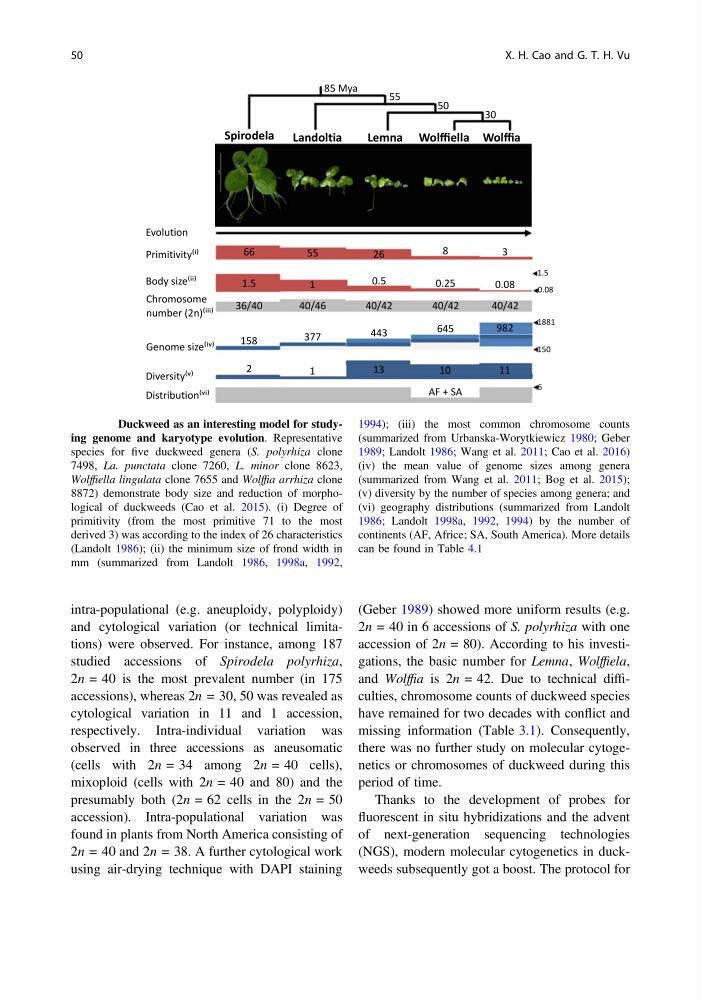
Fig. 4.1 Duckweed as an interesting model for studying genome and karyotype evolution. Representative
species for five duckweed genera (S. polyrhiza clone
7498, La. punctata clone 7260, L. minor clone 8623,
Wolffiella lingulata clone 7655 and Wolffia arrhiza clone
8872) demonstrate body size and reduction of morphological of duckweeds (Cao et al. 2015). (i) Degree of
primitivity (from the most primitive 71 to the most
derived 3) was according to the index of 26 characteristics
(Landolt 1986); (ii) the minimum size of frond width in
mm (summarized from Landolt 1986, 1998a, 1992,
1994); (iii) the most common chromosome counts
(summarized from Urbanska-Worytkiewicz 1980; Geber
1989; Landolt 1986; Wang et al. 2011; Cao et al. 2016)
(iv) the mean value of genome sizes among genera
(summarized from Wang et al. 2011; Bog et al. 2015);
(v) diversity by the number of species among genera; and
(vi) geography distributions (summarized from Landolt
1986; Landolt 1998a, 1992, 1994) by the number of
continents (AF, Africe; SA, South America). More details
can be found in Table 4.1
50
X. H. Cao and G. T. H. Vu
and cytological variation (or technical limitations) were observed. For instance, among 187
studied accessions of Spirodela polyrhiza,
2n = 40 is the most prevalent number (in 175
accessions), whereas 2n = 30, 50 was revealed as
cytological variation in 11 and 1 accession,
respectively. Intra-individual variation was
observed in three accessions as aneusomatic
(cells with 2n = 34 among 2n = 40 cells),
mixoploid (cells with 2n = 40 and 80) and the
presumably both (2n = 62 cells in the 2n = 50
accession). Intra-populational variation was
found in plants from North America consisting of
2n = 40 and 2n = 38. A further cytological work
using air-drying technique with DAPI staining
(Geber 1989) showed more uniform results (e.g.
2n = 40 in 6 accessions of S. polyrhiza with one
accession of 2n = 80). According to his investigations, the basic number for Lemna, Wolffiela,
and Wolffia is 2n = 42. Due to technical difficulties, chromosome counts of duckweed species
have remained for two decades with conflict and
missing information (Table 3.1). Consequently,
there was no further study on molecular cytogenetics or chromosomes of duckweed during this
period of time.
Thanks to the development of probes for
fluorescent in situ hybridizations and the advent
of next-generation sequencing technologies
(NGS), modern molecular cytogenetics in duckweeds subsequently got a boost. The protocol for
85 Mya
55
50
30
Spirodela Landoltia
Lemna Wolffiella Wolffia
Evolution
Primitivity
Body size
Chromosome
number (2n)
Genome size
Diversity
Distribution
55
66
26
8
3
1.5
1
0.5
0.25
0.08
36/40
40/46
40/42
40/42
40/42
158
377
443
645
982
2
1
13
10
11
AF + SA
1.5
0.08
1881
150
6
Fig. 4.1 Duckweed as an interesting model for studying genome and karyotype evolution. Representative
species for five duckweed genera (S. polyrhiza clone
7498, La. punctata clone 7260, L. minor clone 8623,
Wolffiella lingulata clone 7655 and Wolffia arrhiza clone
8872) demonstrate body size and reduction of morphological of duckweeds (Cao et al. 2015). (i) Degree of
primitivity (from the most primitive 71 to the most
derived 3) was according to the index of 26 characteristics
(Landolt 1986); (ii) the minimum size of frond width in
mm (summarized from Landolt 1986, 1998a, 1992,
1994); (iii) the most common chromosome counts
(summarized from Urbanska-Worytkiewicz 1980; Geber
1989; Landolt 1986; Wang et al. 2011; Cao et al. 2016)
(iv) the mean value of genome sizes among genera
(summarized from Wang et al. 2011; Bog et al. 2015);
(v) diversity by the number of species among genera; and
(vi) geography distributions (summarized from Landolt
1986; Landolt 1998a, 1992, 1994) by the number of
continents (AF, Africe; SA, South America). More details
can be found in Table 4.1
50
X. H. Cao and G. T. H. Vu