

cluster culture allowed successful differentiation
of transgenic W. arrhiza plants (Khvatkov et al.
2015b). To our knowledge, this is the only
reported stable transformation for the genus
Wolffia. Most approaches described above
include a transgenic plant developing from a
secondary structure, which has earlier been
co-cultivated with A. tumefaciens.
In contrast, our approach focuses on carrying
out the Agrobacterium-based transformation in
planta, i.e., utilizing the full plant (Edelman et al.
1998; Stomp and Rajbhandari 2000). There is no
need to cut the plant into small particles or to use
tissue culture followed by in vitro regeneration
for the transformation. Edelman (Edelman et al.
1998) co-cultivated complete L. punctata fronds
with A. tumefaciens and obtained GUS-positive
fronds. Prior to co-cultivation, existing daughter
fronds of the to-be-transformed mother fronds
were removed and vacuum infiltration was performed. Other reports examined the influence of
injuring fronds before vacuum infiltration on
transformation efficiency for W. columbiana
(Boehm et al. 2001) or L. minor (Ko et al. 2011).
Another less common option used for the larger
Lemna or Spirodela species is the microinjection
of DNA into the meristem (Edelman et al. 1998).
Our group also developed a highly efficient
protocol for in planta transformation. Several
parameters were tested; some of those resulted in
an increase of transformation rate (Table 17.3).
• The frond injury before the transformation
event was not performed manually, but by the
use of an ultrasonic bath under white light;
• A. tumefaciens used for transformation were
supplied with acetosyringone before inoculation (Stomp 2005);
• The inoculation itself was repeated three
times using vacuum infiltration.
After 4–7 days of co-culture, Wolffia plants
were washed at least two times for 20 min, in
order to remove remaining Agrobacteria. SH
media supplemented with 250 mg/l Timentin was
used. After this procedure, plants were placed on
solid SH medium with Timentin. If a selection
with allyl alcohol (prop-2-en-1-ol) had to be performed (s. b.), the plants were placed in liquid SH
medium with 20 µM allyl alcohol and incubated
for one hour (Widholm and Kishinami 1988).
This in planta transformation approach led to
transient transformed, chimeric plants. These
chimeric plants could be used to develop the
protocols needed for the transformation in a
minimal time period (Fig. 17.2). A transient
transformation is a prerequisite for performing
the genome editing.
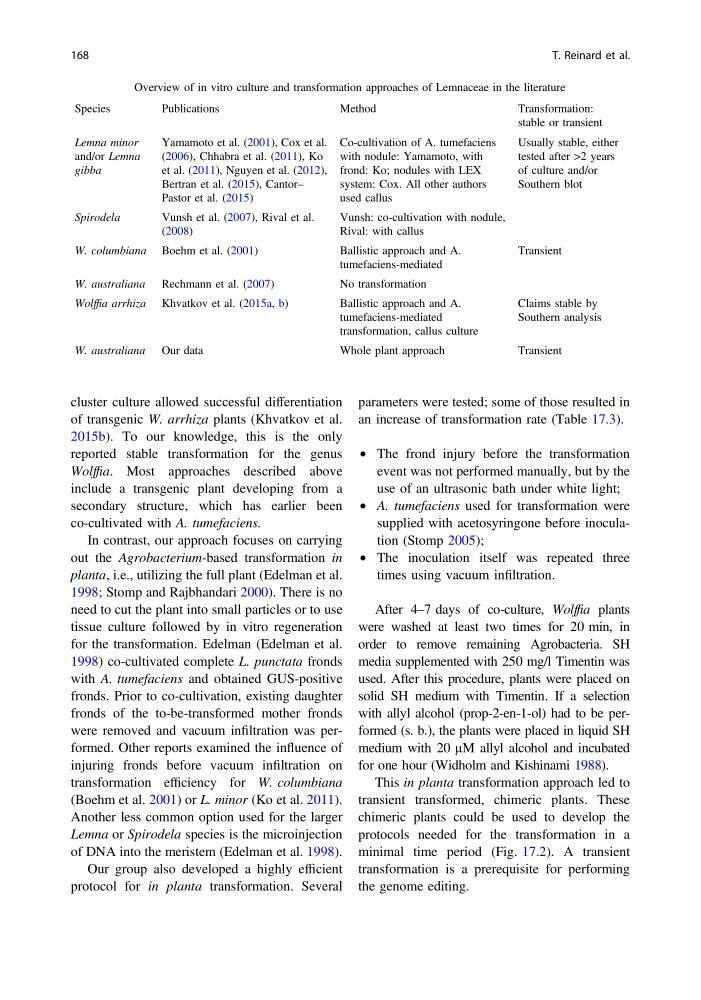
Table 17.2 Overview of in vitro culture and transformation approaches of Lemnaceae in the literature
Species
Publications
Method
Transformation:
stable or transient
Lemna minor
and/or Lemna
gibba
Yamamoto et al. (2001), Cox et al.
(2006), Chhabra et al. (2011), Ko
et al. (2011), Nguyen et al. (2012),
Bertran et al. (2015), Cantor–
Pastor et al. (2015)
Co-cultivation of A. tumefaciens
with nodule: Yamamoto, with
frond: Ko; nodules with LEX
system: Cox. All other authors
used callus
Usually stable, either
tested after >2 years
of culture and/or
Southern blot
Spirodela
Vunsh et al. (2007), Rival et al.
(2008)
Vunsh: co-cultivation with nodule,
Rival: with callus
W. columbiana Boehm et al. (2001)
Ballistic approach and A.
tumefaciens-mediated
Transient
W. australiana Rechmann et al. (2007)
No transformation
Wolffia arrhiza Khvatkov et al. (2015a, b)
Ballistic approach and A.
tumefaciens-mediated
transformation, callus culture
Claims stable by
Southern analysis
W. australiana Our data
Whole plant approach
Transient
168
T. Reinard et al.
of transgenic W. arrhiza plants (Khvatkov et al.
2015b). To our knowledge, this is the only
reported stable transformation for the genus
Wolffia. Most approaches described above
include a transgenic plant developing from a
secondary structure, which has earlier been
co-cultivated with A. tumefaciens.
In contrast, our approach focuses on carrying
out the Agrobacterium-based transformation in
planta, i.e., utilizing the full plant (Edelman et al.
1998; Stomp and Rajbhandari 2000). There is no
need to cut the plant into small particles or to use
tissue culture followed by in vitro regeneration
for the transformation. Edelman (Edelman et al.
1998) co-cultivated complete L. punctata fronds
with A. tumefaciens and obtained GUS-positive
fronds. Prior to co-cultivation, existing daughter
fronds of the to-be-transformed mother fronds
were removed and vacuum infiltration was performed. Other reports examined the influence of
injuring fronds before vacuum infiltration on
transformation efficiency for W. columbiana
(Boehm et al. 2001) or L. minor (Ko et al. 2011).
Another less common option used for the larger
Lemna or Spirodela species is the microinjection
of DNA into the meristem (Edelman et al. 1998).
Our group also developed a highly efficient
protocol for in planta transformation. Several
parameters were tested; some of those resulted in
an increase of transformation rate (Table 17.3).
• The frond injury before the transformation
event was not performed manually, but by the
use of an ultrasonic bath under white light;
• A. tumefaciens used for transformation were
supplied with acetosyringone before inoculation (Stomp 2005);
• The inoculation itself was repeated three
times using vacuum infiltration.
After 4–7 days of co-culture, Wolffia plants
were washed at least two times for 20 min, in
order to remove remaining Agrobacteria. SH
media supplemented with 250 mg/l Timentin was
used. After this procedure, plants were placed on
solid SH medium with Timentin. If a selection
with allyl alcohol (prop-2-en-1-ol) had to be performed (s. b.), the plants were placed in liquid SH
medium with 20 µM allyl alcohol and incubated
for one hour (Widholm and Kishinami 1988).
This in planta transformation approach led to
transient transformed, chimeric plants. These
chimeric plants could be used to develop the
protocols needed for the transformation in a
minimal time period (Fig. 17.2). A transient
transformation is a prerequisite for performing
the genome editing.
Table 17.2 Overview of in vitro culture and transformation approaches of Lemnaceae in the literature
Species
Publications
Method
Transformation:
stable or transient
Lemna minor
and/or Lemna
gibba
Yamamoto et al. (2001), Cox et al.
(2006), Chhabra et al. (2011), Ko
et al. (2011), Nguyen et al. (2012),
Bertran et al. (2015), Cantor–
Pastor et al. (2015)
Co-cultivation of A. tumefaciens
with nodule: Yamamoto, with
frond: Ko; nodules with LEX
system: Cox. All other authors
used callus
Usually stable, either
tested after >2 years
of culture and/or
Southern blot
Spirodela
Vunsh et al. (2007), Rival et al.
(2008)
Vunsh: co-cultivation with nodule,
Rival: with callus
W. columbiana Boehm et al. (2001)
Ballistic approach and A.
tumefaciens-mediated
Transient
W. australiana Rechmann et al. (2007)
No transformation
Wolffia arrhiza Khvatkov et al. (2015a, b)
Ballistic approach and A.
tumefaciens-mediated
transformation, callus culture
Claims stable by
Southern analysis
W. australiana Our data
Whole plant approach
Transient
168
T. Reinard et al.