

families. The three experiments studied strains
LT5a, 9509, and 7498 which originated in China,
USA, and Germany, providing a global perspective of the species. The control conditions
were largely similar using Schenk & Hildebrandt
medium at a pH of 5.8, with the known variations mainly being the 15 °C night time temperature, and relatively young cultures for LT5a
and harvesting based on water surface coverage
in 7498. While these expression results from
strains across the world grown in control conditions vary in rank and abundance of miRNA
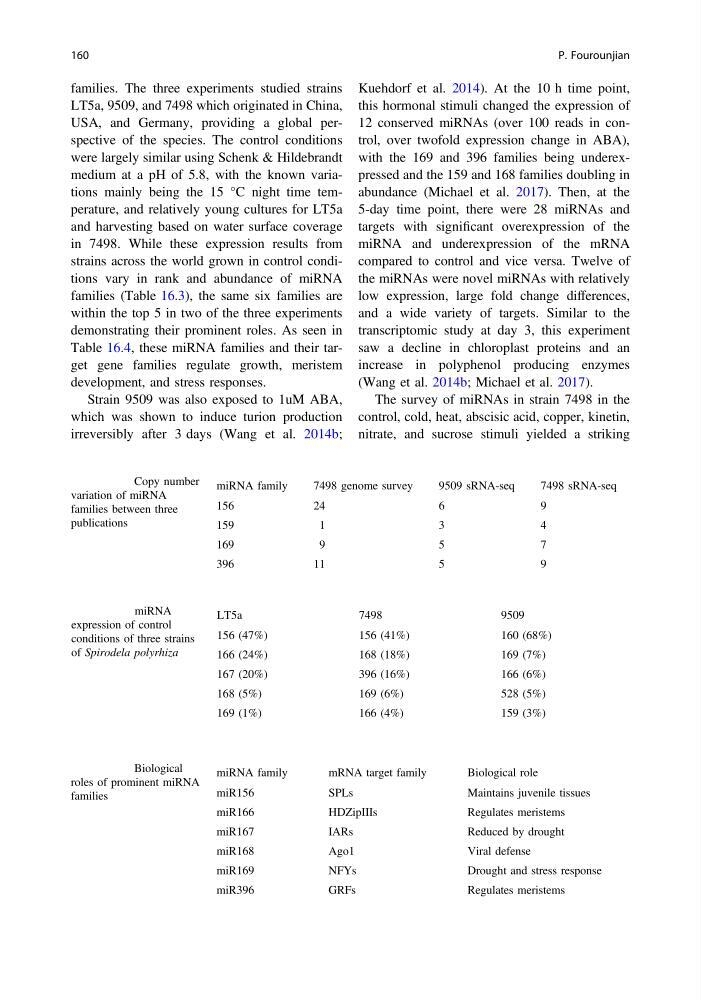
families (Table 16.3), the same six families are
within the top 5 in two of the three experiments
demonstrating their prominent roles. As seen in
Table 16.4, these miRNA families and their target gene families regulate growth, meristem
development, and stress responses.
Strain 9509 was also exposed to 1uM ABA,
which was shown to induce turion production
irreversibly after 3 days (Wang et al. 2014b;
Kuehdorf et al. 2014). At the 10 h time point,
this hormonal stimuli changed the expression of
12 conserved miRNAs (over 100 reads in control, over twofold expression change in ABA),
with the 169 and 396 families being underexpressed and the 159 and 168 families doubling in
abundance (Michael et al. 2017). Then, at the
5-day time point, there were 28 miRNAs and
targets with significant overexpression of the
miRNA and underexpression of the mRNA
compared to control and vice versa. Twelve of
the miRNAs were novel miRNAs with relatively
low expression, large fold change differences,
and a wide variety of targets. Similar to the
transcriptomic study at day 3, this experiment
saw a decline in chloroplast proteins and an
increase in polyphenol producing enzymes
(Wang et al. 2014b; Michael et al. 2017).
The survey of miRNAs in strain 7498 in the
control, cold, heat, abscisic acid, copper, kinetin,
nitrate, and sucrose stimuli yielded a striking
Table 16.2 Copy number
variation of miRNA
families between three
publications
miRNA family
7498 genome survey
9509 sRNA-seq
7498 sRNA-seq
156
24
6
9
159
1
3
4
169
9
5
7
396
11
5
9
Table 16.3 miRNA
expression of control
conditions of three strains
of Spirodela polyrhiza
LT5a
7498
9509
156 (47%)
156 (41%)
160 (68%)
166 (24%)
168 (18%)
169 (7%)
167 (20%)
396 (16%)
166 (6%)
168 (5%)
169 (6%)
528 (5%)
169 (1%)
166 (4%)
159 (3%)
Table 16.4 Biological
roles of prominent miRNA
families
miRNA family
mRNA target family
Biological role
miR156
SPLs
Maintains juvenile tissues
miR166
HDZipIIIs
Regulates meristems
miR167
IARs
Reduced by drought
miR168
Ago1
Viral defense
miR169
NFYs
Drought and stress response
miR396
GRFs
Regulates meristems
160
P. Fourounjian
LT5a, 9509, and 7498 which originated in China,
USA, and Germany, providing a global perspective of the species. The control conditions
were largely similar using Schenk & Hildebrandt
medium at a pH of 5.8, with the known variations mainly being the 15 °C night time temperature, and relatively young cultures for LT5a
and harvesting based on water surface coverage
in 7498. While these expression results from
strains across the world grown in control conditions vary in rank and abundance of miRNA
families (Table 16.3), the same six families are
within the top 5 in two of the three experiments
demonstrating their prominent roles. As seen in
Table 16.4, these miRNA families and their target gene families regulate growth, meristem
development, and stress responses.
Strain 9509 was also exposed to 1uM ABA,
which was shown to induce turion production
irreversibly after 3 days (Wang et al. 2014b;
Kuehdorf et al. 2014). At the 10 h time point,
this hormonal stimuli changed the expression of
12 conserved miRNAs (over 100 reads in control, over twofold expression change in ABA),
with the 169 and 396 families being underexpressed and the 159 and 168 families doubling in
abundance (Michael et al. 2017). Then, at the
5-day time point, there were 28 miRNAs and
targets with significant overexpression of the
miRNA and underexpression of the mRNA
compared to control and vice versa. Twelve of
the miRNAs were novel miRNAs with relatively
low expression, large fold change differences,
and a wide variety of targets. Similar to the
transcriptomic study at day 3, this experiment
saw a decline in chloroplast proteins and an
increase in polyphenol producing enzymes
(Wang et al. 2014b; Michael et al. 2017).
The survey of miRNAs in strain 7498 in the
control, cold, heat, abscisic acid, copper, kinetin,
nitrate, and sucrose stimuli yielded a striking
Table 16.2 Copy number
variation of miRNA
families between three
publications
miRNA family
7498 genome survey
9509 sRNA-seq
7498 sRNA-seq
156
24
6
9
159
1
3
4
169
9
5
7
396
11
5
9
Table 16.3 miRNA
expression of control
conditions of three strains
of Spirodela polyrhiza
LT5a
7498
9509
156 (47%)
156 (41%)
160 (68%)
166 (24%)
168 (18%)
169 (7%)
167 (20%)
396 (16%)
166 (6%)
168 (5%)
169 (6%)
528 (5%)
169 (1%)
166 (4%)
159 (3%)
Table 16.4 Biological
roles of prominent miRNA
families
miRNA family
mRNA target family
Biological role
miR156
SPLs
Maintains juvenile tissues
miR166
HDZipIIIs
Regulates meristems
miR167
IARs
Reduced by drought
miR168
Ago1
Viral defense
miR169
NFYs
Drought and stress response
miR396
GRFs
Regulates meristems
160
P. Fourounjian