

70% being 21nt in length. These are sufficient to
distinguish randomly degraded transcripts from
mRNAs that had been transcribed into dsRNA
and then diced into 21nt tasiRNAs. TargetFinder
was then used with a cutoff of 6 and a requirement of two miRNA bind sites to identify the
targeted genes. This search yielded two cleaved
TAS3 genes, and the miR393 targeting another
putative TAS gene that was also found in oil
palm and banana.
The most recent miRNA survey started with
strain 7498 grown in three replicate flasks of
eight growth conditions: control, cold, heat,
abscisic acid, copper, kinetin, nitrate, and sucrose
stimuli. After harvest, RNA extraction, and size
selection, 32 million reads of the 24 libraries
were sequenced on the SOLiD5500 platform and
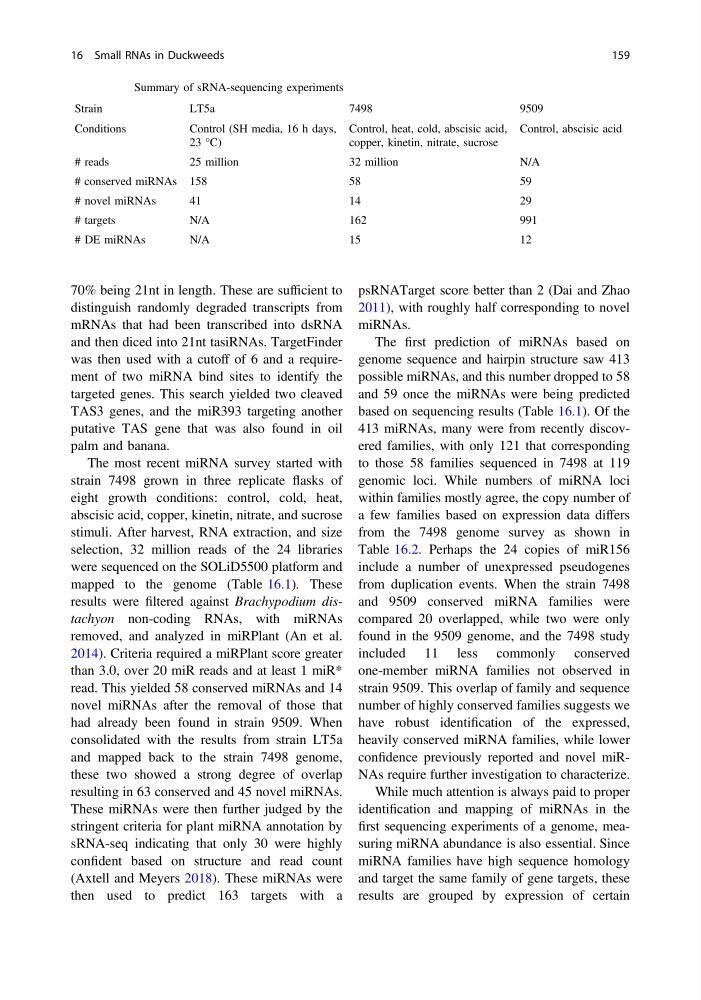
mapped to the genome (Table 16.1). These
results were filtered against Brachypodium distachyon non-coding RNAs, with miRNAs
removed, and analyzed in miRPlant (An et al.
2014). Criteria required a miRPlant score greater
than 3.0, over 20 miR reads and at least 1 miR*
read. This yielded 58 conserved miRNAs and 14
novel miRNAs after the removal of those that
had already been found in strain 9509. When
consolidated with the results from strain LT5a
and mapped back to the strain 7498 genome,
these two showed a strong degree of overlap
resulting in 63 conserved and 45 novel miRNAs.
These miRNAs were then further judged by the
stringent criteria for plant miRNA annotation by
sRNA-seq indicating that only 30 were highly
confident based on structure and read count
(Axtell and Meyers 2018). These miRNAs were
then used to predict 163 targets with a
psRNATarget score better than 2 (Dai and Zhao
2011), with roughly half corresponding to novel
miRNAs.
The first prediction of miRNAs based on
genome sequence and hairpin structure saw 413
possible miRNAs, and this number dropped to 58
and 59 once the miRNAs were being predicted
based on sequencing results (Table 16.1). Of the
413 miRNAs, many were from recently discovered families, with only 121 that corresponding
to those 58 families sequenced in 7498 at 119
genomic loci. While numbers of miRNA loci
within families mostly agree, the copy number of
a few families based on expression data differs
from the 7498 genome survey as shown in
Table 16.2. Perhaps the 24 copies of miR156
include a number of unexpressed pseudogenes
from duplication events. When the strain 7498
and 9509 conserved miRNA families were
compared 20 overlapped, while two were only
found in the 9509 genome, and the 7498 study
included 11 less commonly conserved
one-member miRNA families not observed in
strain 9509. This overlap of family and sequence
number of highly conserved families suggests we
have robust identification of the expressed,
heavily conserved miRNA families, while lower
confidence previously reported and novel miRNAs require further investigation to characterize.
While much attention is always paid to proper
identification and mapping of miRNAs in the
first sequencing experiments of a genome, measuring miRNA abundance is also essential. Since
miRNA families have high sequence homology
and target the same family of gene targets, these
results are grouped by expression of certain
Table 16.1 Summary of sRNA-sequencing experiments
Strain
LT5a
7498
9509
Conditions
Control (SH media, 16 h days,
23 °C)
Control, heat, cold, abscisic acid,
copper, kinetin, nitrate, sucrose
Control, abscisic acid
# reads
25 million
32 million
N/A
# conserved miRNAs 158
58
59
# novel miRNAs
41
14
29
# targets
N/A
162
991
# DE miRNAs
N/A
15
12
16 Small RNAs in Duckweeds
159
distinguish randomly degraded transcripts from
mRNAs that had been transcribed into dsRNA
and then diced into 21nt tasiRNAs. TargetFinder
was then used with a cutoff of 6 and a requirement of two miRNA bind sites to identify the
targeted genes. This search yielded two cleaved
TAS3 genes, and the miR393 targeting another
putative TAS gene that was also found in oil
palm and banana.
The most recent miRNA survey started with
strain 7498 grown in three replicate flasks of
eight growth conditions: control, cold, heat,
abscisic acid, copper, kinetin, nitrate, and sucrose
stimuli. After harvest, RNA extraction, and size
selection, 32 million reads of the 24 libraries
were sequenced on the SOLiD5500 platform and
mapped to the genome (Table 16.1). These
results were filtered against Brachypodium distachyon non-coding RNAs, with miRNAs
removed, and analyzed in miRPlant (An et al.
2014). Criteria required a miRPlant score greater
than 3.0, over 20 miR reads and at least 1 miR*
read. This yielded 58 conserved miRNAs and 14
novel miRNAs after the removal of those that
had already been found in strain 9509. When
consolidated with the results from strain LT5a
and mapped back to the strain 7498 genome,
these two showed a strong degree of overlap
resulting in 63 conserved and 45 novel miRNAs.
These miRNAs were then further judged by the
stringent criteria for plant miRNA annotation by
sRNA-seq indicating that only 30 were highly
confident based on structure and read count
(Axtell and Meyers 2018). These miRNAs were
then used to predict 163 targets with a
psRNATarget score better than 2 (Dai and Zhao
2011), with roughly half corresponding to novel
miRNAs.
The first prediction of miRNAs based on
genome sequence and hairpin structure saw 413
possible miRNAs, and this number dropped to 58
and 59 once the miRNAs were being predicted
based on sequencing results (Table 16.1). Of the
413 miRNAs, many were from recently discovered families, with only 121 that corresponding
to those 58 families sequenced in 7498 at 119
genomic loci. While numbers of miRNA loci
within families mostly agree, the copy number of
a few families based on expression data differs
from the 7498 genome survey as shown in
Table 16.2. Perhaps the 24 copies of miR156
include a number of unexpressed pseudogenes
from duplication events. When the strain 7498
and 9509 conserved miRNA families were
compared 20 overlapped, while two were only
found in the 9509 genome, and the 7498 study
included 11 less commonly conserved
one-member miRNA families not observed in
strain 9509. This overlap of family and sequence
number of highly conserved families suggests we
have robust identification of the expressed,
heavily conserved miRNA families, while lower
confidence previously reported and novel miRNAs require further investigation to characterize.
While much attention is always paid to proper
identification and mapping of miRNAs in the
first sequencing experiments of a genome, measuring miRNA abundance is also essential. Since
miRNA families have high sequence homology
and target the same family of gene targets, these
results are grouped by expression of certain
Table 16.1 Summary of sRNA-sequencing experiments
Strain
LT5a
7498
9509
Conditions
Control (SH media, 16 h days,
23 °C)
Control, heat, cold, abscisic acid,
copper, kinetin, nitrate, sucrose
Control, abscisic acid
# reads
25 million
32 million
N/A
# conserved miRNAs 158
58
59
# novel miRNAs
41
14
29
# targets
N/A
162
991
# DE miRNAs
N/A
15
12
16 Small RNAs in Duckweeds
159