

mixture of total DNA (Murray and Thompson
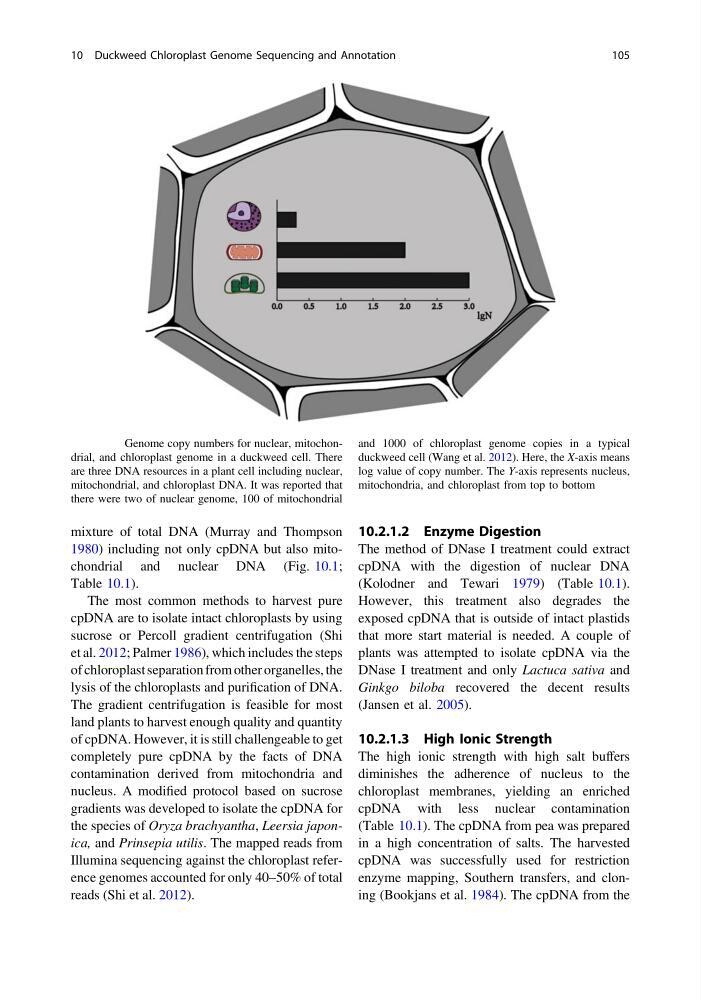
1980) including not only cpDNA but also mitochondrial and nuclear DNA (Fig. 10.1;
Table 10.1).
The most common methods to harvest pure
cpDNA are to isolate intact chloroplasts by using
sucrose or Percoll gradient centrifugation (Shi
et al. 2012; Palmer 1986), which includes the steps
of chloroplast separation from other organelles, the
lysis of the chloroplasts and purification of DNA.
The gradient centrifugation is feasible for most
land plants to harvest enough quality and quantity
of cpDNA. However, it is still challengeable to get
completely pure cpDNA by the facts of DNA
contamination derived from mitochondria and
nucleus. A modified protocol based on sucrose
gradients was developed to isolate the cpDNA for
the species of Oryza brachyantha, Leersia japonica, and Prinsepia utilis. The mapped reads from
Illumina sequencing against the chloroplast reference genomes accounted for only 40–50% of total
reads (Shi et al. 2012).
10.2.1.2 Enzyme Digestion
The method of DNase I treatment could extract
cpDNA with the digestion of nuclear DNA
(Kolodner and Tewari 1979) (Table 10.1).
However, this treatment also degrades the
exposed cpDNA that is outside of intact plastids
that more start material is needed. A couple of
plants was attempted to isolate cpDNA via the
DNase I treatment and only Lactuca sativa and
Ginkgo biloba recovered the decent results
(Jansen et al. 2005).
10.2.1.3 High Ionic Strength
The high ionic strength with high salt buffers
diminishes the adherence of nucleus to the
chloroplast membranes, yielding an enriched
cpDNA with less nuclear contamination
(Table 10.1). The cpDNA from pea was prepared
in a high concentration of salts. The harvested
cpDNA was successfully used for restriction
enzyme mapping, Southern transfers, and cloning (Bookjans et al. 1984). The cpDNA from the
Fig. 10.1 Genome copy numbers for nuclear, mitochondrial, and chloroplast genome in a duckweed cell. There
are three DNA resources in a plant cell including nuclear,
mitochondrial, and chloroplast DNA. It was reported that
there were two of nuclear genome, 100 of mitochondrial
and 1000 of chloroplast genome copies in a typical
duckweed cell (Wang et al. 2012). Here, the X-axis means
log value of copy number. The Y-axis represents nucleus,
mitochondria, and chloroplast from top to bottom
10 Duckweed Chloroplast Genome Sequencing and Annotation
105
1980) including not only cpDNA but also mitochondrial and nuclear DNA (Fig. 10.1;
Table 10.1).
The most common methods to harvest pure
cpDNA are to isolate intact chloroplasts by using
sucrose or Percoll gradient centrifugation (Shi
et al. 2012; Palmer 1986), which includes the steps
of chloroplast separation from other organelles, the
lysis of the chloroplasts and purification of DNA.
The gradient centrifugation is feasible for most
land plants to harvest enough quality and quantity
of cpDNA. However, it is still challengeable to get
completely pure cpDNA by the facts of DNA
contamination derived from mitochondria and
nucleus. A modified protocol based on sucrose
gradients was developed to isolate the cpDNA for
the species of Oryza brachyantha, Leersia japonica, and Prinsepia utilis. The mapped reads from
Illumina sequencing against the chloroplast reference genomes accounted for only 40–50% of total
reads (Shi et al. 2012).
10.2.1.2 Enzyme Digestion
The method of DNase I treatment could extract
cpDNA with the digestion of nuclear DNA
(Kolodner and Tewari 1979) (Table 10.1).
However, this treatment also degrades the
exposed cpDNA that is outside of intact plastids
that more start material is needed. A couple of
plants was attempted to isolate cpDNA via the
DNase I treatment and only Lactuca sativa and
Ginkgo biloba recovered the decent results
(Jansen et al. 2005).
10.2.1.3 High Ionic Strength
The high ionic strength with high salt buffers
diminishes the adherence of nucleus to the
chloroplast membranes, yielding an enriched
cpDNA with less nuclear contamination
(Table 10.1). The cpDNA from pea was prepared
in a high concentration of salts. The harvested
cpDNA was successfully used for restriction
enzyme mapping, Southern transfers, and cloning (Bookjans et al. 1984). The cpDNA from the
Fig. 10.1 Genome copy numbers for nuclear, mitochondrial, and chloroplast genome in a duckweed cell. There
are three DNA resources in a plant cell including nuclear,
mitochondrial, and chloroplast DNA. It was reported that
there were two of nuclear genome, 100 of mitochondrial
and 1000 of chloroplast genome copies in a typical
duckweed cell (Wang et al. 2012). Here, the X-axis means
log value of copy number. The Y-axis represents nucleus,
mitochondria, and chloroplast from top to bottom
10 Duckweed Chloroplast Genome Sequencing and Annotation
105