

probably favored by the absence of prominent actin microfilament bundles, extensive
microtubule arrangements (Baluška et al. 1997) and ER cisternae in the central area as
well as the proximal position of the nucleus and the starch content of the amyloplaststatoliths. All other organelles in statocytes as well as the organelles in all other cell
types are precisely fixed in their position by cytoskeletal elements.
Upon reorientation statoliths sediment along the gravitational vector. Already at
the beginning of the twentieth century, this was considered a trigger for gravitropic
responses (Haberlandt 1900; Nemec 1900). Convincing evidence in favor of the
statoliths-based sensing mechanism comes from magnetophoretic experiments
with barley coleoptiles and flax roots as well as in moss protonemata (Ceratodon
purpureus) showing clearly that a lateral displacement of statoliths without tilting
the plant organs or the protonemata from the vertical growth direction is sufficient
to trigger typical gravitropic responses independent of the gravitational vector
(Kuznetsov and Hasenstein 1996, 1997; Kuznetsov et al. 1999). Cold treatment,
starvation and destarching amyloplast-statoliths with gibberellic acid or kinetin
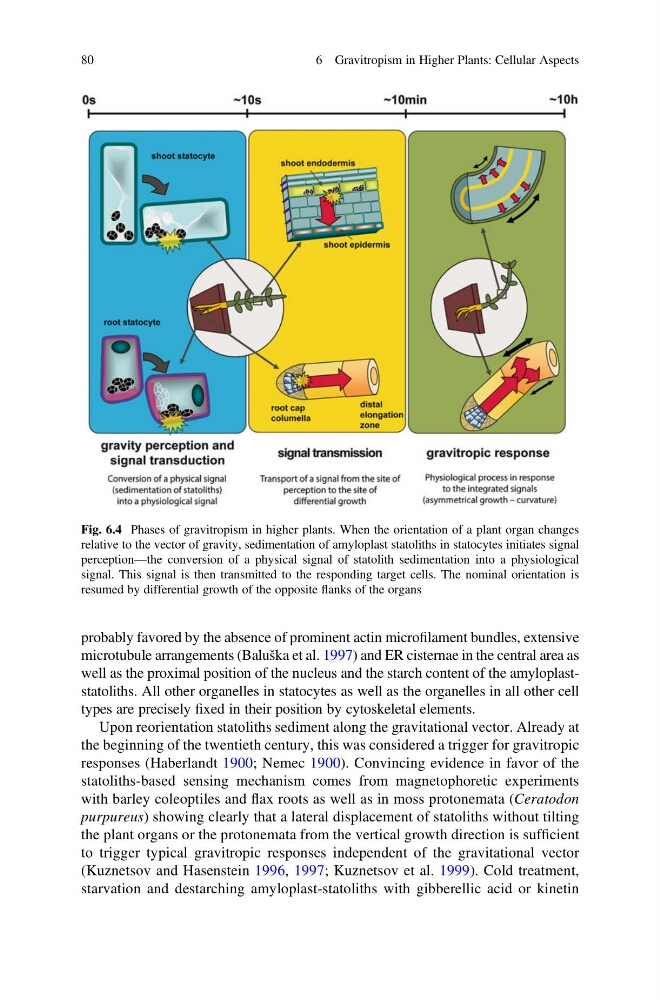
Fig. 6.4 Phases of gravitropism in higher plants. When the orientation of a plant organ changes
relative to the vector of gravity, sedimentation of amyloplast statoliths in statocytes initiates signal
perception—the conversion of a physical signal of statolith sedimentation into a physiological
signal. This signal is then transmitted to the responding target cells. The nominal orientation is
resumed by differential growth of the opposite flanks of the organs
80
6 Gravitropism in Higher Plants: Cellular Aspects
microtubule arrangements (Baluška et al. 1997) and ER cisternae in the central area as
well as the proximal position of the nucleus and the starch content of the amyloplaststatoliths. All other organelles in statocytes as well as the organelles in all other cell
types are precisely fixed in their position by cytoskeletal elements.
Upon reorientation statoliths sediment along the gravitational vector. Already at
the beginning of the twentieth century, this was considered a trigger for gravitropic
responses (Haberlandt 1900; Nemec 1900). Convincing evidence in favor of the
statoliths-based sensing mechanism comes from magnetophoretic experiments
with barley coleoptiles and flax roots as well as in moss protonemata (Ceratodon
purpureus) showing clearly that a lateral displacement of statoliths without tilting
the plant organs or the protonemata from the vertical growth direction is sufficient
to trigger typical gravitropic responses independent of the gravitational vector
(Kuznetsov and Hasenstein 1996, 1997; Kuznetsov et al. 1999). Cold treatment,
starvation and destarching amyloplast-statoliths with gibberellic acid or kinetin
Fig. 6.4 Phases of gravitropism in higher plants. When the orientation of a plant organ changes
relative to the vector of gravity, sedimentation of amyloplast statoliths in statocytes initiates signal
perception—the conversion of a physical signal of statolith sedimentation into a physiological
signal. This signal is then transmitted to the responding target cells. The nominal orientation is
resumed by differential growth of the opposite flanks of the organs
80
6 Gravitropism in Higher Plants: Cellular Aspects