

6.2.2 Starch-Statolith Hypothesis
The starch-statolith hypothesis for plant gravity sensing is widely accepted by most
researchers today. Statocytes are highly specialized gravity-sensing cells of higher
plants and are characterized by a polar architecture (first described in detail by Sievers
and Volkmann 1971, 1977) and the presence of starch-filled amyloplasts, the
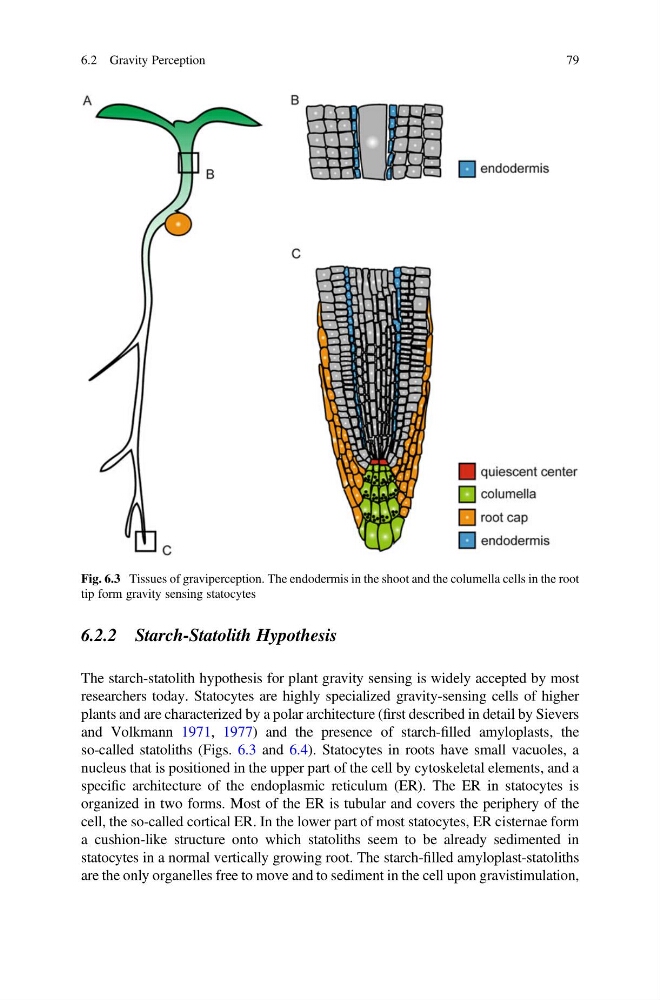
so-called statoliths (Figs. 6.3 and 6.4). Statocytes in roots have small vacuoles, a
nucleus that is positioned in the upper part of the cell by cytoskeletal elements, and a
specific architecture of the endoplasmic reticulum (ER). The ER in statocytes is
organized in two forms. Most of the ER is tubular and covers the periphery of the
cell, the so-called cortical ER. In the lower part of most statocytes, ER cisternae form
a cushion-like structure onto which statoliths seem to be already sedimented in
statocytes in a normal vertically growing root. The starch-filled amyloplast-statoliths
are the only organelles free to move and to sediment in the cell upon gravistimulation,
Fig. 6.3 Tissues of graviperception. The endodermis in the shoot and the columella cells in the root
tip form gravity sensing statocytes
6.2 Gravity Perception
79
The starch-statolith hypothesis for plant gravity sensing is widely accepted by most
researchers today. Statocytes are highly specialized gravity-sensing cells of higher
plants and are characterized by a polar architecture (first described in detail by Sievers
and Volkmann 1971, 1977) and the presence of starch-filled amyloplasts, the
so-called statoliths (Figs. 6.3 and 6.4). Statocytes in roots have small vacuoles, a
nucleus that is positioned in the upper part of the cell by cytoskeletal elements, and a
specific architecture of the endoplasmic reticulum (ER). The ER in statocytes is
organized in two forms. Most of the ER is tubular and covers the periphery of the
cell, the so-called cortical ER. In the lower part of most statocytes, ER cisternae form
a cushion-like structure onto which statoliths seem to be already sedimented in
statocytes in a normal vertically growing root. The starch-filled amyloplast-statoliths
are the only organelles free to move and to sediment in the cell upon gravistimulation,
Fig. 6.3 Tissues of graviperception. The endodermis in the shoot and the columella cells in the root
tip form gravity sensing statocytes
6.2 Gravity Perception
79