

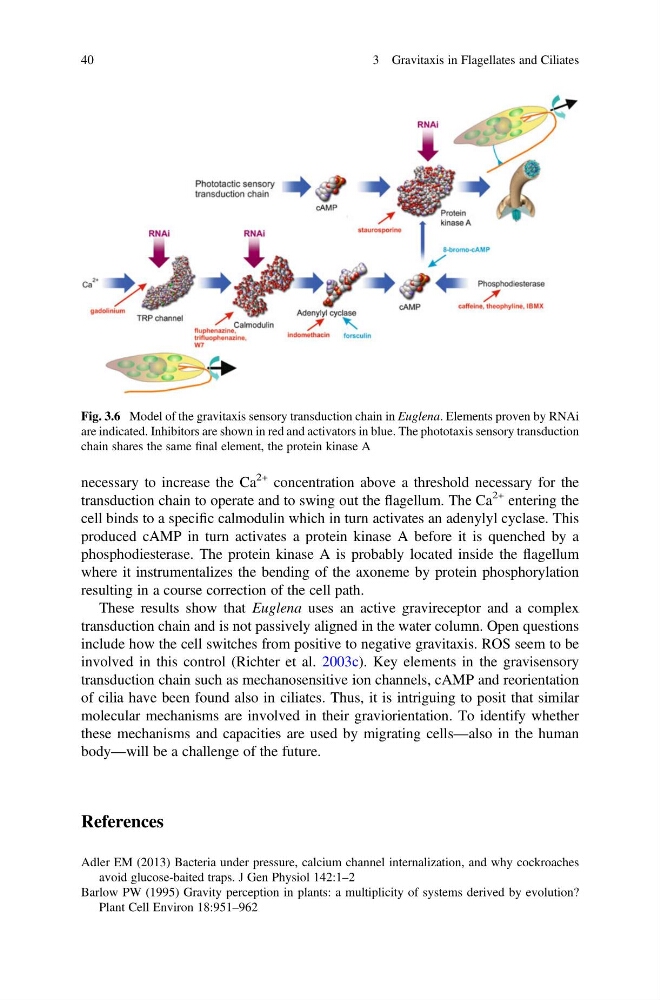
necessary to increase the Ca
2+ concentration above a threshold necessary for the
transduction chain to operate and to swing out the flagellum. The Ca
2+ entering the
cell binds to a specific calmodulin which in turn activates an adenylyl cyclase. This
produced cAMP in turn activates a protein kinase A before it is quenched by a
phosphodiesterase. The protein kinase A is probably located inside the flagellum
where it instrumentalizes the bending of the axoneme by protein phosphorylation
resulting in a course correction of the cell path.
These results show that Euglena uses an active gravireceptor and a complex
transduction chain and is not passively aligned in the water column. Open questions
include how the cell switches from positive to negative gravitaxis. ROS seem to be
involved in this control (Richter et al. 2003c). Key elements in the gravisensory
transduction chain such as mechanosensitive ion channels, cAMP and reorientation
of cilia have been found also in ciliates. Thus, it is intriguing to posit that similar
molecular mechanisms are involved in their graviorientation. To identify whether
these mechanisms and capacities are used by migrating cells—also in the human
body—will be a challenge of the future.
References
Adler EM (2013) Bacteria under pressure, calcium channel internalization, and why cockroaches
avoid glucose-baited traps. J Gen Physiol 142:1–2
Barlow PW (1995) Gravity perception in plants: a multiplicity of systems derived by evolution?
Plant Cell Environ 18:951–962
Fig. 3.6 Model of the gravitaxis sensory transduction chain in Euglena. Elements proven by RNAi
are indicated. Inhibitors are shown in red and activators in blue. The phototaxis sensory transduction
chain shares the same final element, the protein kinase A
40
3 Gravitaxis in Flagellates and Ciliates
2+ concentration above a threshold necessary for the
transduction chain to operate and to swing out the flagellum. The Ca
2+ entering the
cell binds to a specific calmodulin which in turn activates an adenylyl cyclase. This
produced cAMP in turn activates a protein kinase A before it is quenched by a
phosphodiesterase. The protein kinase A is probably located inside the flagellum
where it instrumentalizes the bending of the axoneme by protein phosphorylation
resulting in a course correction of the cell path.
These results show that Euglena uses an active gravireceptor and a complex
transduction chain and is not passively aligned in the water column. Open questions
include how the cell switches from positive to negative gravitaxis. ROS seem to be
involved in this control (Richter et al. 2003c). Key elements in the gravisensory
transduction chain such as mechanosensitive ion channels, cAMP and reorientation
of cilia have been found also in ciliates. Thus, it is intriguing to posit that similar
molecular mechanisms are involved in their graviorientation. To identify whether
these mechanisms and capacities are used by migrating cells—also in the human
body—will be a challenge of the future.
References
Adler EM (2013) Bacteria under pressure, calcium channel internalization, and why cockroaches
avoid glucose-baited traps. J Gen Physiol 142:1–2
Barlow PW (1995) Gravity perception in plants: a multiplicity of systems derived by evolution?
Plant Cell Environ 18:951–962
Fig. 3.6 Model of the gravitaxis sensory transduction chain in Euglena. Elements proven by RNAi
are indicated. Inhibitors are shown in red and activators in blue. The phototaxis sensory transduction
chain shares the same final element, the protein kinase A
40
3 Gravitaxis in Flagellates and Ciliates