

the cell membrane, induces intracellular signaling triggering an increase in cytosolic
Ca
2+ and in turn the reaction between luciferin and luciferase resulting in the
emission of light. Thus, the signal intensity provides valuable information about
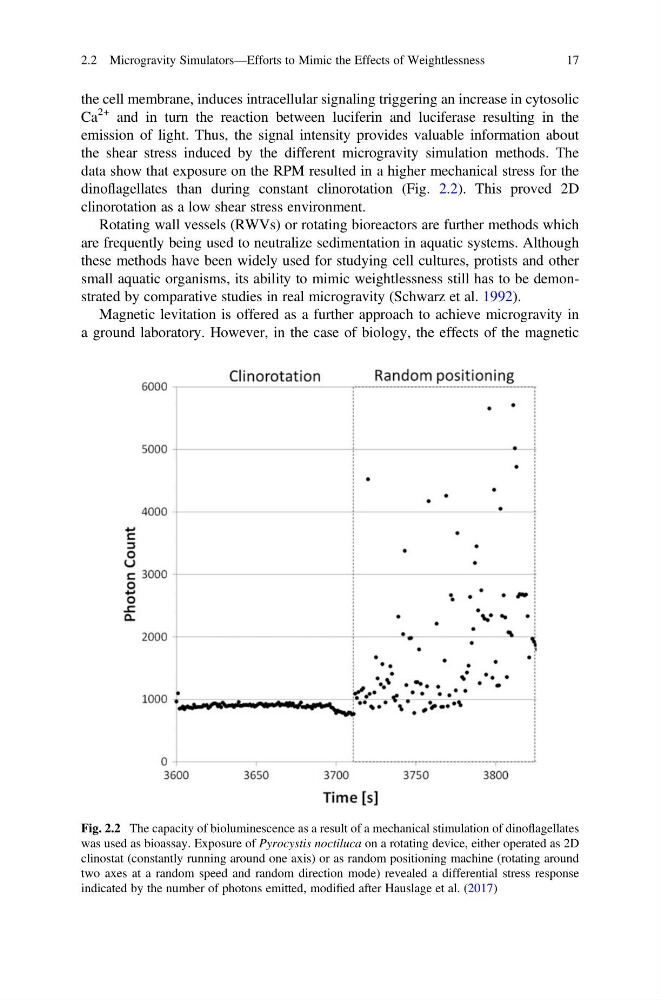
the shear stress induced by the different microgravity simulation methods. The
data show that exposure on the RPM resulted in a higher mechanical stress for the
dinoflagellates than during constant clinorotation (Fig. 2.2). This proved 2D
clinorotation as a low shear stress environment.
Rotating wall vessels (RWVs) or rotating bioreactors are further methods which
are frequently being used to neutralize sedimentation in aquatic systems. Although
these methods have been widely used for studying cell cultures, protists and other
small aquatic organisms, its ability to mimic weightlessness still has to be demonstrated by comparative studies in real microgravity (Schwarz et al. 1992).
Magnetic levitation is offered as a further approach to achieve microgravity in
a ground laboratory. However, in the case of biology, the effects of the magnetic
Fig. 2.2 The capacity of bioluminescence as a result of a mechanical stimulation of dinoflagellates
was used as bioassay. Exposure of Pyrocystis noctiluca on a rotating device, either operated as 2D
clinostat (constantly running around one axis) or as random positioning machine (rotating around
two axes at a random speed and random direction mode) revealed a differential stress response
indicated by the number of photons emitted, modified after Hauslage et al. (2017)
2.2 Microgravity Simulators—Efforts to Mimic the Effects of Weightlessness
17
Ca
2+ and in turn the reaction between luciferin and luciferase resulting in the
emission of light. Thus, the signal intensity provides valuable information about
the shear stress induced by the different microgravity simulation methods. The
data show that exposure on the RPM resulted in a higher mechanical stress for the
dinoflagellates than during constant clinorotation (Fig. 2.2). This proved 2D
clinorotation as a low shear stress environment.
Rotating wall vessels (RWVs) or rotating bioreactors are further methods which
are frequently being used to neutralize sedimentation in aquatic systems. Although
these methods have been widely used for studying cell cultures, protists and other
small aquatic organisms, its ability to mimic weightlessness still has to be demonstrated by comparative studies in real microgravity (Schwarz et al. 1992).
Magnetic levitation is offered as a further approach to achieve microgravity in
a ground laboratory. However, in the case of biology, the effects of the magnetic
Fig. 2.2 The capacity of bioluminescence as a result of a mechanical stimulation of dinoflagellates
was used as bioassay. Exposure of Pyrocystis noctiluca on a rotating device, either operated as 2D
clinostat (constantly running around one axis) or as random positioning machine (rotating around
two axes at a random speed and random direction mode) revealed a differential stress response
indicated by the number of photons emitted, modified after Hauslage et al. (2017)
2.2 Microgravity Simulators—Efforts to Mimic the Effects of Weightlessness
17