

clinostats and the Random Positioning Machines (RPM) have come into use. They
are characterized and operated with two independently rotating frames mounted
in a gimbal manner (Hoson et al. 1996; van Loon 2007). An algorithm controls the
motors with respect to acceleration or directional changes. Commonly, 3D clinostats
are continuously rotating but changing the velocity at random. In a RPM, not only
the velocity but in addition also the direction of rotation is randomized.
Comparative studies—also in real microgravity—are necessary to understand the
differences and to validate the quality of the simulation (Herranz et al. 2013). Here,
we will give some examples to demonstrate this kind of approach.
To critically assess the assumption whether a second rotation axis and sophisticated modes of operation provide a more perfect simulation, Krause et al. (2018)
studied the dynamics of the actin-dependent movements of statoliths in the rhizoids
of Chara (cf. Chap. 4). The role of gravity in this process was already investigated in
real microgravity in a MAXUS sounding rocket mission; thus, data for verification
and validation were available and could be compared to data from 2D and 3D
clinorotation. Fast rotational speeds in the range of 60–85 rpm in 2D and 3D
modes resulted in a similar kinetics of statolith displacement as compared to real
μg, while slower clinorotation (2–11 rpm) caused a reduced one. The addition of a
second rotation axis clearly did not increase the quality of microgravity simulation,
however, increased non-gravitational effects such as an increase in the level of
vibration (with multiple potential side effects). Thus, for Chara rhizoids, fast 2D
clinorotation is the most appropriate microgravity simulation method for investigating its graviperception mechanism.
Hauslage et al. (2017) visualized shear and hydrodynamic forces in various
ground-based facilities by using dinoflagellates as bioassay and mechanosensitive
reporter systems. Pyrocystis noctiluca populations were exposed on a Random
Positioning Machine either operating as 2D clinostat (constant rotation around one
axis with 60 rpm) or in a random positioning mode (two axes with random velocity
and direction). Shear stress due to hydrodynamic forces leads to a deformation of
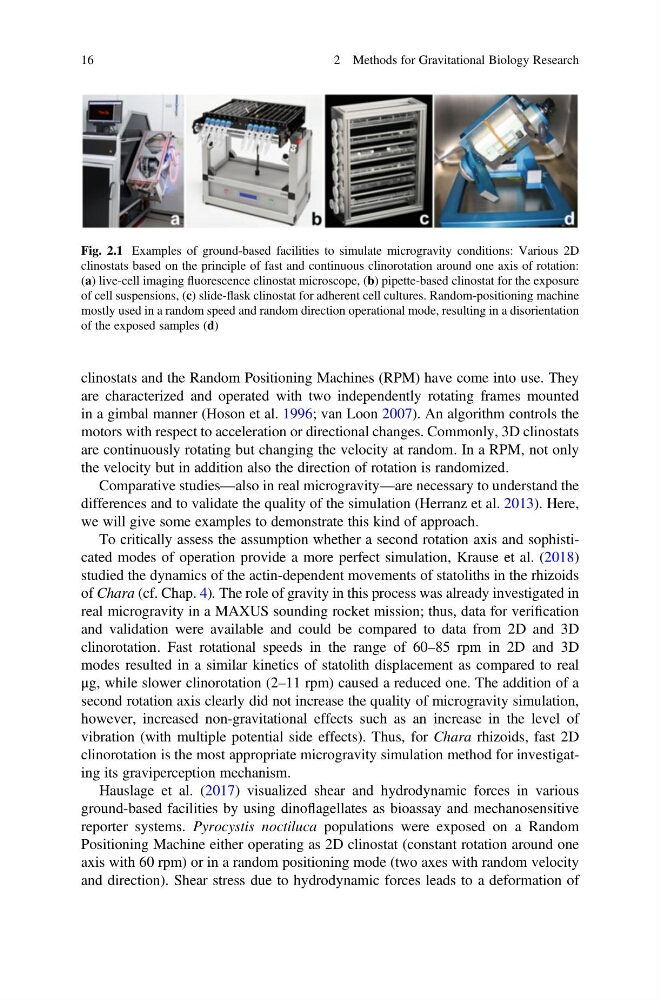
Fig. 2.1 Examples of ground-based facilities to simulate microgravity conditions: Various 2D
clinostats based on the principle of fast and continuous clinorotation around one axis of rotation:
(a) live-cell imaging fluorescence clinostat microscope, (b) pipette-based clinostat for the exposure
of cell suspensions, (c) slide-flask clinostat for adherent cell cultures. Random-positioning machine
mostly used in a random speed and random direction operational mode, resulting in a disorientation
of the exposed samples (d)
16
2 Methods for Gravitational Biology Research
are characterized and operated with two independently rotating frames mounted
in a gimbal manner (Hoson et al. 1996; van Loon 2007). An algorithm controls the
motors with respect to acceleration or directional changes. Commonly, 3D clinostats
are continuously rotating but changing the velocity at random. In a RPM, not only
the velocity but in addition also the direction of rotation is randomized.
Comparative studies—also in real microgravity—are necessary to understand the
differences and to validate the quality of the simulation (Herranz et al. 2013). Here,
we will give some examples to demonstrate this kind of approach.
To critically assess the assumption whether a second rotation axis and sophisticated modes of operation provide a more perfect simulation, Krause et al. (2018)
studied the dynamics of the actin-dependent movements of statoliths in the rhizoids
of Chara (cf. Chap. 4). The role of gravity in this process was already investigated in
real microgravity in a MAXUS sounding rocket mission; thus, data for verification
and validation were available and could be compared to data from 2D and 3D
clinorotation. Fast rotational speeds in the range of 60–85 rpm in 2D and 3D
modes resulted in a similar kinetics of statolith displacement as compared to real
μg, while slower clinorotation (2–11 rpm) caused a reduced one. The addition of a
second rotation axis clearly did not increase the quality of microgravity simulation,
however, increased non-gravitational effects such as an increase in the level of
vibration (with multiple potential side effects). Thus, for Chara rhizoids, fast 2D
clinorotation is the most appropriate microgravity simulation method for investigating its graviperception mechanism.
Hauslage et al. (2017) visualized shear and hydrodynamic forces in various
ground-based facilities by using dinoflagellates as bioassay and mechanosensitive
reporter systems. Pyrocystis noctiluca populations were exposed on a Random
Positioning Machine either operating as 2D clinostat (constant rotation around one
axis with 60 rpm) or in a random positioning mode (two axes with random velocity
and direction). Shear stress due to hydrodynamic forces leads to a deformation of
Fig. 2.1 Examples of ground-based facilities to simulate microgravity conditions: Various 2D
clinostats based on the principle of fast and continuous clinorotation around one axis of rotation:
(a) live-cell imaging fluorescence clinostat microscope, (b) pipette-based clinostat for the exposure
of cell suspensions, (c) slide-flask clinostat for adherent cell cultures. Random-positioning machine
mostly used in a random speed and random direction operational mode, resulting in a disorientation
of the exposed samples (d)
16
2 Methods for Gravitational Biology Research