

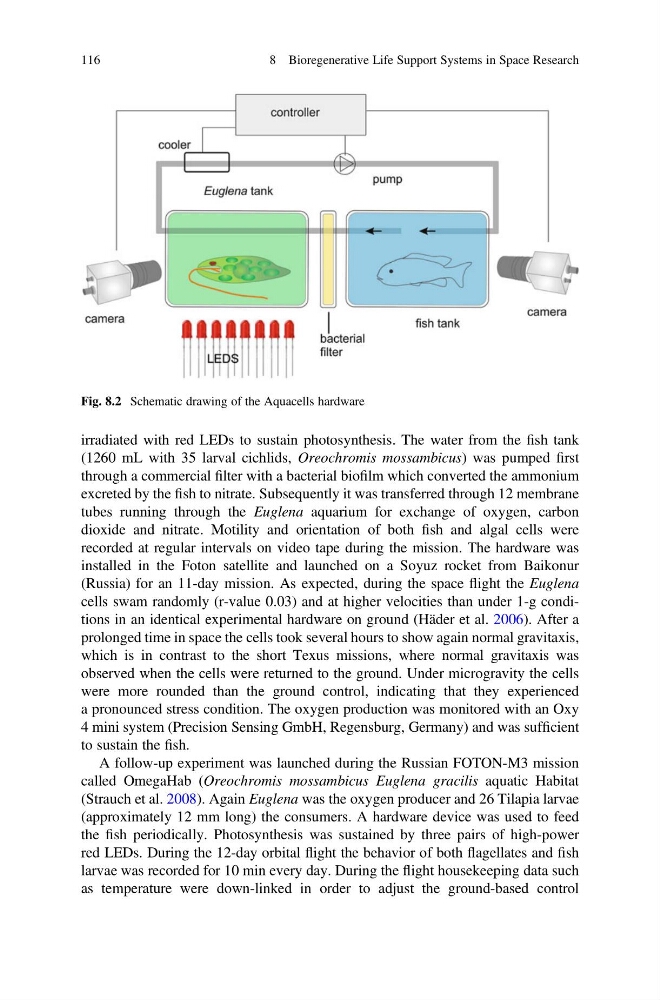
irradiated with red LEDs to sustain photosynthesis. The water from the fish tank
(1260 mL with 35 larval cichlids, Oreochromis mossambicus) was pumped first
through a commercial filter with a bacterial biofilm which converted the ammonium
excreted by the fish to nitrate. Subsequently it was transferred through 12 membrane
tubes running through the Euglena aquarium for exchange of oxygen, carbon
dioxide and nitrate. Motility and orientation of both fish and algal cells were
recorded at regular intervals on video tape during the mission. The hardware was
installed in the Foton satellite and launched on a Soyuz rocket from Baikonur
(Russia) for an 11-day mission. As expected, during the space flight the Euglena
cells swam randomly (r-value 0.03) and at higher velocities than under 1-g conditions in an identical experimental hardware on ground (Häder et al. 2006). After a
prolonged time in space the cells took several hours to show again normal gravitaxis,
which is in contrast to the short Texus missions, where normal gravitaxis was
observed when the cells were returned to the ground. Under microgravity the cells
were more rounded than the ground control, indicating that they experienced
a pronounced stress condition. The oxygen production was monitored with an Oxy
4 mini system (Precision Sensing GmbH, Regensburg, Germany) and was sufficient
to sustain the fish.
A follow-up experiment was launched during the Russian FOTON-M3 mission
called OmegaHab (Oreochromis mossambicus Euglena gracilis aquatic Habitat
(Strauch et al. 2008). Again Euglena was the oxygen producer and 26 Tilapia larvae
(approximately 12 mm long) the consumers. A hardware device was used to feed
the fish periodically. Photosynthesis was sustained by three pairs of high-power
red LEDs. During the 12-day orbital flight the behavior of both flagellates and fish
larvae was recorded for 10 min every day. During the flight housekeeping data such
as temperature were down-linked in order to adjust the ground-based control
Fig. 8.2 Schematic drawing of the Aquacells hardware
116
8 Bioregenerative Life Support Systems in Space Research
(1260 mL with 35 larval cichlids, Oreochromis mossambicus) was pumped first
through a commercial filter with a bacterial biofilm which converted the ammonium
excreted by the fish to nitrate. Subsequently it was transferred through 12 membrane
tubes running through the Euglena aquarium for exchange of oxygen, carbon
dioxide and nitrate. Motility and orientation of both fish and algal cells were
recorded at regular intervals on video tape during the mission. The hardware was
installed in the Foton satellite and launched on a Soyuz rocket from Baikonur
(Russia) for an 11-day mission. As expected, during the space flight the Euglena
cells swam randomly (r-value 0.03) and at higher velocities than under 1-g conditions in an identical experimental hardware on ground (Häder et al. 2006). After a
prolonged time in space the cells took several hours to show again normal gravitaxis,
which is in contrast to the short Texus missions, where normal gravitaxis was
observed when the cells were returned to the ground. Under microgravity the cells
were more rounded than the ground control, indicating that they experienced
a pronounced stress condition. The oxygen production was monitored with an Oxy
4 mini system (Precision Sensing GmbH, Regensburg, Germany) and was sufficient
to sustain the fish.
A follow-up experiment was launched during the Russian FOTON-M3 mission
called OmegaHab (Oreochromis mossambicus Euglena gracilis aquatic Habitat
(Strauch et al. 2008). Again Euglena was the oxygen producer and 26 Tilapia larvae
(approximately 12 mm long) the consumers. A hardware device was used to feed
the fish periodically. Photosynthesis was sustained by three pairs of high-power
red LEDs. During the 12-day orbital flight the behavior of both flagellates and fish
larvae was recorded for 10 min every day. During the flight housekeeping data such
as temperature were down-linked in order to adjust the ground-based control
Fig. 8.2 Schematic drawing of the Aquacells hardware
116
8 Bioregenerative Life Support Systems in Space Research