

there was no pronounced increase in the concentration of cells which were in a
stationary phase. The chlorophyll a concentration was measured at 675 nm and
calculated per cell. The initial concentration decreased first slowly and then at a
faster pace. After 540 d it had fallen to 64% of the initial value.
Euglena gracilis shows a pronounced negative gravitaxis (cf. Chap. 3) which was
very precise shortly after inoculation as indicated by r-values !0.8. The precision of
orientation dropped to an r-value of about 0.3 and with increasing culture age
decreased to below 0.2 which is regarded to indicate random orientation.
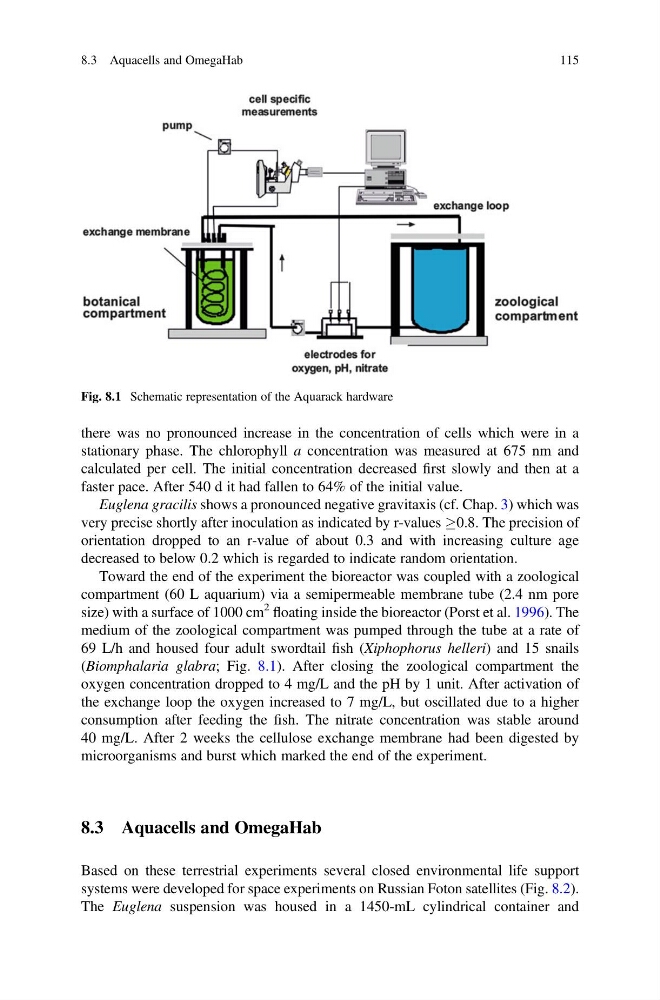
Toward the end of the experiment the bioreactor was coupled with a zoological
compartment (60 L aquarium) via a semipermeable membrane tube (2.4 nm pore
size) with a surface of 1000 cm
2
floating inside the bioreactor (Porst et al. 1996). The
medium of the zoological compartment was pumped through the tube at a rate of
69 L/h and housed four adult swordtail fish (Xiphophorus helleri) and 15 snails
(Biomphalaria glabra; Fig. 8.1). After closing the zoological compartment the
oxygen concentration dropped to 4 mg/L and the pH by 1 unit. After activation of
the exchange loop the oxygen increased to 7 mg/L, but oscillated due to a higher
consumption after feeding the fish. The nitrate concentration was stable around
40 mg/L. After 2 weeks the cellulose exchange membrane had been digested by
microorganisms and burst which marked the end of the experiment.
8.3 Aquacells and OmegaHab
Based on these terrestrial experiments several closed environmental life support
systems were developed for space experiments on Russian Foton satellites (Fig. 8.2).
The Euglena suspension was housed in a 1450-mL cylindrical container and
Fig. 8.1 Schematic representation of the Aquarack hardware
8.3 Aquacells and OmegaHab
115
stationary phase. The chlorophyll a concentration was measured at 675 nm and
calculated per cell. The initial concentration decreased first slowly and then at a
faster pace. After 540 d it had fallen to 64% of the initial value.
Euglena gracilis shows a pronounced negative gravitaxis (cf. Chap. 3) which was
very precise shortly after inoculation as indicated by r-values !0.8. The precision of
orientation dropped to an r-value of about 0.3 and with increasing culture age
decreased to below 0.2 which is regarded to indicate random orientation.
Toward the end of the experiment the bioreactor was coupled with a zoological
compartment (60 L aquarium) via a semipermeable membrane tube (2.4 nm pore
size) with a surface of 1000 cm
2
floating inside the bioreactor (Porst et al. 1996). The
medium of the zoological compartment was pumped through the tube at a rate of
69 L/h and housed four adult swordtail fish (Xiphophorus helleri) and 15 snails
(Biomphalaria glabra; Fig. 8.1). After closing the zoological compartment the
oxygen concentration dropped to 4 mg/L and the pH by 1 unit. After activation of
the exchange loop the oxygen increased to 7 mg/L, but oscillated due to a higher
consumption after feeding the fish. The nitrate concentration was stable around
40 mg/L. After 2 weeks the cellulose exchange membrane had been digested by
microorganisms and burst which marked the end of the experiment.
8.3 Aquacells and OmegaHab
Based on these terrestrial experiments several closed environmental life support
systems were developed for space experiments on Russian Foton satellites (Fig. 8.2).
The Euglena suspension was housed in a 1450-mL cylindrical container and
Fig. 8.1 Schematic representation of the Aquarack hardware
8.3 Aquacells and OmegaHab
115