

40
caveolin-1, and β-catenin) was significantly decreased on stiffer substrates [47].
Although glycated collagen culture models have shown that sprouting angiogenesis
was delayed in stiff collagen gels [12], nonenzymatic glycation approach has shown
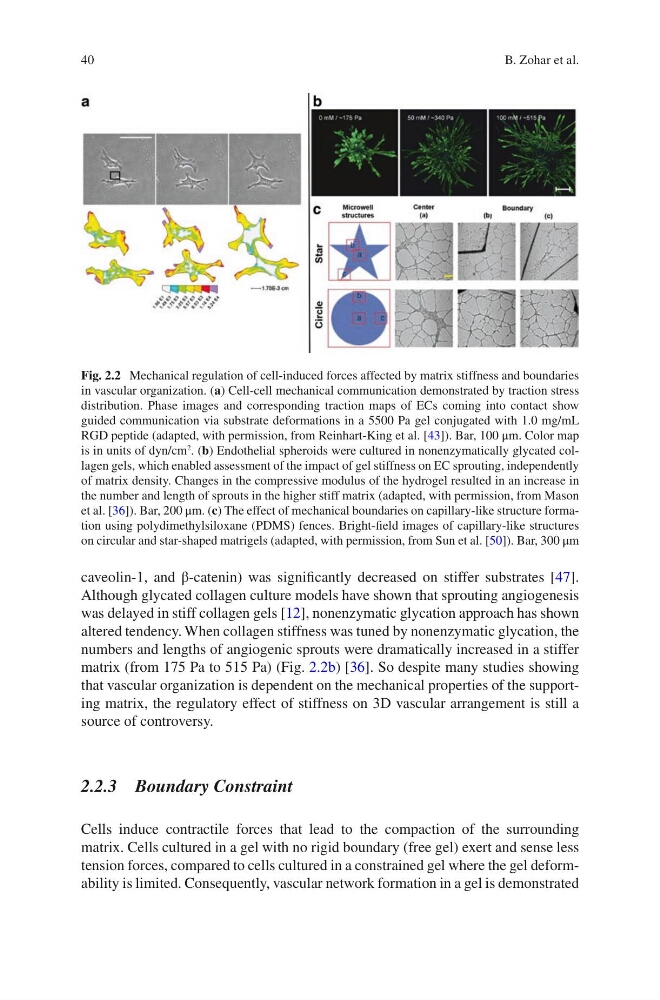
altered tendency. When collagen stiffness was tuned by nonenzymatic glycation, the
numbers and lengths of angiogenic sprouts were dramatically increased in a stiffer
matrix (from 175 Pa to 515 Pa) (Fig. 2.2b) [36]. So despite many studies showing
that vascular organization is dependent on the mechanical properties of the supporting matrix, the regulatory effect of stiffness on 3D vascular arrangement is still a
source of controversy.
2.2.3 Boundary Constraint
Cells induce contractile forces that lead to the compaction of the surrounding
matrix. Cells cultured in a gel with no rigid boundary (free gel) exert and sense less
tension forces, compared to cells cultured in a constrained gel where the gel deformability is limited. Consequently, vascular network formation in a gel is demonstrated
Fig. 2.2 Mechanical regulation of cell-induced forces affected by matrix stiffness and boundaries
in vascular organization. (a) Cell-cell mechanical communication demonstrated by traction stress
distribution. Phase images and corresponding traction maps of ECs coming into contact show
guided communication via substrate deformations in a 5500 Pa gel conjugated with 1.0 mg/mL
RGD peptide (adapted, with permission, from Reinhart-King et al. [43]). Bar, 100 μm. Color map
is in units of dyn/cm
2 . (b) Endothelial spheroids were cultured in nonenzymatically glycated collagen gels, which enabled assessment of the impact of gel stiffness on EC sprouting, independently
of matrix density. Changes in the compressive modulus of the hydrogel resulted in an increase in
the number and length of sprouts in the higher stiff matrix (adapted, with permission, from Mason
et al. [36]). Bar, 200 μm. (c) The effect of mechanical boundaries on capillary-like structure formation using polydimethylsiloxane (PDMS) fences. Bright-field images of capillary-like structures
on circular and star-shaped matrigels (adapted, with permission, from Sun et al. [50]). Bar, 300 μm
B. Zohar et al.
caveolin-1, and β-catenin) was significantly decreased on stiffer substrates [47].
Although glycated collagen culture models have shown that sprouting angiogenesis
was delayed in stiff collagen gels [12], nonenzymatic glycation approach has shown
altered tendency. When collagen stiffness was tuned by nonenzymatic glycation, the
numbers and lengths of angiogenic sprouts were dramatically increased in a stiffer
matrix (from 175 Pa to 515 Pa) (Fig. 2.2b) [36]. So despite many studies showing
that vascular organization is dependent on the mechanical properties of the supporting matrix, the regulatory effect of stiffness on 3D vascular arrangement is still a
source of controversy.
2.2.3 Boundary Constraint
Cells induce contractile forces that lead to the compaction of the surrounding
matrix. Cells cultured in a gel with no rigid boundary (free gel) exert and sense less
tension forces, compared to cells cultured in a constrained gel where the gel deformability is limited. Consequently, vascular network formation in a gel is demonstrated
Fig. 2.2 Mechanical regulation of cell-induced forces affected by matrix stiffness and boundaries
in vascular organization. (a) Cell-cell mechanical communication demonstrated by traction stress
distribution. Phase images and corresponding traction maps of ECs coming into contact show
guided communication via substrate deformations in a 5500 Pa gel conjugated with 1.0 mg/mL
RGD peptide (adapted, with permission, from Reinhart-King et al. [43]). Bar, 100 μm. Color map
is in units of dyn/cm
2 . (b) Endothelial spheroids were cultured in nonenzymatically glycated collagen gels, which enabled assessment of the impact of gel stiffness on EC sprouting, independently
of matrix density. Changes in the compressive modulus of the hydrogel resulted in an increase in
the number and length of sprouts in the higher stiff matrix (adapted, with permission, from Mason
et al. [36]). Bar, 200 μm. (c) The effect of mechanical boundaries on capillary-like structure formation using polydimethylsiloxane (PDMS) fences. Bright-field images of capillary-like structures
on circular and star-shaped matrigels (adapted, with permission, from Sun et al. [50]). Bar, 300 μm
B. Zohar et al.