

39
Boundary Constraint
Mechanical Cues in an Engineered Microvessel
External Fluid Shear Stress
External Tensile
Forces
EC
Pericytes
Matrix
Scaffold
Flow-Induced
Luminal Wall
Shear Stress
Cell-induced
Contractile Forces
Matrix Stiffness
Pressure-Induced
Circumferential
Stretch
Lumen
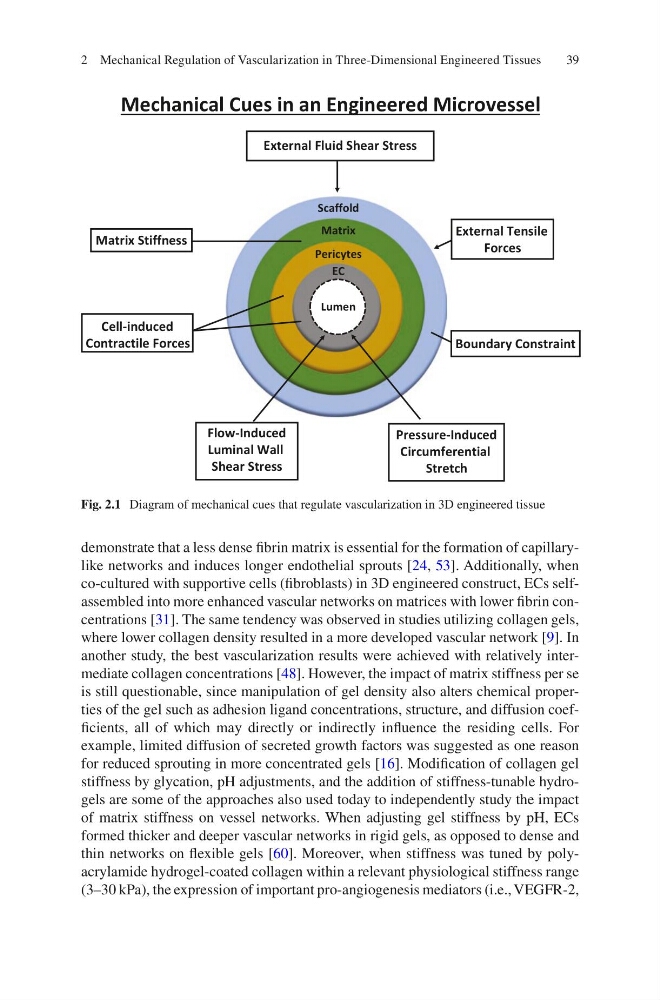
Fig. 2.1 Diagram of mechanical cues that regulate vascularization in 3D engineered tissue
demonstrate that a less dense fibrin matrix is essential for the formation of capillarylike networks and induces longer endothelial sprouts [24, 53]. Additionally, when
co- cultured with supportive cells (fibroblasts) in 3D engineered construct, ECs selfassembled into more enhanced vascular networks on matrices with lower fibrin concentrations [31]. The same tendency was observed in studies utilizing collagen gels,
where lower collagen density resulted in a more developed vascular network [9]. In
another study, the best vascularization results were achieved with relatively intermediate collagen concentrations [48]. However, the impact of matrix stiffness per se
is still questionable, since manipulation of gel density also alters chemical properties of the gel such as adhesion ligand concentrations, structure, and diffusion coefficients, all of which may directly or indirectly influence the residing cells. For
example, limited diffusion of secreted growth factors was suggested as one reason
for reduced sprouting in more concentrated gels [16]. Modification of collagen gel
stiffness by glycation, pH adjustments, and the addition of stiffness-tunable hydrogels are some of the approaches also used today to independently study the impact
of matrix stiffness on vessel networks. When adjusting gel stiffness by pH, ECs
formed thicker and deeper vascular networks in rigid gels, as opposed to dense and
thin networks on flexible gels [60]. Moreover, when stiffness was tuned by polyacrylamide hydrogel-coated collagen within a relevant physiological stiffness range
(3–30 kPa), the expression of important pro-angiogenesis mediators (i.e., VEGFR- 2,
2 Mechanical Regulation of Vascularization in Three-Dimensional Engineered Tissues
Boundary Constraint
Mechanical Cues in an Engineered Microvessel
External Fluid Shear Stress
External Tensile
Forces
EC
Pericytes
Matrix
Scaffold
Flow-Induced
Luminal Wall
Shear Stress
Cell-induced
Contractile Forces
Matrix Stiffness
Pressure-Induced
Circumferential
Stretch
Lumen
Fig. 2.1 Diagram of mechanical cues that regulate vascularization in 3D engineered tissue
demonstrate that a less dense fibrin matrix is essential for the formation of capillarylike networks and induces longer endothelial sprouts [24, 53]. Additionally, when
co- cultured with supportive cells (fibroblasts) in 3D engineered construct, ECs selfassembled into more enhanced vascular networks on matrices with lower fibrin concentrations [31]. The same tendency was observed in studies utilizing collagen gels,
where lower collagen density resulted in a more developed vascular network [9]. In
another study, the best vascularization results were achieved with relatively intermediate collagen concentrations [48]. However, the impact of matrix stiffness per se
is still questionable, since manipulation of gel density also alters chemical properties of the gel such as adhesion ligand concentrations, structure, and diffusion coefficients, all of which may directly or indirectly influence the residing cells. For
example, limited diffusion of secreted growth factors was suggested as one reason
for reduced sprouting in more concentrated gels [16]. Modification of collagen gel
stiffness by glycation, pH adjustments, and the addition of stiffness-tunable hydrogels are some of the approaches also used today to independently study the impact
of matrix stiffness on vessel networks. When adjusting gel stiffness by pH, ECs
formed thicker and deeper vascular networks in rigid gels, as opposed to dense and
thin networks on flexible gels [60]. Moreover, when stiffness was tuned by polyacrylamide hydrogel-coated collagen within a relevant physiological stiffness range
(3–30 kPa), the expression of important pro-angiogenesis mediators (i.e., VEGFR- 2,
2 Mechanical Regulation of Vascularization in Three-Dimensional Engineered Tissues