

101
tion [41, 131, 133]. Additional parameters that need to be considered in vivo are the
vascularization of the tissue and the transport of O 2 via hemoglobin proteins, making the concentration of hemoglobin another essential factor for determining the
oxygenation of the tissue. Studies take these additional factors into account using
the following equation:
D
C
V z
C
N
O
j
O
j
z
O
j
O
2
2
2
2
2
∇
=
∂
∂
+
ϕ
(4.6)
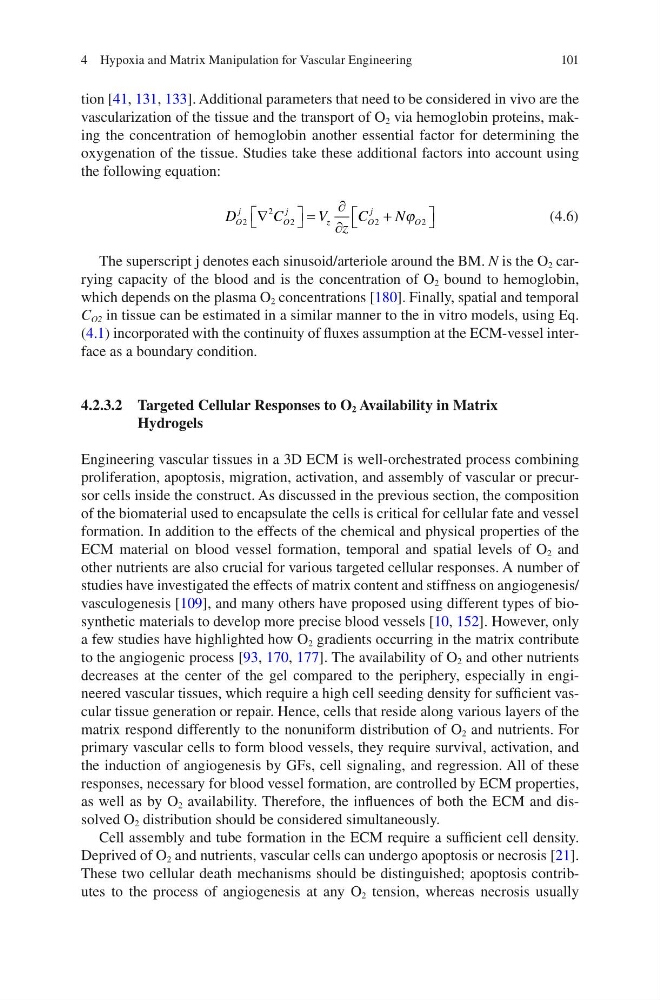
The superscript j denotes each sinusoid/arteriole around the BM. N is the O 2 carrying capacity of the blood and is the concentration of O 2 bound to hemoglobin,
which depends on the plasma O 2 concentrations [180]. Finally, spatial and temporal
C O2 in tissue can be estimated in a similar manner to the in vitro models, using Eq.
(4.1) incorporated with the continuity of fluxes assumption at the ECM-vessel interface as a boundary condition.
4.2.3.2 Targeted Cellular Responses to O 2 Availability in Matrix
Hydrogels
Engineering vascular tissues in a 3D ECM is well-orchestrated process combining
proliferation, apoptosis, migration, activation, and assembly of vascular or precursor cells inside the construct. As discussed in the previous section, the composition
of the biomaterial used to encapsulate the cells is critical for cellular fate and vessel
formation. In addition to the effects of the chemical and physical properties of the
ECM material on blood vessel formation, temporal and spatial levels of O 2 and
other nutrients are also crucial for various targeted cellular responses. A number of
studies have investigated the effects of matrix content and stiffness on angiogenesis/
vasculogenesis [109], and many others have proposed using different types of biosynthetic materials to develop more precise blood vessels [10, 152]. However, only
a few studies have highlighted how O 2 gradients occurring in the matrix contribute
to the angiogenic process [93, 170, 177]. The availability of O 2 and other nutrients
decreases at the center of the gel compared to the periphery, especially in engineered vascular tissues, which require a high cell seeding density for sufficient vascular tissue generation or repair. Hence, cells that reside along various layers of the
matrix respond differently to the nonuniform distribution of O 2 and nutrients. For
primary vascular cells to form blood vessels, they require survival, activation, and
the induction of angiogenesis by GFs, cell signaling, and regression. All of these
responses, necessary for blood vessel formation, are controlled by ECM properties,
as well as by O 2 availability. Therefore, the influences of both the ECM and dissolved O 2 distribution should be considered simultaneously.
Cell assembly and tube formation in the ECM require a sufficient cell density.
Deprived of O 2 and nutrients, vascular cells can undergo apoptosis or necrosis [21].
These two cellular death mechanisms should be distinguished; apoptosis contributes to the process of angiogenesis at any O 2 tension, whereas necrosis usually
4 Hypoxia and Matrix Manipulation for Vascular Engineering
tion [41, 131, 133]. Additional parameters that need to be considered in vivo are the
vascularization of the tissue and the transport of O 2 via hemoglobin proteins, making the concentration of hemoglobin another essential factor for determining the
oxygenation of the tissue. Studies take these additional factors into account using
the following equation:
D
C
V z
C
N
O
j
O
j
z
O
j
O
2
2
2
2
2
∇
=
∂
∂
+
ϕ
(4.6)
The superscript j denotes each sinusoid/arteriole around the BM. N is the O 2 carrying capacity of the blood and is the concentration of O 2 bound to hemoglobin,
which depends on the plasma O 2 concentrations [180]. Finally, spatial and temporal
C O2 in tissue can be estimated in a similar manner to the in vitro models, using Eq.
(4.1) incorporated with the continuity of fluxes assumption at the ECM-vessel interface as a boundary condition.
4.2.3.2 Targeted Cellular Responses to O 2 Availability in Matrix
Hydrogels
Engineering vascular tissues in a 3D ECM is well-orchestrated process combining
proliferation, apoptosis, migration, activation, and assembly of vascular or precursor cells inside the construct. As discussed in the previous section, the composition
of the biomaterial used to encapsulate the cells is critical for cellular fate and vessel
formation. In addition to the effects of the chemical and physical properties of the
ECM material on blood vessel formation, temporal and spatial levels of O 2 and
other nutrients are also crucial for various targeted cellular responses. A number of
studies have investigated the effects of matrix content and stiffness on angiogenesis/
vasculogenesis [109], and many others have proposed using different types of biosynthetic materials to develop more precise blood vessels [10, 152]. However, only
a few studies have highlighted how O 2 gradients occurring in the matrix contribute
to the angiogenic process [93, 170, 177]. The availability of O 2 and other nutrients
decreases at the center of the gel compared to the periphery, especially in engineered vascular tissues, which require a high cell seeding density for sufficient vascular tissue generation or repair. Hence, cells that reside along various layers of the
matrix respond differently to the nonuniform distribution of O 2 and nutrients. For
primary vascular cells to form blood vessels, they require survival, activation, and
the induction of angiogenesis by GFs, cell signaling, and regression. All of these
responses, necessary for blood vessel formation, are controlled by ECM properties,
as well as by O 2 availability. Therefore, the influences of both the ECM and dissolved O 2 distribution should be considered simultaneously.
Cell assembly and tube formation in the ECM require a sufficient cell density.
Deprived of O 2 and nutrients, vascular cells can undergo apoptosis or necrosis [21].
These two cellular death mechanisms should be distinguished; apoptosis contributes to the process of angiogenesis at any O 2 tension, whereas necrosis usually
4 Hypoxia and Matrix Manipulation for Vascular Engineering