

as for most of the biological materials, diffraction effects are weak and to a good
approximation the magnitude and angular distribution of the scattering reflect
simply the number and sort of scattering atoms. This approximation holds at least in
thin samples where multiple scattering effects are small. We therefore start our
discussion of the electron-specimen interaction with the single-scattering approximation for independent atoms (i.e., the “thin specimen limit”).
The differential scattering cross-section conveniently describes the angular distribution of scattering from a target atom. For elastic scattering, the differential
cross-section follows the Rutherford formula for the screened Coulomb potential of
the nuclear charge [21]. For fast electrons, the largest contribution to the total elastic
scattering cross-section r el stems from forward scattering and depends on the
screening of the nuclear charge by shell electrons. In the Wentzel approximation,
the nuclear charge is screened by an exponential term with the shielding parameter
R. The statistical Thomas-Fermi model yields R = a H Z
−1/3 with the Bohr radius
a H = 0.0529 nm. In this shielding approximation the differential cross-section for
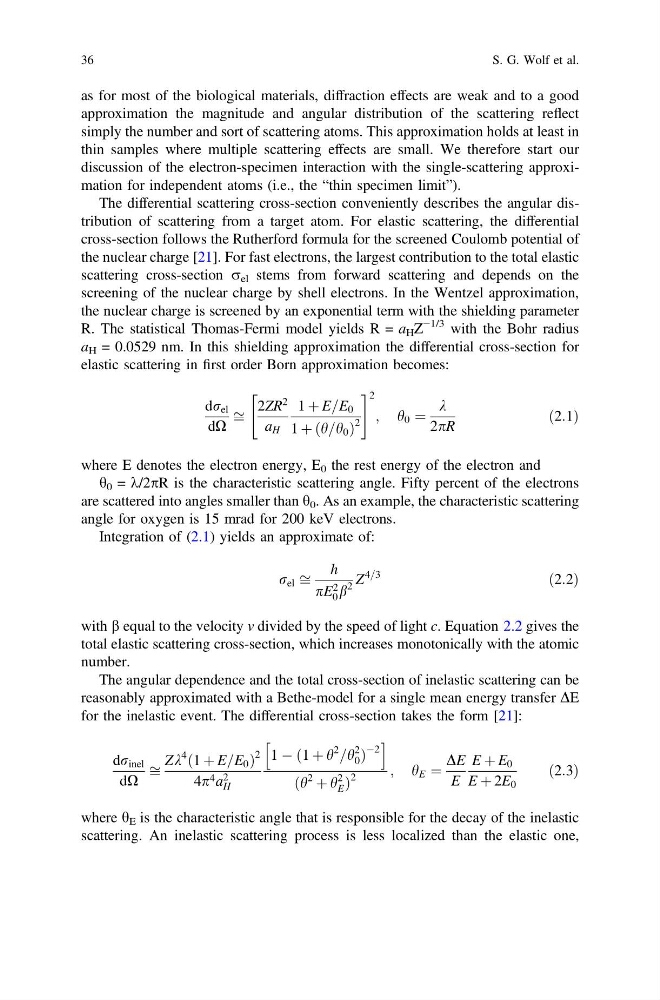
elastic scattering in first order Born approximation becomes:
dr el
dX
ffi
2ZR
2
a H
1 þ E=E 0
1 þ ðh=h 0 Þ
2
"
# 2
; h 0 ¼
k
2pR
ð2:1Þ
where E denotes the electron energy, E 0 the rest energy of the electron and
h 0 = k/2pR is the characteristic scattering angle. Fifty percent of the electrons
are scattered into angles smaller than h 0 . As an example, the characteristic scattering
angle for oxygen is 15 mrad for 200 keV electrons.
Integration of (2.1) yields an approximate of:
r el ffi
h
pE 2
0 b
2
Z
4=3
ð2:2Þ
with b equal to the velocity v divided by the speed of light c. Equation 2.2 gives the
total elastic scattering cross-section, which increases monotonically with the atomic
number.
The angular dependence and the total cross-section of inelastic scattering can be
reasonably approximated with a Bethe-model for a single mean energy transfer DE
for the inelastic event. The differential cross-section takes the form [21]:
dr inel
dX
ffi
Zk
4
ð1 þ E=E 0 Þ
2
4p 4 a 2
H
1 À ð1 þ h
2
=h
2
0 Þ
À2
h
i
ðh
2
þ h
2
E Þ
2
; h E ¼
DE
E
E þ E 0
E þ 2E 0
ð2:3Þ
where h E is the characteristic angle that is responsible for the decay of the inelastic
scattering. An inelastic scattering process is less localized than the elastic one,
36
S. G. Wolf et al.
approximation the magnitude and angular distribution of the scattering reflect
simply the number and sort of scattering atoms. This approximation holds at least in
thin samples where multiple scattering effects are small. We therefore start our
discussion of the electron-specimen interaction with the single-scattering approximation for independent atoms (i.e., the “thin specimen limit”).
The differential scattering cross-section conveniently describes the angular distribution of scattering from a target atom. For elastic scattering, the differential
cross-section follows the Rutherford formula for the screened Coulomb potential of
the nuclear charge [21]. For fast electrons, the largest contribution to the total elastic
scattering cross-section r el stems from forward scattering and depends on the
screening of the nuclear charge by shell electrons. In the Wentzel approximation,
the nuclear charge is screened by an exponential term with the shielding parameter
R. The statistical Thomas-Fermi model yields R = a H Z
−1/3 with the Bohr radius
a H = 0.0529 nm. In this shielding approximation the differential cross-section for
elastic scattering in first order Born approximation becomes:
dr el
dX
ffi
2ZR
2
a H
1 þ E=E 0
1 þ ðh=h 0 Þ
2
"
# 2
; h 0 ¼
k
2pR
ð2:1Þ
where E denotes the electron energy, E 0 the rest energy of the electron and
h 0 = k/2pR is the characteristic scattering angle. Fifty percent of the electrons
are scattered into angles smaller than h 0 . As an example, the characteristic scattering
angle for oxygen is 15 mrad for 200 keV electrons.
Integration of (2.1) yields an approximate of:
r el ffi
h
pE 2
0 b
2
Z
4=3
ð2:2Þ
with b equal to the velocity v divided by the speed of light c. Equation 2.2 gives the
total elastic scattering cross-section, which increases monotonically with the atomic
number.
The angular dependence and the total cross-section of inelastic scattering can be
reasonably approximated with a Bethe-model for a single mean energy transfer DE
for the inelastic event. The differential cross-section takes the form [21]:
dr inel
dX
ffi
Zk
4
ð1 þ E=E 0 Þ
2
4p 4 a 2
H
1 À ð1 þ h
2
=h
2
0 Þ
À2
h
i
ðh
2
þ h
2
E Þ
2
; h E ¼
DE
E
E þ E 0
E þ 2E 0
ð2:3Þ
where h E is the characteristic angle that is responsible for the decay of the inelastic
scattering. An inelastic scattering process is less localized than the elastic one,
36
S. G. Wolf et al.