

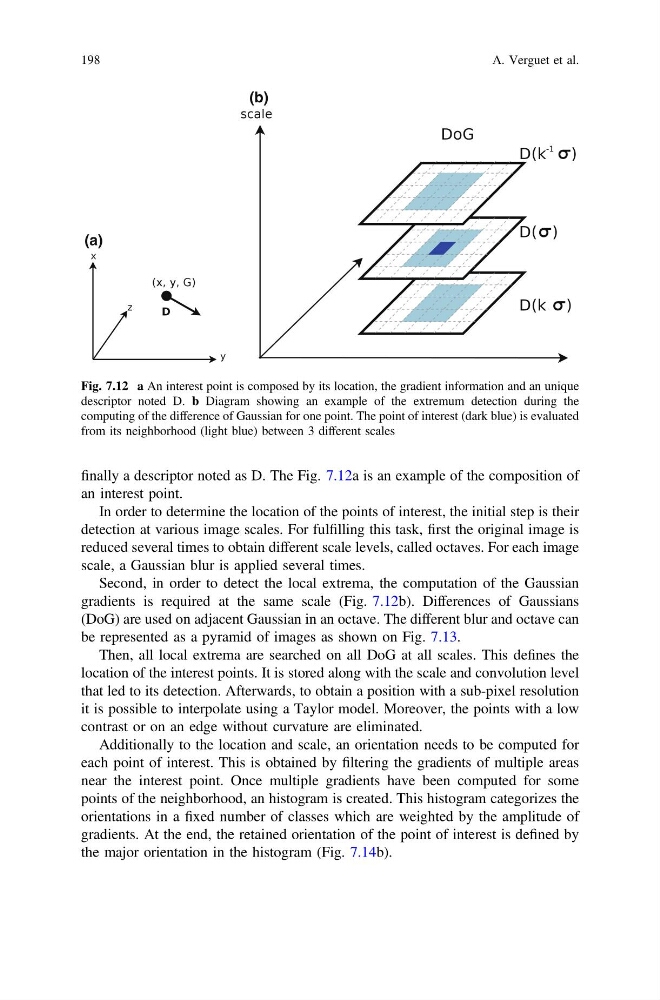
finally a descriptor noted as D. The Fig. 7.12a is an example of the composition of
an interest point.
In order to determine the location of the points of interest, the initial step is their
detection at various image scales. For fulfilling this task, first the original image is
reduced several times to obtain different scale levels, called octaves. For each image
scale, a Gaussian blur is applied several times.
Second, in order to detect the local extrema, the computation of the Gaussian
gradients is required at the same scale (Fig. 7.12b). Differences of Gaussians
(DoG) are used on adjacent Gaussian in an octave. The different blur and octave can
be represented as a pyramid of images as shown on Fig. 7.13.
Then, all local extrema are searched on all DoG at all scales. This defines the
location of the interest points. It is stored along with the scale and convolution level
that led to its detection. Afterwards, to obtain a position with a sub-pixel resolution
it is possible to interpolate using a Taylor model. Moreover, the points with a low
contrast or on an edge without curvature are eliminated.
Additionally to the location and scale, an orientation needs to be computed for
each point of interest. This is obtained by filtering the gradients of multiple areas
near the interest point. Once multiple gradients have been computed for some
points of the neighborhood, an histogram is created. This histogram categorizes the
orientations in a fixed number of classes which are weighted by the amplitude of
gradients. At the end, the retained orientation of the point of interest is defined by
the major orientation in the histogram (Fig. 7.14b).
(a)
(b)
Fig. 7.12 a An interest point is composed by its location, the gradient information and an unique
descriptor noted D. b Diagram showing an example of the extremum detection during the
computing of the difference of Gaussian for one point. The point of interest (dark blue) is evaluated
from its neighborhood (light blue) between 3 different scales
198
A. Verguet et al.
an interest point.
In order to determine the location of the points of interest, the initial step is their
detection at various image scales. For fulfilling this task, first the original image is
reduced several times to obtain different scale levels, called octaves. For each image
scale, a Gaussian blur is applied several times.
Second, in order to detect the local extrema, the computation of the Gaussian
gradients is required at the same scale (Fig. 7.12b). Differences of Gaussians
(DoG) are used on adjacent Gaussian in an octave. The different blur and octave can
be represented as a pyramid of images as shown on Fig. 7.13.
Then, all local extrema are searched on all DoG at all scales. This defines the
location of the interest points. It is stored along with the scale and convolution level
that led to its detection. Afterwards, to obtain a position with a sub-pixel resolution
it is possible to interpolate using a Taylor model. Moreover, the points with a low
contrast or on an edge without curvature are eliminated.
Additionally to the location and scale, an orientation needs to be computed for
each point of interest. This is obtained by filtering the gradients of multiple areas
near the interest point. Once multiple gradients have been computed for some
points of the neighborhood, an histogram is created. This histogram categorizes the
orientations in a fixed number of classes which are weighted by the amplitude of
gradients. At the end, the retained orientation of the point of interest is defined by
the major orientation in the histogram (Fig. 7.14b).
(a)
(b)
Fig. 7.12 a An interest point is composed by its location, the gradient information and an unique
descriptor noted D. b Diagram showing an example of the extremum detection during the
computing of the difference of Gaussian for one point. The point of interest (dark blue) is evaluated
from its neighborhood (light blue) between 3 different scales
198
A. Verguet et al.