

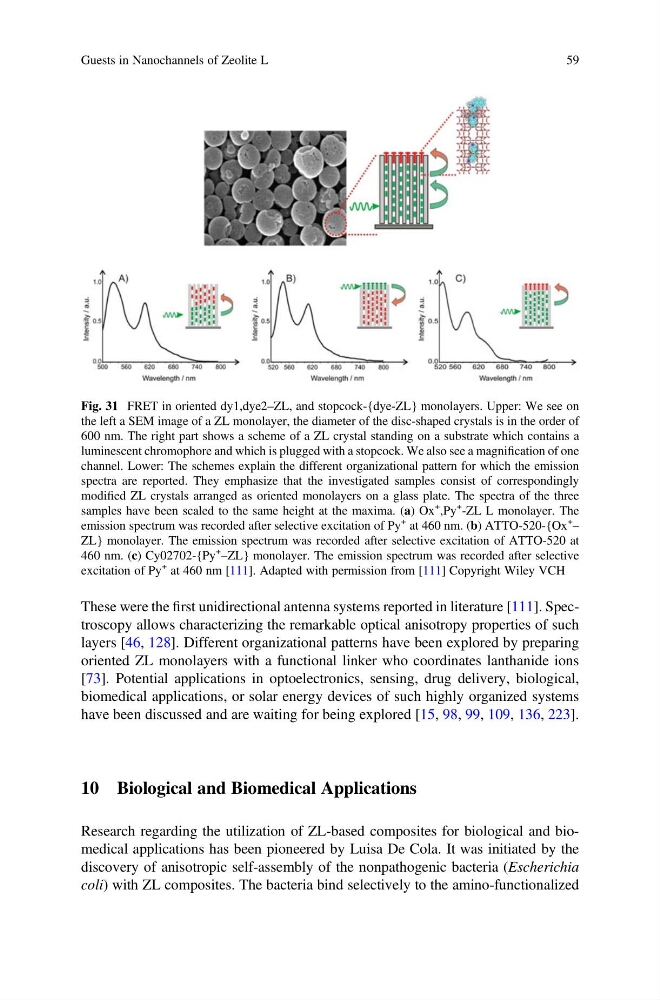
These were the first unidirectional antenna systems reported in literature [111]. Spectroscopy allows characterizing the remarkable optical anisotropy properties of such
layers [46, 128]. Different organizational patterns have been explored by preparing
oriented ZL monolayers with a functional linker who coordinates lanthanide ions
[73]. Potential applications in optoelectronics, sensing, drug delivery, biological,
biomedical applications, or solar energy devices of such highly organized systems
have been discussed and are waiting for being explored [15, 98, 99, 109, 136, 223].
10 Biological and Biomedical Applications
Research regarding the utilization of ZL-based composites for biological and biomedical applications has been pioneered by Luisa De Cola. It was initiated by the
discovery of anisotropic self-assembly of the nonpathogenic bacteria (Escherichia
coli) with ZL composites. The bacteria bind selectively to the amino-functionalized
Fig. 31 FRET in oriented dy1,dye2–ZL, and stopcock-{dye-ZL} monolayers. Upper: We see on
the left a SEM image of a ZL monolayer, the diameter of the disc-shaped crystals is in the order of
600 nm. The right part shows a scheme of a ZL crystal standing on a substrate which contains a
luminescent chromophore and which is plugged with a stopcock. We also see a magnification of one
channel. Lower: The schemes explain the different organizational pattern for which the emission
spectra are reported. They emphasize that the investigated samples consist of correspondingly
modified ZL crystals arranged as oriented monolayers on a glass plate. The spectra of the three
samples have been scaled to the same height at the maxima. (a) Ox
+ ,Py
+ -ZL L monolayer. The
emission spectrum was recorded after selective excitation of Py
+ at 460 nm. (b) ATTO-520-{Ox
+ –
ZL} monolayer. The emission spectrum was recorded after selective excitation of ATTO-520 at
460 nm. (c) Cy02702-{Py
+ –ZL} monolayer. The emission spectrum was recorded after selective
excitation of Py
+ at 460 nm [111]. Adapted with permission from [111] Copyright Wiley VCH
Guests in Nanochannels of Zeolite L
59
layers [46, 128]. Different organizational patterns have been explored by preparing
oriented ZL monolayers with a functional linker who coordinates lanthanide ions
[73]. Potential applications in optoelectronics, sensing, drug delivery, biological,
biomedical applications, or solar energy devices of such highly organized systems
have been discussed and are waiting for being explored [15, 98, 99, 109, 136, 223].
10 Biological and Biomedical Applications
Research regarding the utilization of ZL-based composites for biological and biomedical applications has been pioneered by Luisa De Cola. It was initiated by the
discovery of anisotropic self-assembly of the nonpathogenic bacteria (Escherichia
coli) with ZL composites. The bacteria bind selectively to the amino-functionalized
Fig. 31 FRET in oriented dy1,dye2–ZL, and stopcock-{dye-ZL} monolayers. Upper: We see on
the left a SEM image of a ZL monolayer, the diameter of the disc-shaped crystals is in the order of
600 nm. The right part shows a scheme of a ZL crystal standing on a substrate which contains a
luminescent chromophore and which is plugged with a stopcock. We also see a magnification of one
channel. Lower: The schemes explain the different organizational pattern for which the emission
spectra are reported. They emphasize that the investigated samples consist of correspondingly
modified ZL crystals arranged as oriented monolayers on a glass plate. The spectra of the three
samples have been scaled to the same height at the maxima. (a) Ox
+ ,Py
+ -ZL L monolayer. The
emission spectrum was recorded after selective excitation of Py
+ at 460 nm. (b) ATTO-520-{Ox
+ –
ZL} monolayer. The emission spectrum was recorded after selective excitation of ATTO-520 at
460 nm. (c) Cy02702-{Py
+ –ZL} monolayer. The emission spectrum was recorded after selective
excitation of Py
+ at 460 nm [111]. Adapted with permission from [111] Copyright Wiley VCH
Guests in Nanochannels of Zeolite L
59