

OGS technique is reported. The electronic and especially the luminescence properties of some organic guests and those of all rare earth guests are sensitive or even
very sensitive to the presence of protons, namely, the Brönsted acidity. We discuss
this in Sect. 7.3.
7.2 Oscillator Strength
We introduce the notion of the oscillator strength f because we will need it below.
The value of f provides a mean to get a feeling for the intensity of light absorption
and luminescence of dye-ZL composites. The oscillator strength f can be calculated
from the absorption spectrum according to Eq. (5), where ν is the wavenumber in
cm
À1 of the electronic transition S 0 ! S 1 and E ν
ð Þ is the extinction coefficient in
M
À1 cm
À1 at wavenumber ν [179].
f ¼ 4:319 Â 10
À9 M cm
2
Z
ε υ
ð Þdυ
ð5Þ
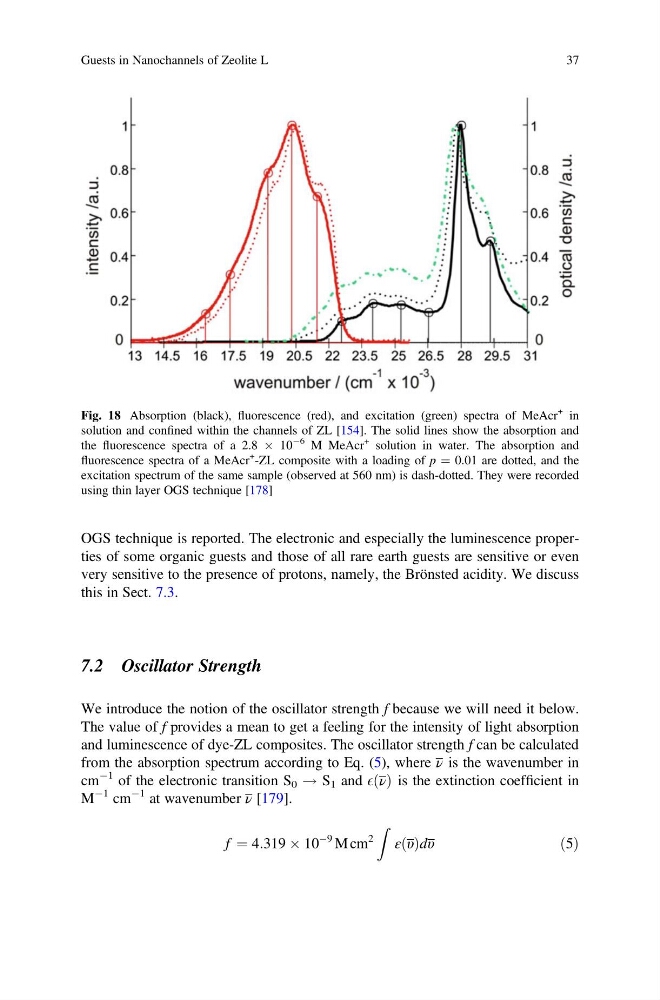
Fig. 18 Absorption (black), fluorescence (red), and excitation (green) spectra of MeAcr
+ in
solution and confined within the channels of ZL [154]. The solid lines show the absorption and
the fluorescence spectra of a 2.8 Â 10
À6 M MeAcr
+ solution in water. The absorption and
fluorescence spectra of a MeAcr
+ -ZL composite with a loading of p ¼ 0.01 are dotted, and the
excitation spectrum of the same sample (observed at 560 nm) is dash-dotted. They were recorded
using thin layer OGS technique [178]
Guests in Nanochannels of Zeolite L
37
very sensitive to the presence of protons, namely, the Brönsted acidity. We discuss
this in Sect. 7.3.
7.2 Oscillator Strength
We introduce the notion of the oscillator strength f because we will need it below.
The value of f provides a mean to get a feeling for the intensity of light absorption
and luminescence of dye-ZL composites. The oscillator strength f can be calculated
from the absorption spectrum according to Eq. (5), where ν is the wavenumber in
cm
À1 of the electronic transition S 0 ! S 1 and E ν
ð Þ is the extinction coefficient in
M
À1 cm
À1 at wavenumber ν [179].
f ¼ 4:319 Â 10
À9 M cm
2
Z
ε υ
ð Þdυ
ð5Þ
Fig. 18 Absorption (black), fluorescence (red), and excitation (green) spectra of MeAcr
+ in
solution and confined within the channels of ZL [154]. The solid lines show the absorption and
the fluorescence spectra of a 2.8 Â 10
À6 M MeAcr
+ solution in water. The absorption and
fluorescence spectra of a MeAcr
+ -ZL composite with a loading of p ¼ 0.01 are dotted, and the
excitation spectrum of the same sample (observed at 560 nm) is dash-dotted. They were recorded
using thin layer OGS technique [178]
Guests in Nanochannels of Zeolite L
37