

affected by the host, including the co-solvent water. This fully agrees with the results
reported in Fig. 15 and the finding that the carbonyl groups of these dyes bind to the
zeolite extra framework potassium cations [44].
We now discuss the spectra of MeAcr
+ -ZL. The first π–πà (S 1
S 0 ) transition,
which establishes the S 1 state from which the cationic dye Me-Acr
+ emits, is weak
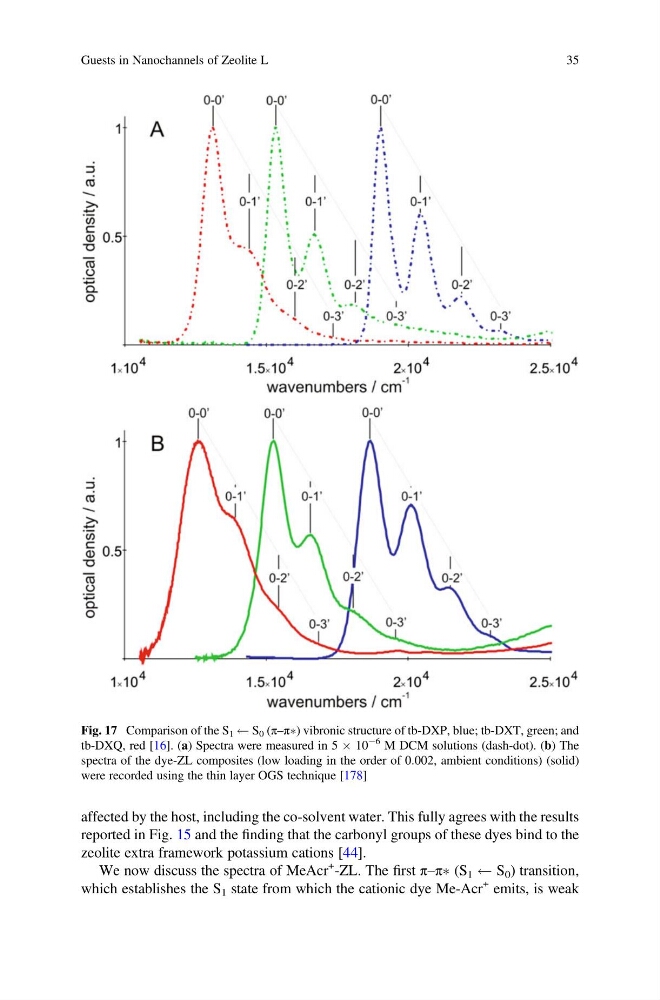
Fig. 17 Comparison of the S 1 S 0 (π–πÃ) vibronic structure of tb-DXP, blue; tb-DXT, green; and
tb-DXQ, red [16]. (a) Spectra were measured in 5 Â 10
À6 M DCM solutions (dash-dot). (b) The
spectra of the dye-ZL composites (low loading in the order of 0.002, ambient conditions) (solid)
were recorded using the thin layer OGS technique [178]
Guests in Nanochannels of Zeolite L
35
reported in Fig. 15 and the finding that the carbonyl groups of these dyes bind to the
zeolite extra framework potassium cations [44].
We now discuss the spectra of MeAcr
+ -ZL. The first π–πà (S 1
S 0 ) transition,
which establishes the S 1 state from which the cationic dye Me-Acr
+ emits, is weak
Fig. 17 Comparison of the S 1 S 0 (π–πÃ) vibronic structure of tb-DXP, blue; tb-DXT, green; and
tb-DXQ, red [16]. (a) Spectra were measured in 5 Â 10
À6 M DCM solutions (dash-dot). (b) The
spectra of the dye-ZL composites (low loading in the order of 0.002, ambient conditions) (solid)
were recorded using the thin layer OGS technique [178]
Guests in Nanochannels of Zeolite L
35