

In the field of UCNPs, research has gone one step forward and opened up new
alternatives for successful and non-invasive antitumoural theragnosis, thus proving
how it is possible to perform Vis imaging tracking without triggering therapy by
having another dye present on the nanohybrid surface with no absorption
overlapping with the UCNP emission, thus allowing direct absorption (either Stokes
or anti-Stokes via two-photon absorption) for innocuous tracking (Fig. 9) [1].
Thus, the UCNH consisted of a tridoped UCNP (NaYF 4 :Yb,Er,Tm (UC YbErTm ))
emitting in the UV, Vis and NIR; a broadband-absorbing natural porphyrin (PP) in
the UV-to-NIR range but from 580 to 675 nm; and a 1,8-naphthalimide (NI) with
two absorption bands (UV, Vis) and dual emission. The production of cytotoxic
reactive oxygen species took place upon NIR excitation due to the co-localization of
UCNP that allowed for effective RET from the UCNP to dyes. In fact, in vitro assays
demonstrated that UC YbErTm @PP/NI UCNH was non-cytotoxic and extremely
effective for NIR-induced cancer cell death upon NIR irradiation while offering
fluorescence tracking features without therapy when specifically exciting NI.
Multifunctional NaYF 4 :Yb,Er@polypyrrole (PPy) core-shell nanoplates can also
be simultaneously used for cancer diagnosis and photothermal therapy. In this
nanohybrid, the core serves as an efficient nanoprobe for upconversion luminescence
(UCL)/X-ray computed tomography (CT) dual-modal imaging, whereas the shell of
PPy also shows strong NIR absorption, which makes it effective in photothermal
ablation of cancer cells and infrared thermal imaging in vivo [129]. Therefore, in this
particular example, the UCL is used for imaging but not for PPy activation.
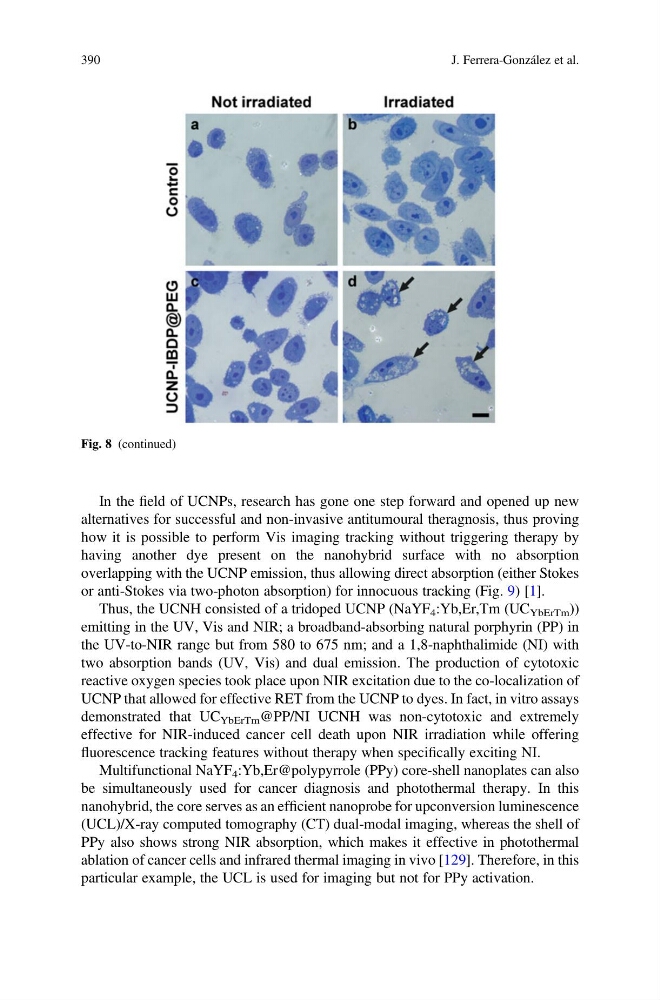
Fig. 8 (continued)
390
J. Ferrera-González et al.
alternatives for successful and non-invasive antitumoural theragnosis, thus proving
how it is possible to perform Vis imaging tracking without triggering therapy by
having another dye present on the nanohybrid surface with no absorption
overlapping with the UCNP emission, thus allowing direct absorption (either Stokes
or anti-Stokes via two-photon absorption) for innocuous tracking (Fig. 9) [1].
Thus, the UCNH consisted of a tridoped UCNP (NaYF 4 :Yb,Er,Tm (UC YbErTm ))
emitting in the UV, Vis and NIR; a broadband-absorbing natural porphyrin (PP) in
the UV-to-NIR range but from 580 to 675 nm; and a 1,8-naphthalimide (NI) with
two absorption bands (UV, Vis) and dual emission. The production of cytotoxic
reactive oxygen species took place upon NIR excitation due to the co-localization of
UCNP that allowed for effective RET from the UCNP to dyes. In fact, in vitro assays
demonstrated that UC YbErTm @PP/NI UCNH was non-cytotoxic and extremely
effective for NIR-induced cancer cell death upon NIR irradiation while offering
fluorescence tracking features without therapy when specifically exciting NI.
Multifunctional NaYF 4 :Yb,Er@polypyrrole (PPy) core-shell nanoplates can also
be simultaneously used for cancer diagnosis and photothermal therapy. In this
nanohybrid, the core serves as an efficient nanoprobe for upconversion luminescence
(UCL)/X-ray computed tomography (CT) dual-modal imaging, whereas the shell of
PPy also shows strong NIR absorption, which makes it effective in photothermal
ablation of cancer cells and infrared thermal imaging in vivo [129]. Therefore, in this
particular example, the UCL is used for imaging but not for PPy activation.
Fig. 8 (continued)
390
J. Ferrera-González et al.