

in Scheme 4) have been studied from 1935 [192] and those in layered materials have
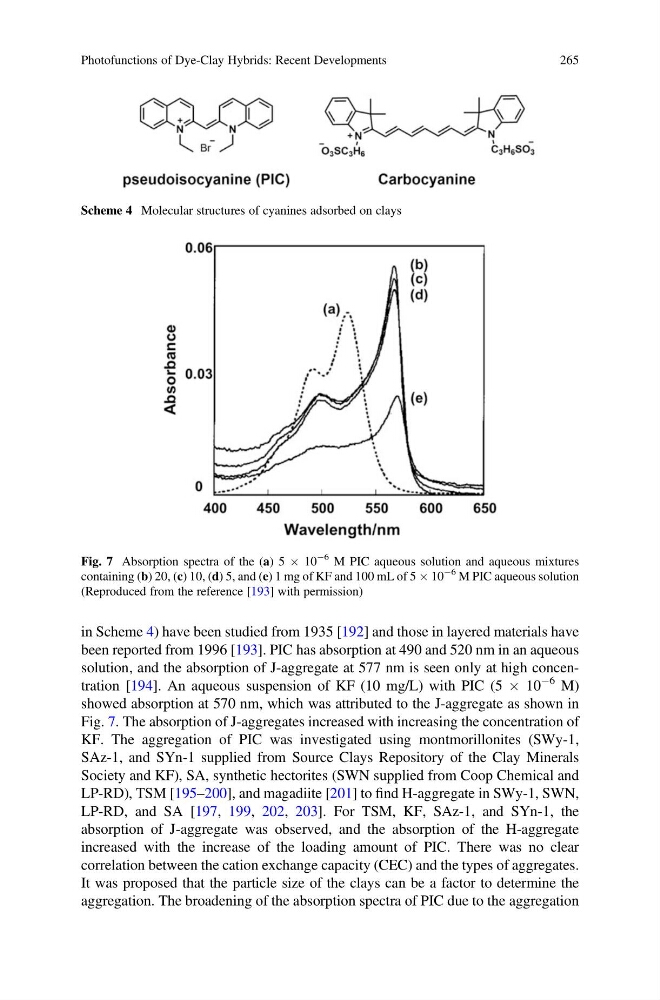
been reported from 1996 [193]. PIC has absorption at 490 and 520 nm in an aqueous
solution, and the absorption of J-aggregate at 577 nm is seen only at high concentration [194]. An aqueous suspension of KF (10 mg/L) with PIC (5 Â 10
À6 M)
showed absorption at 570 nm, which was attributed to the J-aggregate as shown in
Fig. 7. The absorption of J-aggregates increased with increasing the concentration of
KF. The aggregation of PIC was investigated using montmorillonites (SWy-1,
SAz-1, and SYn-1 supplied from Source Clays Repository of the Clay Minerals
Society and KF), SA, synthetic hectorites (SWN supplied from Coop Chemical and
LP-RD), TSM [195–200], and magadiite [201] to find H-aggregate in SWy-1, SWN,
LP-RD, and SA [197, 199, 202, 203]. For TSM, KF, SAz-1, and SYn-1, the
absorption of J-aggregate was observed, and the absorption of the H-aggregate
increased with the increase of the loading amount of PIC. There was no clear
correlation between the cation exchange capacity (CEC) and the types of aggregates.
It was proposed that the particle size of the clays can be a factor to determine the
aggregation. The broadening of the absorption spectra of PIC due to the aggregation
Scheme 4 Molecular structures of cyanines adsorbed on clays
Fig. 7 Absorption spectra of the (a) 5 Â 10
À6 M PIC aqueous solution and aqueous mixtures
containing (b) 20, (c) 10, (d) 5, and (e) 1 mg of KF and 100 mL of 5 Â 10
À6 M PIC aqueous solution
(Reproduced from the reference [193] with permission)
Photofunctions of Dye-Clay Hybrids: Recent Developments
265
been reported from 1996 [193]. PIC has absorption at 490 and 520 nm in an aqueous
solution, and the absorption of J-aggregate at 577 nm is seen only at high concentration [194]. An aqueous suspension of KF (10 mg/L) with PIC (5 Â 10
À6 M)
showed absorption at 570 nm, which was attributed to the J-aggregate as shown in
Fig. 7. The absorption of J-aggregates increased with increasing the concentration of
KF. The aggregation of PIC was investigated using montmorillonites (SWy-1,
SAz-1, and SYn-1 supplied from Source Clays Repository of the Clay Minerals
Society and KF), SA, synthetic hectorites (SWN supplied from Coop Chemical and
LP-RD), TSM [195–200], and magadiite [201] to find H-aggregate in SWy-1, SWN,
LP-RD, and SA [197, 199, 202, 203]. For TSM, KF, SAz-1, and SYn-1, the
absorption of J-aggregate was observed, and the absorption of the H-aggregate
increased with the increase of the loading amount of PIC. There was no clear
correlation between the cation exchange capacity (CEC) and the types of aggregates.
It was proposed that the particle size of the clays can be a factor to determine the
aggregation. The broadening of the absorption spectra of PIC due to the aggregation
Scheme 4 Molecular structures of cyanines adsorbed on clays
Fig. 7 Absorption spectra of the (a) 5 Â 10
À6 M PIC aqueous solution and aqueous mixtures
containing (b) 20, (c) 10, (d) 5, and (e) 1 mg of KF and 100 mL of 5 Â 10
À6 M PIC aqueous solution
(Reproduced from the reference [193] with permission)
Photofunctions of Dye-Clay Hybrids: Recent Developments
265