

visible absorption spectra, which was thought to be due to the head-to-tail orientation
[62]. Considering the molecular size of AZC 2 N
+
C 2 OH and the observed
bathochromic shifts of the visible absorption spectrum, it was proposed that
AZC 2 N
+
C 2 OH formed J-aggregate as monolayer or bilayer as shown in Fig. 2.
The absorption spectrum of AZC 2 N
+
C 2 OH intercalated in magadiite showed a
hypsochromic shift, indicating the formation of H-aggregate, which has a gallery
height of 1.57 nm [165, 186]. It was considered that the larger layer charge density of
magadiite led the AZC 2 N
+
C 2 OH with the higher tilt angle to the silicate layer than
that in KF to lead the H-aggregate (head-to-tail dimer).
The absorption spectra of methylene blue (Scheme 1) in the aqueous dispersions
of smectites, whose layer charge densities were reduced by Hofmann-Klemen effect,
was investigated [23, 115]. The phenomenon called Hofmann-Klemen effect is
attributed to the migration of interlayer lithium ions to the vacancies in the octahedral
sheet of smectites by heating. The absorption of J-aggregate decreased, and the
dimer increased by reducing the layer charge density of the montmorillonite
(obtained from Apache Country, Arizona) [115]. The same trend was seen in
montmorillonites obtained from San Diego Country, California, and Horní
Dunajovice, Czech Republic; a beidellite obtained from Stebno, Czech Republic;
and a smectite obtained from Grand Country, Washington.
Dialkylated spiropyrans (Alkyl-SP-1 and Alkyl-SP-2 in Scheme 3) were intercalated into a film of a didodecyldimethylammonium exchanged montmorillonite, and
the aggregation of photochemically formed merocyanines was investigated [171]. A
photomerocyanine formed from 6-NO 2 -SP has a characteristic absorption at 552 nm,
while those of Alkyl-SP-1 and Alkyl-SP-2 absorbed at 493 and 617 nm, which were
attributed to H- and J-aggregates, respectively.
Aggregation of dyes in the interlayer space has been reported. The emission of
dyes is weaker for H-aggregate due to that the transition dipoles weaken each other
[187, 188], while the emission of J-aggregate is intense, and the Stokes shift is
smaller than those of the monomer [189–191]. Aggregates of pseudoisocyanine (PIC
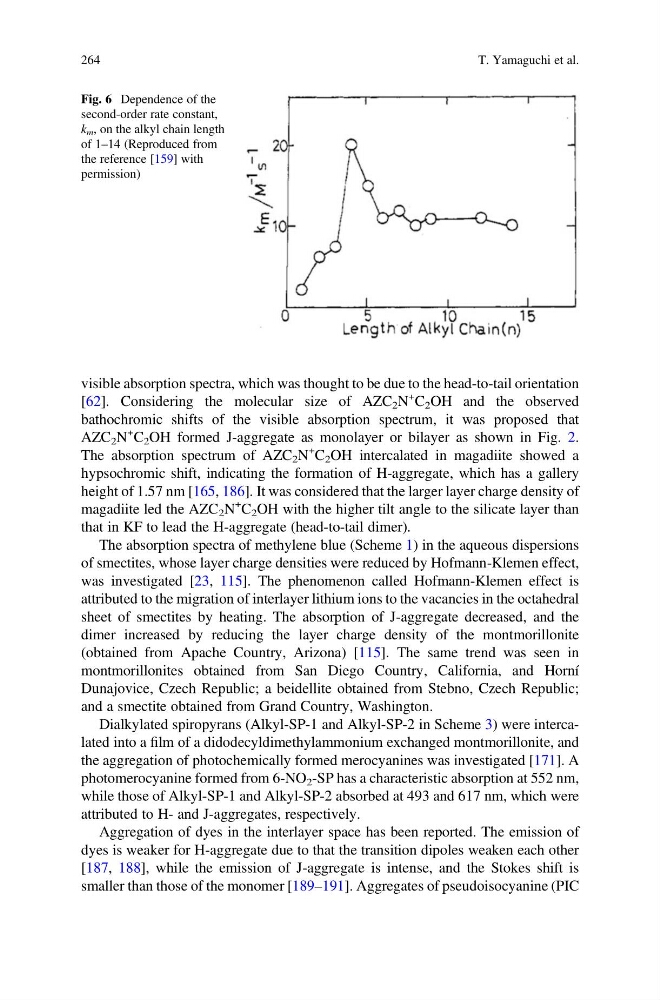
Fig. 6 Dependence of the
second-order rate constant,
k m , on the alkyl chain length
of 1–14 (Reproduced from
the reference [159] with
permission)
264
T. Yamaguchi et al.
[62]. Considering the molecular size of AZC 2 N
+
C 2 OH and the observed
bathochromic shifts of the visible absorption spectrum, it was proposed that
AZC 2 N
+
C 2 OH formed J-aggregate as monolayer or bilayer as shown in Fig. 2.
The absorption spectrum of AZC 2 N
+
C 2 OH intercalated in magadiite showed a
hypsochromic shift, indicating the formation of H-aggregate, which has a gallery
height of 1.57 nm [165, 186]. It was considered that the larger layer charge density of
magadiite led the AZC 2 N
+
C 2 OH with the higher tilt angle to the silicate layer than
that in KF to lead the H-aggregate (head-to-tail dimer).
The absorption spectra of methylene blue (Scheme 1) in the aqueous dispersions
of smectites, whose layer charge densities were reduced by Hofmann-Klemen effect,
was investigated [23, 115]. The phenomenon called Hofmann-Klemen effect is
attributed to the migration of interlayer lithium ions to the vacancies in the octahedral
sheet of smectites by heating. The absorption of J-aggregate decreased, and the
dimer increased by reducing the layer charge density of the montmorillonite
(obtained from Apache Country, Arizona) [115]. The same trend was seen in
montmorillonites obtained from San Diego Country, California, and Horní
Dunajovice, Czech Republic; a beidellite obtained from Stebno, Czech Republic;
and a smectite obtained from Grand Country, Washington.
Dialkylated spiropyrans (Alkyl-SP-1 and Alkyl-SP-2 in Scheme 3) were intercalated into a film of a didodecyldimethylammonium exchanged montmorillonite, and
the aggregation of photochemically formed merocyanines was investigated [171]. A
photomerocyanine formed from 6-NO 2 -SP has a characteristic absorption at 552 nm,
while those of Alkyl-SP-1 and Alkyl-SP-2 absorbed at 493 and 617 nm, which were
attributed to H- and J-aggregates, respectively.
Aggregation of dyes in the interlayer space has been reported. The emission of
dyes is weaker for H-aggregate due to that the transition dipoles weaken each other
[187, 188], while the emission of J-aggregate is intense, and the Stokes shift is
smaller than those of the monomer [189–191]. Aggregates of pseudoisocyanine (PIC
Fig. 6 Dependence of the
second-order rate constant,
k m , on the alkyl chain length
of 1–14 (Reproduced from
the reference [159] with
permission)
264
T. Yamaguchi et al.