

the intercalation [38–52]. One of the characteristic features of smectites is the
possible surface modification. Nanoporous pillared smectites have been obtained
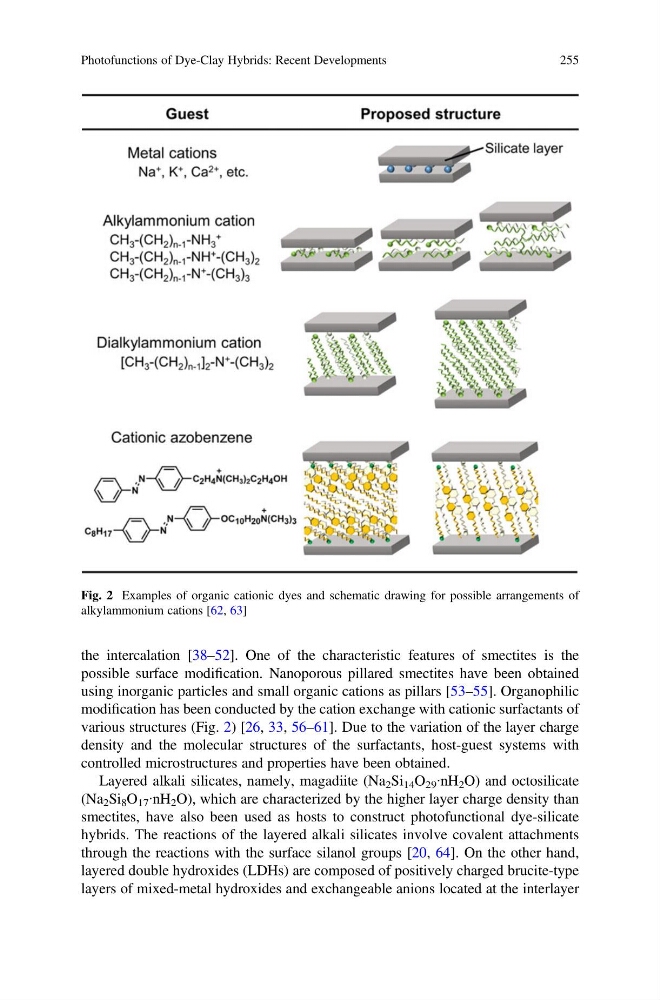
using inorganic particles and small organic cations as pillars [53–55]. Organophilic
modification has been conducted by the cation exchange with cationic surfactants of
various structures (Fig. 2) [26, 33, 56–61]. Due to the variation of the layer charge
density and the molecular structures of the surfactants, host-guest systems with
controlled microstructures and properties have been obtained.
Layered alkali silicates, namely, magadiite (Na 2 Si 14 O 29 ∙nH 2 O) and octosilicate
(Na 2 Si 8 O 17 ∙nH 2 O), which are characterized by the higher layer charge density than
smectites, have also been used as hosts to construct photofunctional dye-silicate
hybrids. The reactions of the layered alkali silicates involve covalent attachments
through the reactions with the surface silanol groups [20, 64]. On the other hand,
layered double hydroxides (LDHs) are composed of positively charged brucite-type
layers of mixed-metal hydroxides and exchangeable anions located at the interlayer
Fig. 2 Examples of organic cationic dyes and schematic drawing for possible arrangements of
alkylammonium cations [62, 63]
Photofunctions of Dye-Clay Hybrids: Recent Developments
255
possible surface modification. Nanoporous pillared smectites have been obtained
using inorganic particles and small organic cations as pillars [53–55]. Organophilic
modification has been conducted by the cation exchange with cationic surfactants of
various structures (Fig. 2) [26, 33, 56–61]. Due to the variation of the layer charge
density and the molecular structures of the surfactants, host-guest systems with
controlled microstructures and properties have been obtained.
Layered alkali silicates, namely, magadiite (Na 2 Si 14 O 29 ∙nH 2 O) and octosilicate
(Na 2 Si 8 O 17 ∙nH 2 O), which are characterized by the higher layer charge density than
smectites, have also been used as hosts to construct photofunctional dye-silicate
hybrids. The reactions of the layered alkali silicates involve covalent attachments
through the reactions with the surface silanol groups [20, 64]. On the other hand,
layered double hydroxides (LDHs) are composed of positively charged brucite-type
layers of mixed-metal hydroxides and exchangeable anions located at the interlayer
Fig. 2 Examples of organic cationic dyes and schematic drawing for possible arrangements of
alkylammonium cations [62, 63]
Photofunctions of Dye-Clay Hybrids: Recent Developments
255