

the site of the isomorphous substitution influences the surface and colloidal properties of smectites. Impurities present both within the structure and on the particle
surface, and elements and their amounts vary depending on the source of the clay
minerals. Synthetic analogs of smectites, i.e., hectorite (Laponite, Rockwood Ind.
Co. and Sumecton SWF, Kunimine Ind. Co.) [32], saponite (Sumecton SA,
Kunimine Ind. Co.) [33], and swelling mica (sodium-fluor-tetrasilicic mica, TSM,
Topy Ind. Co. and others) [33], do not contain colored impurities so that they are
advantages for the photochemical studies. In addition to the commercially available
ones, synthetic analogs of smectite have been prepared in the laboratory and used for
the adsorption of dyes [25, 34]. The interlayer cation, which compensates the
negative charge of the silicate layer, is exchangeable by the reactions in suspension
and in solid state [35–37].
Cation exchange with interlayer exchangeable cations and the adsorption of polar
molecules by ion-dipole interactions with interlayer cations and/or hydrogen bonding with the surface oxygen atom of the silicate sheets are known driving forces for
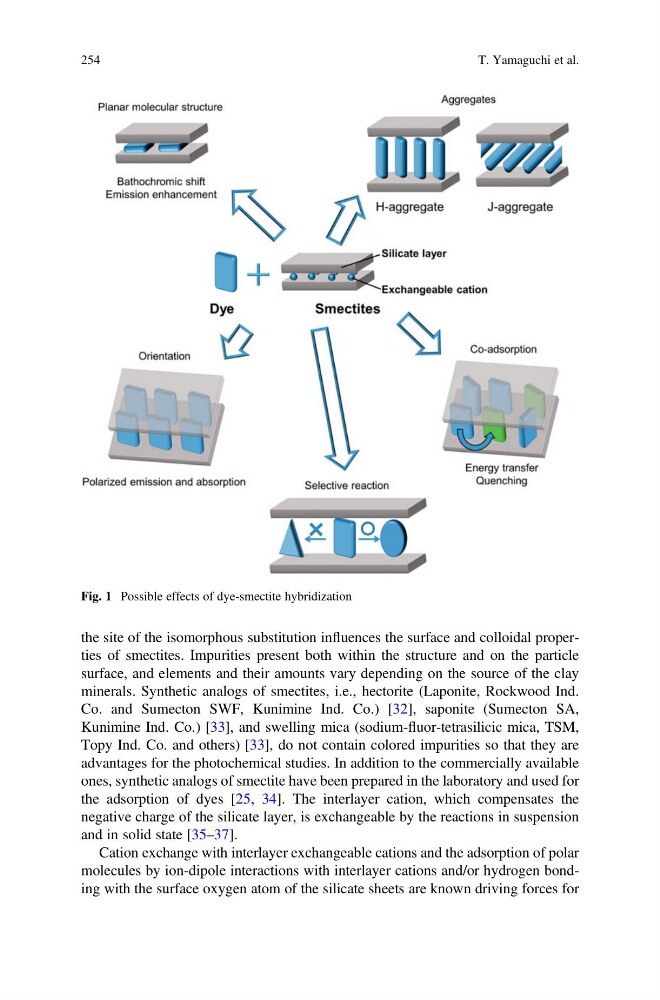
Fig. 1 Possible effects of dye-smectite hybridization
254
T. Yamaguchi et al.
surface, and elements and their amounts vary depending on the source of the clay
minerals. Synthetic analogs of smectites, i.e., hectorite (Laponite, Rockwood Ind.
Co. and Sumecton SWF, Kunimine Ind. Co.) [32], saponite (Sumecton SA,
Kunimine Ind. Co.) [33], and swelling mica (sodium-fluor-tetrasilicic mica, TSM,
Topy Ind. Co. and others) [33], do not contain colored impurities so that they are
advantages for the photochemical studies. In addition to the commercially available
ones, synthetic analogs of smectite have been prepared in the laboratory and used for
the adsorption of dyes [25, 34]. The interlayer cation, which compensates the
negative charge of the silicate layer, is exchangeable by the reactions in suspension
and in solid state [35–37].
Cation exchange with interlayer exchangeable cations and the adsorption of polar
molecules by ion-dipole interactions with interlayer cations and/or hydrogen bonding with the surface oxygen atom of the silicate sheets are known driving forces for
Fig. 1 Possible effects of dye-smectite hybridization
254
T. Yamaguchi et al.