

Fig. 7
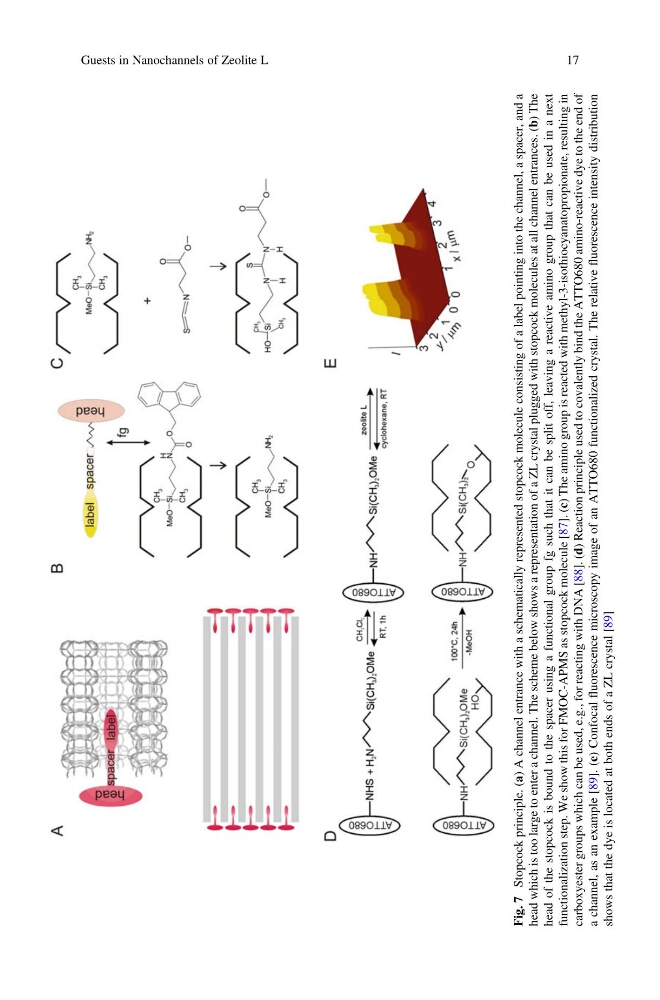
Stopcock principle. (a) A channel entrance with a schematically represented stopcock molecule consisting of a label pointing into the channel, a spacer, and a
head which is too large to enter a channel. The scheme below shows a representation of a ZL crystal plugged with stopcock molecules at all channel entrances. (b) The
head of the stopcock is bound to the spacer using a functional group fg such that it can be split off, leaving a reactive amino group that can be used in a next
functionalization step. We show this for FMOC-APMS as stopcock molecule [87]. (c) The amino group is reacted with methyl-3-isothiocyanatopropionate, resulting in
carboxyester groups which can be used, e.g., for reacting with DNA [88]. (d) Reaction principle used to covalently bind the ATTO680 amino-reactive dye to the end of
a channel, as an example [89]. (e) Confocal
fluorescence microscopy image of an ATTO680 functionalized crystal. The relative
fluorescence intensity distribution
shows that the dye is located at both ends of a ZL crystal [89]
Guests in Nanochannels of Zeolite L
17
Stopcock principle. (a) A channel entrance with a schematically represented stopcock molecule consisting of a label pointing into the channel, a spacer, and a
head which is too large to enter a channel. The scheme below shows a representation of a ZL crystal plugged with stopcock molecules at all channel entrances. (b) The
head of the stopcock is bound to the spacer using a functional group fg such that it can be split off, leaving a reactive amino group that can be used in a next
functionalization step. We show this for FMOC-APMS as stopcock molecule [87]. (c) The amino group is reacted with methyl-3-isothiocyanatopropionate, resulting in
carboxyester groups which can be used, e.g., for reacting with DNA [88]. (d) Reaction principle used to covalently bind the ATTO680 amino-reactive dye to the end of
a channel, as an example [89]. (e) Confocal
fluorescence microscopy image of an ATTO680 functionalized crystal. The relative
fluorescence intensity distribution
shows that the dye is located at both ends of a ZL crystal [89]
Guests in Nanochannels of Zeolite L
17