

assumed based on a low efficiency of electron transfer between adsorbed [Ru
(bpy) 3 ]
2+ and methylviologen [54]. However, later on, similar materials exhibited
no segregation [55], which was later confirmed for various types of materials [11, 36,
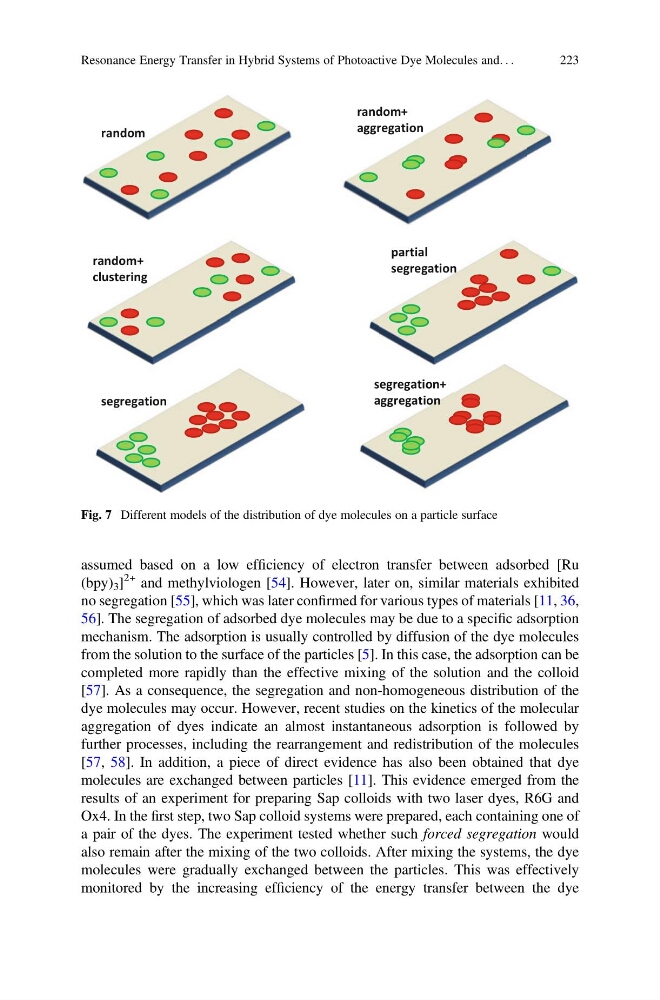
56]. The segregation of adsorbed dye molecules may be due to a specific adsorption
mechanism. The adsorption is usually controlled by diffusion of the dye molecules
from the solution to the surface of the particles [5]. In this case, the adsorption can be
completed more rapidly than the effective mixing of the solution and the colloid
[57]. As a consequence, the segregation and non-homogeneous distribution of the
dye molecules may occur. However, recent studies on the kinetics of the molecular
aggregation of dyes indicate an almost instantaneous adsorption is followed by
further processes, including the rearrangement and redistribution of the molecules
[57, 58]. In addition, a piece of direct evidence has also been obtained that dye
molecules are exchanged between particles [11]. This evidence emerged from the
results of an experiment for preparing Sap colloids with two laser dyes, R6G and
Ox4. In the first step, two Sap colloid systems were prepared, each containing one of
a pair of the dyes. The experiment tested whether such forced segregation would
also remain after the mixing of the two colloids. After mixing the systems, the dye
molecules were gradually exchanged between the particles. This was effectively
monitored by the increasing efficiency of the energy transfer between the dye
random
random+
aggregation
random+
clustering
partial
segregation
segregation
segregation+
aggregation
Fig. 7 Different models of the distribution of dye molecules on a particle surface
Resonance Energy Transfer in Hybrid Systems of Photoactive Dye Molecules and. . .
223
(bpy) 3 ]
2+ and methylviologen [54]. However, later on, similar materials exhibited
no segregation [55], which was later confirmed for various types of materials [11, 36,
56]. The segregation of adsorbed dye molecules may be due to a specific adsorption
mechanism. The adsorption is usually controlled by diffusion of the dye molecules
from the solution to the surface of the particles [5]. In this case, the adsorption can be
completed more rapidly than the effective mixing of the solution and the colloid
[57]. As a consequence, the segregation and non-homogeneous distribution of the
dye molecules may occur. However, recent studies on the kinetics of the molecular
aggregation of dyes indicate an almost instantaneous adsorption is followed by
further processes, including the rearrangement and redistribution of the molecules
[57, 58]. In addition, a piece of direct evidence has also been obtained that dye
molecules are exchanged between particles [11]. This evidence emerged from the
results of an experiment for preparing Sap colloids with two laser dyes, R6G and
Ox4. In the first step, two Sap colloid systems were prepared, each containing one of
a pair of the dyes. The experiment tested whether such forced segregation would
also remain after the mixing of the two colloids. After mixing the systems, the dye
molecules were gradually exchanged between the particles. This was effectively
monitored by the increasing efficiency of the energy transfer between the dye
random
random+
aggregation
random+
clustering
partial
segregation
segregation
segregation+
aggregation
Fig. 7 Different models of the distribution of dye molecules on a particle surface
Resonance Energy Transfer in Hybrid Systems of Photoactive Dye Molecules and. . .
223