

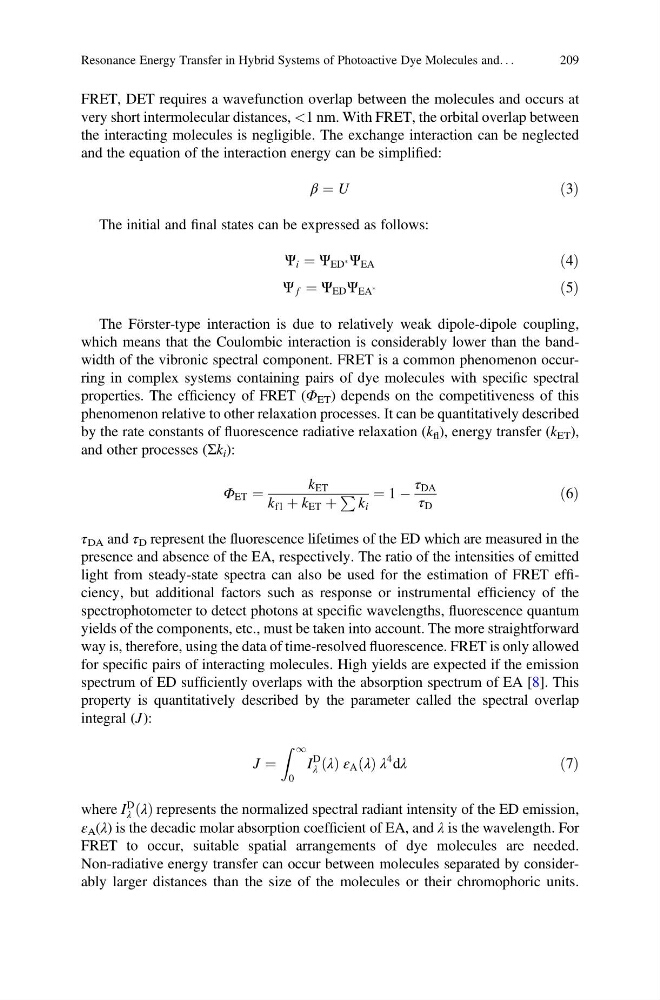
FRET, DET requires a wavefunction overlap between the molecules and occurs at
very short intermolecular distances, <1 nm. With FRET, the orbital overlap between
the interacting molecules is negligible. The exchange interaction can be neglected
and the equation of the interaction energy can be simplified:
β ¼ U
ð3Þ
The initial and final states can be expressed as follows:
Ψ i ¼ Ψ ED
Ã Ψ EA
ð4Þ
Ψ f ¼ Ψ ED Ψ EA
Ã
ð5Þ
The Förster-type interaction is due to relatively weak dipole-dipole coupling,
which means that the Coulombic interaction is considerably lower than the bandwidth of the vibronic spectral component. FRET is a common phenomenon occurring in complex systems containing pairs of dye molecules with specific spectral
properties. The efficiency of FRET (Φ ET ) depends on the competitiveness of this
phenomenon relative to other relaxation processes. It can be quantitatively described
by the rate constants of fluorescence radiative relaxation (k fl ), energy transfer (k ET ),
and other processes (Σk i ):
Φ ET ¼
k ET
k f l þ k ET þ
P
k i
¼ 1 À
τ DA
τ D
ð6Þ
τ DA and τ D represent the fluorescence lifetimes of the ED which are measured in the
presence and absence of the EA, respectively. The ratio of the intensities of emitted
light from steady-state spectra can also be used for the estimation of FRET efficiency, but additional factors such as response or instrumental efficiency of the
spectrophotometer to detect photons at specific wavelengths, fluorescence quantum
yields of the components, etc., must be taken into account. The more straightforward
way is, therefore, using the data of time-resolved fluorescence. FRET is only allowed
for specific pairs of interacting molecules. High yields are expected if the emission
spectrum of ED sufficiently overlaps with the absorption spectrum of EA [8]. This
property is quantitatively described by the parameter called the spectral overlap
integral (J ):
J ¼
Z 1
0
I
D
λ λ
ð Þ ε A λ
ð Þ λ
4 dλ
ð7Þ
where I
D
λ λ
ð Þ represents the normalized spectral radiant intensity of the ED emission,
ε A (λ) is the decadic molar absorption coefficient of EA, and λ is the wavelength. For
FRET to occur, suitable spatial arrangements of dye molecules are needed.
Non-radiative energy transfer can occur between molecules separated by considerably larger distances than the size of the molecules or their chromophoric units.
Resonance Energy Transfer in Hybrid Systems of Photoactive Dye Molecules and. . .
209
very short intermolecular distances, <1 nm. With FRET, the orbital overlap between
the interacting molecules is negligible. The exchange interaction can be neglected
and the equation of the interaction energy can be simplified:
β ¼ U
ð3Þ
The initial and final states can be expressed as follows:
Ψ i ¼ Ψ ED
Ã Ψ EA
ð4Þ
Ψ f ¼ Ψ ED Ψ EA
Ã
ð5Þ
The Förster-type interaction is due to relatively weak dipole-dipole coupling,
which means that the Coulombic interaction is considerably lower than the bandwidth of the vibronic spectral component. FRET is a common phenomenon occurring in complex systems containing pairs of dye molecules with specific spectral
properties. The efficiency of FRET (Φ ET ) depends on the competitiveness of this
phenomenon relative to other relaxation processes. It can be quantitatively described
by the rate constants of fluorescence radiative relaxation (k fl ), energy transfer (k ET ),
and other processes (Σk i ):
Φ ET ¼
k ET
k f l þ k ET þ
P
k i
¼ 1 À
τ DA
τ D
ð6Þ
τ DA and τ D represent the fluorescence lifetimes of the ED which are measured in the
presence and absence of the EA, respectively. The ratio of the intensities of emitted
light from steady-state spectra can also be used for the estimation of FRET efficiency, but additional factors such as response or instrumental efficiency of the
spectrophotometer to detect photons at specific wavelengths, fluorescence quantum
yields of the components, etc., must be taken into account. The more straightforward
way is, therefore, using the data of time-resolved fluorescence. FRET is only allowed
for specific pairs of interacting molecules. High yields are expected if the emission
spectrum of ED sufficiently overlaps with the absorption spectrum of EA [8]. This
property is quantitatively described by the parameter called the spectral overlap
integral (J ):
J ¼
Z 1
0
I
D
λ λ
ð Þ ε A λ
ð Þ λ
4 dλ
ð7Þ
where I
D
λ λ
ð Þ represents the normalized spectral radiant intensity of the ED emission,
ε A (λ) is the decadic molar absorption coefficient of EA, and λ is the wavelength. For
FRET to occur, suitable spatial arrangements of dye molecules are needed.
Non-radiative energy transfer can occur between molecules separated by considerably larger distances than the size of the molecules or their chromophoric units.
Resonance Energy Transfer in Hybrid Systems of Photoactive Dye Molecules and. . .
209