

k ic þ k isc ¼ k fl =ϕ fl À k fl
ð3Þ
The effect of the saponite surface on these parameters has been examined for
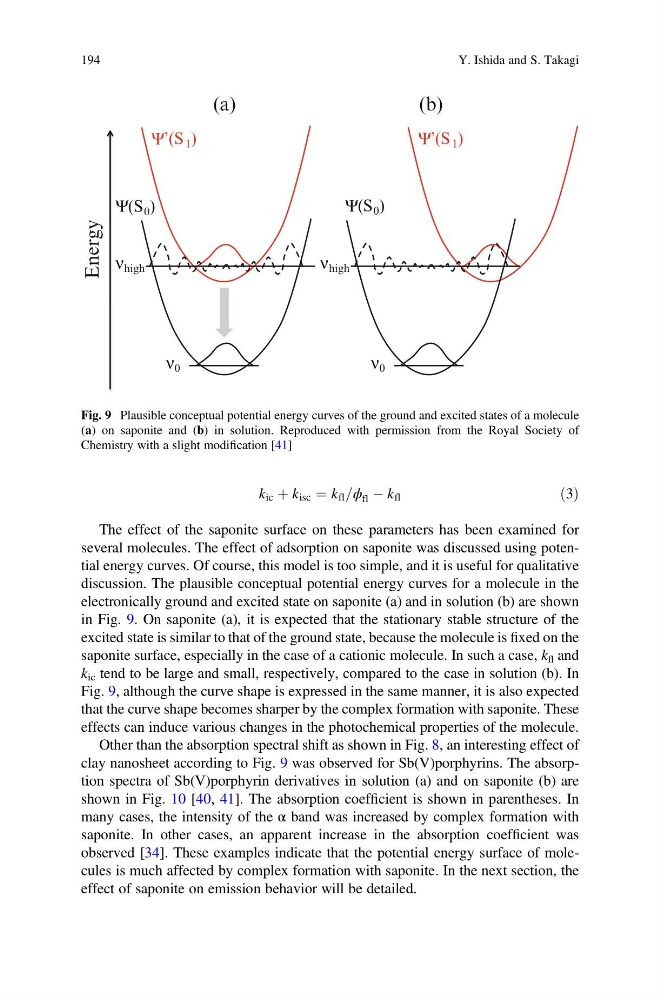
several molecules. The effect of adsorption on saponite was discussed using potential energy curves. Of course, this model is too simple, and it is useful for qualitative
discussion. The plausible conceptual potential energy curves for a molecule in the
electronically ground and excited state on saponite (a) and in solution (b) are shown
in Fig. 9. On saponite (a), it is expected that the stationary stable structure of the
excited state is similar to that of the ground state, because the molecule is fixed on the
saponite surface, especially in the case of a cationic molecule. In such a case, k fl and
k ic tend to be large and small, respectively, compared to the case in solution (b). In
Fig. 9, although the curve shape is expressed in the same manner, it is also expected
that the curve shape becomes sharper by the complex formation with saponite. These
effects can induce various changes in the photochemical properties of the molecule.
Other than the absorption spectral shift as shown in Fig. 8, an interesting effect of
clay nanosheet according to Fig. 9 was observed for Sb(V)porphyrins. The absorption spectra of Sb(V)porphyrin derivatives in solution (a) and on saponite (b) are
shown in Fig. 10 [40, 41]. The absorption coefficient is shown in parentheses. In
many cases, the intensity of the α band was increased by complex formation with
saponite. In other cases, an apparent increase in the absorption coefficient was
observed [34]. These examples indicate that the potential energy surface of molecules is much affected by complex formation with saponite. In the next section, the
effect of saponite on emission behavior will be detailed.
’(S 1 )
Energy
(S 0 )
ν high
ν 0
’(S 1 )
(S 0 )
ν high
ν 0
(a)
(b)
Ψ
Ψ
Ψ
Ψ
Fig. 9 Plausible conceptual potential energy curves of the ground and excited states of a molecule
(a) on saponite and (b) in solution. Reproduced with permission from the Royal Society of
Chemistry with a slight modification [41]
194
Y. Ishida and S. Takagi
ð3Þ
The effect of the saponite surface on these parameters has been examined for
several molecules. The effect of adsorption on saponite was discussed using potential energy curves. Of course, this model is too simple, and it is useful for qualitative
discussion. The plausible conceptual potential energy curves for a molecule in the
electronically ground and excited state on saponite (a) and in solution (b) are shown
in Fig. 9. On saponite (a), it is expected that the stationary stable structure of the
excited state is similar to that of the ground state, because the molecule is fixed on the
saponite surface, especially in the case of a cationic molecule. In such a case, k fl and
k ic tend to be large and small, respectively, compared to the case in solution (b). In
Fig. 9, although the curve shape is expressed in the same manner, it is also expected
that the curve shape becomes sharper by the complex formation with saponite. These
effects can induce various changes in the photochemical properties of the molecule.
Other than the absorption spectral shift as shown in Fig. 8, an interesting effect of
clay nanosheet according to Fig. 9 was observed for Sb(V)porphyrins. The absorption spectra of Sb(V)porphyrin derivatives in solution (a) and on saponite (b) are
shown in Fig. 10 [40, 41]. The absorption coefficient is shown in parentheses. In
many cases, the intensity of the α band was increased by complex formation with
saponite. In other cases, an apparent increase in the absorption coefficient was
observed [34]. These examples indicate that the potential energy surface of molecules is much affected by complex formation with saponite. In the next section, the
effect of saponite on emission behavior will be detailed.
’(S 1 )
Energy
(S 0 )
ν high
ν 0
’(S 1 )
(S 0 )
ν high
ν 0
(a)
(b)
Ψ
Ψ
Ψ
Ψ
Fig. 9 Plausible conceptual potential energy curves of the ground and excited states of a molecule
(a) on saponite and (b) in solution. Reproduced with permission from the Royal Society of
Chemistry with a slight modification [41]
194
Y. Ishida and S. Takagi