

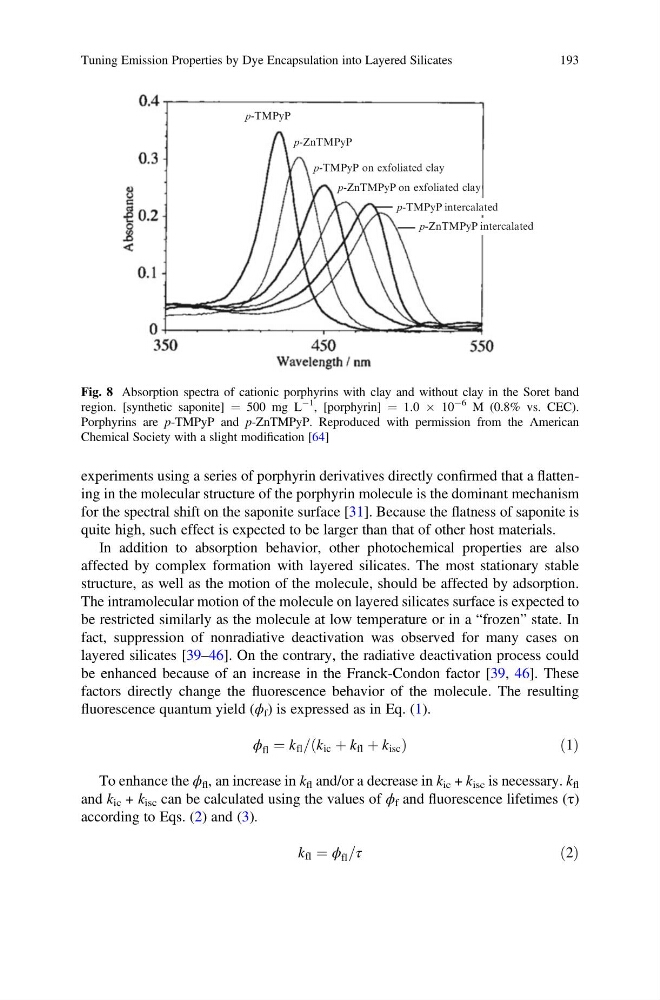
experiments using a series of porphyrin derivatives directly confirmed that a flattening in the molecular structure of the porphyrin molecule is the dominant mechanism
for the spectral shift on the saponite surface [31]. Because the flatness of saponite is
quite high, such effect is expected to be larger than that of other host materials.
In addition to absorption behavior, other photochemical properties are also
affected by complex formation with layered silicates. The most stationary stable
structure, as well as the motion of the molecule, should be affected by adsorption.
The intramolecular motion of the molecule on layered silicates surface is expected to
be restricted similarly as the molecule at low temperature or in a “frozen” state. In
fact, suppression of nonradiative deactivation was observed for many cases on
layered silicates [39–46]. On the contrary, the radiative deactivation process could
be enhanced because of an increase in the Franck-Condon factor [39, 46]. These
factors directly change the fluorescence behavior of the molecule. The resulting
fluorescence quantum yield (ϕ f ) is expressed as in Eq. (1).
ϕ fl ¼ k fl = k ic þ k fl þ k isc
ð
Þ
ð 1Þ
To enhance the ϕ fl , an increase in k fl and/or a decrease in k ic + k isc is necessary. k fl
and k ic + k isc can be calculated using the values of ϕ f and fluorescence lifetimes (τ)
according to Eqs. (2) and (3).
k fl ¼ ϕ fl =τ
ð2Þ
p-TMPyP
p-ZnTMPyP
p-TMPyP on exfoliated clay
p-ZnTMPyP on exfoliated clay
p-TMPyP intercalated
p-ZnTMPyP intercalated
Fig. 8 Absorption spectra of cationic porphyrins with clay and without clay in the Soret band
region. [synthetic saponite] ¼ 500 mg L
À1
, [porphyrin] ¼ 1.0 Â 10
À6 M (0.8% vs. CEC).
Porphyrins are p-TMPyP and p-ZnTMPyP. Reproduced with permission from the American
Chemical Society with a slight modification [64]
Tuning Emission Properties by Dye Encapsulation into Layered Silicates
193
for the spectral shift on the saponite surface [31]. Because the flatness of saponite is
quite high, such effect is expected to be larger than that of other host materials.
In addition to absorption behavior, other photochemical properties are also
affected by complex formation with layered silicates. The most stationary stable
structure, as well as the motion of the molecule, should be affected by adsorption.
The intramolecular motion of the molecule on layered silicates surface is expected to
be restricted similarly as the molecule at low temperature or in a “frozen” state. In
fact, suppression of nonradiative deactivation was observed for many cases on
layered silicates [39–46]. On the contrary, the radiative deactivation process could
be enhanced because of an increase in the Franck-Condon factor [39, 46]. These
factors directly change the fluorescence behavior of the molecule. The resulting
fluorescence quantum yield (ϕ f ) is expressed as in Eq. (1).
ϕ fl ¼ k fl = k ic þ k fl þ k isc
ð
Þ
ð 1Þ
To enhance the ϕ fl , an increase in k fl and/or a decrease in k ic + k isc is necessary. k fl
and k ic + k isc can be calculated using the values of ϕ f and fluorescence lifetimes (τ)
according to Eqs. (2) and (3).
k fl ¼ ϕ fl =τ
ð2Þ
p-TMPyP
p-ZnTMPyP
p-TMPyP on exfoliated clay
p-ZnTMPyP on exfoliated clay
p-TMPyP intercalated
p-ZnTMPyP intercalated
Fig. 8 Absorption spectra of cationic porphyrins with clay and without clay in the Soret band
region. [synthetic saponite] ¼ 500 mg L
À1
, [porphyrin] ¼ 1.0 Â 10
À6 M (0.8% vs. CEC).
Porphyrins are p-TMPyP and p-ZnTMPyP. Reproduced with permission from the American
Chemical Society with a slight modification [64]
Tuning Emission Properties by Dye Encapsulation into Layered Silicates
193