

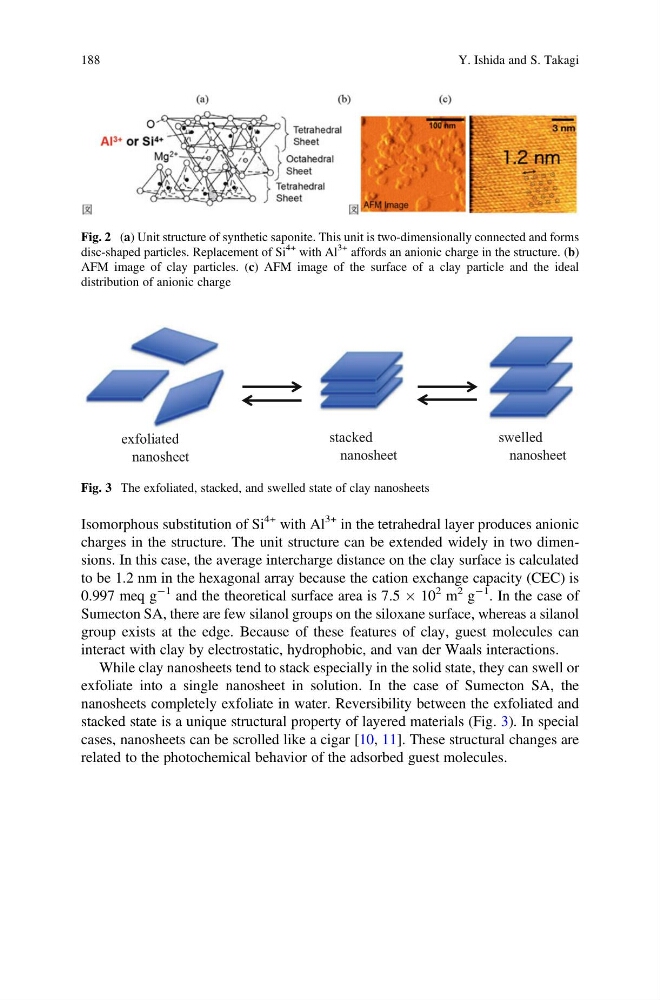
Isomorphous substitution of Si
4+ with Al
3+ in the tetrahedral layer produces anionic
charges in the structure. The unit structure can be extended widely in two dimensions. In this case, the average intercharge distance on the clay surface is calculated
to be 1.2 nm in the hexagonal array because the cation exchange capacity (CEC) is
0.997 meq g
À1 and the theoretical surface area is 7.5 Â 10
2 m
2 g
À1 . In the case of
Sumecton SA, there are few silanol groups on the siloxane surface, whereas a silanol
group exists at the edge. Because of these features of clay, guest molecules can
interact with clay by electrostatic, hydrophobic, and van der Waals interactions.
While clay nanosheets tend to stack especially in the solid state, they can swell or
exfoliate into a single nanosheet in solution. In the case of Sumecton SA, the
nanosheets completely exfoliate in water. Reversibility between the exfoliated and
stacked state is a unique structural property of layered materials (Fig. 3). In special
cases, nanosheets can be scrolled like a cigar [10, 11]. These structural changes are
related to the photochemical behavior of the adsorbed guest molecules.
Fig. 2 (a) Unit structure of synthetic saponite. This unit is two-dimensionally connected and forms
disc-shaped particles. Replacement of Si
4+ with Al
3+ affords an anionic charge in the structure. (b)
AFM image of clay particles. (c) AFM image of the surface of a clay particle and the ideal
distribution of anionic charge
exfoliated
nanosheet
stacked
nanosheet
swelled
nanosheet
Fig. 3 The exfoliated, stacked, and swelled state of clay nanosheets
188
Y. Ishida and S. Takagi
4+ with Al
3+ in the tetrahedral layer produces anionic
charges in the structure. The unit structure can be extended widely in two dimensions. In this case, the average intercharge distance on the clay surface is calculated
to be 1.2 nm in the hexagonal array because the cation exchange capacity (CEC) is
0.997 meq g
À1 and the theoretical surface area is 7.5 Â 10
2 m
2 g
À1 . In the case of
Sumecton SA, there are few silanol groups on the siloxane surface, whereas a silanol
group exists at the edge. Because of these features of clay, guest molecules can
interact with clay by electrostatic, hydrophobic, and van der Waals interactions.
While clay nanosheets tend to stack especially in the solid state, they can swell or
exfoliate into a single nanosheet in solution. In the case of Sumecton SA, the
nanosheets completely exfoliate in water. Reversibility between the exfoliated and
stacked state is a unique structural property of layered materials (Fig. 3). In special
cases, nanosheets can be scrolled like a cigar [10, 11]. These structural changes are
related to the photochemical behavior of the adsorbed guest molecules.
Fig. 2 (a) Unit structure of synthetic saponite. This unit is two-dimensionally connected and forms
disc-shaped particles. Replacement of Si
4+ with Al
3+ affords an anionic charge in the structure. (b)
AFM image of clay particles. (c) AFM image of the surface of a clay particle and the ideal
distribution of anionic charge
exfoliated
nanosheet
stacked
nanosheet
swelled
nanosheet
Fig. 3 The exfoliated, stacked, and swelled state of clay nanosheets
188
Y. Ishida and S. Takagi